Circles appear in nearly every Aboriginal dot painting that comes from the Western Desert tradition. Before trying to decode them, it helps to know that a circle in one painting does not necessarily carry the same meaning as a circle in another. What circles represent depends on the story, the artist, and what surrounds them in the composition. That said, there is a shared visual vocabulary that most circles draw from, and understanding it goes a long way toward reading these paintings.
What Circles Represent in Aboriginal Dot Painting
At the most direct level, a circle or set of concentric circles marks a place where people come together. This can be a meeting place, a campsite, a fireplace, a waterhole, or a ceremonial site. These meanings overlap deliberately: in the Western Desert, waterholes are not just practical resources but sacred places, and ceremonies typically take place where there is water. Because of this, the symbol for a ceremony and the symbol for a waterhole are often used interchangeably by artists.
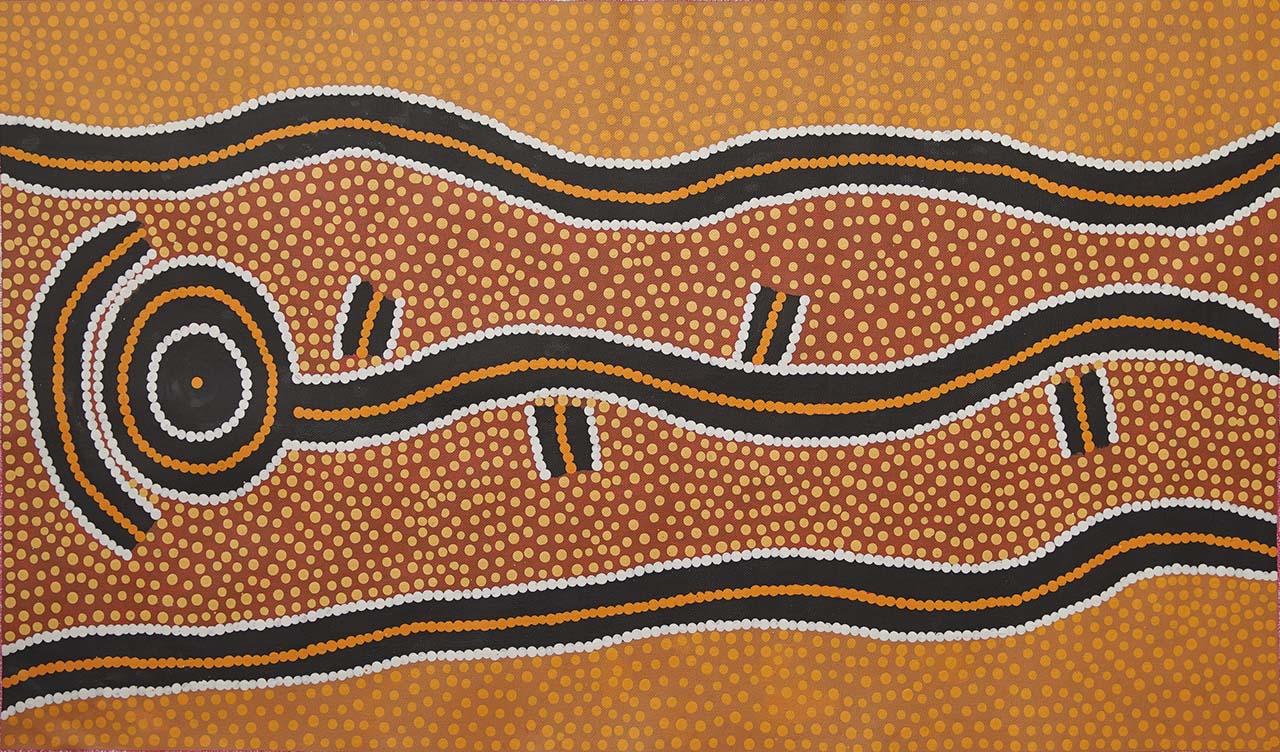
Parallel lines that run between circles almost always show the routes people or ancestral beings travelled between those locations. A composition of circles joined by lines is essentially a map of a journey, showing where travellers stopped along the way. Wavy lines between sites usually indicate water running between them.
Small circles scattered across the composition serve yet another purpose. They frequently represent bush foods such as bush melons or bush tomatoes, water soakages, or seeds. In some paintings, small circles positioned beside the U-shaped figures that represent seated people indicate children rather than food.
Reading the Circles in Context
The U-shape is the Aboriginal symbol for a seated person, drawn from the impression a cross-legged person leaves in the sand. When several U-shapes cluster around a central circle, the image shows people gathered at a specific site. The tools placed beside each U-shape indicate gender: a woman carries a coolamon bowl and digging stick, a man carries spears or boomerangs. If small circles appear alongside the U-shapes, they typically represent the children present at that gathering.
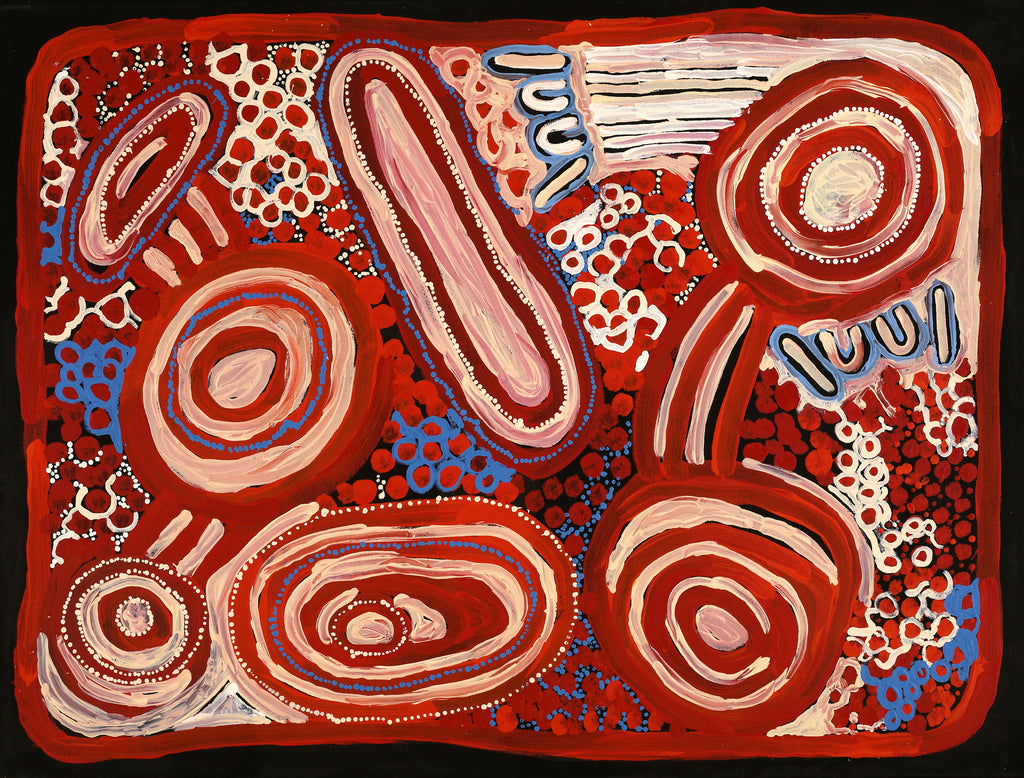
The painting Minyma Kutjara by Inawinytji Stanley shows clearly how multiple circle forms work together inside a single story. The concentric circles trace the sequence of places two women visited on their journey. Small circles in other parts of the composition represent bush foods. A large elongated circle marks a discarded head-ring. Three distinct circle forms carry three distinct meanings, all as part of one narrative without any of them conflicting.
Waterholes, Ceremony, and Why They Share the Same Symbol
In the desert environment of central Australia, the waterhole is one of the most significant features of the landscape. Water determines where people travel, where they camp, and when certain foods become available. For Aboriginal communities, waterholes are also frequently sacred sites where ceremonies are held and where ancestral stories are anchored in the country. This is why the circle that marks a waterhole and the circle that marks a ceremonial site are so often the same form. The practical and the sacred are not separate categories in this tradition.
This connection is also why the circle carries so much weight as a motif in these paintings. When an artist places a concentric circle at the centre of a composition, it may indicate a physical place in the landscape, a site connected to a specific Dreaming story, or a location where ceremony has been performed. Often all three at once. The Aboriginal art symbols system was never designed to separate these meanings cleanly, because the people who made it did not experience them as separate.
Sacred Meanings Below the Surface
Aboriginal art operates on multiple levels of meaning simultaneously. At the first level, a painting communicates through the physical appearance of its symbols and composition. At a second level, it maps landscape information: where water can be found, what food is available, which routes connect different sites. At a third level, the same painting encodes the journeys and actions of Dreamtime ancestors. At a fourth and deepest level, it carries restricted spiritual knowledge that belongs only to initiated members of the community it comes from.
Circles can carry meaning at all four levels at once. What an outsider reads as a waterhole or campsite may simultaneously encode a Dreaming site of deep significance to a particular clan. The information needed to translate the full meaning of these symbols is passed on during ceremonies to the appropriate people, not made available publicly. Artists have long used dots and concentric circles specifically to protect this deeper knowledge while keeping the outer layer of meaning accessible.
Dot painting as it exists today evolved in part to serve this protective function. When Aboriginal dot painting moved from sand and body paint to canvas in the 1970s, it became permanently visible in a way it was never meant to be. The abstraction of sacred designs into dots and circles was artists’ deliberate response to that problem. The circle stayed, but what it held within it became harder to read from outside.
Frequently Asked Questions
What do concentric circles mean in Aboriginal art?
Concentric circles emphasise the significance of a particular site. They most commonly represent a waterhole, a sacred Dreaming site, or a ceremonial location. Because water and ceremony are closely linked in desert culture, the same concentric circle can refer to both at once depending on the story the painting tells.
What do small circles mean in Aboriginal dot painting?
Small circles typically represent bush foods such as bush melons or bush tomatoes, water soakages, or seeds. When they appear beside U-shaped figures, which represent people seated cross-legged, the small circles usually indicate children present at the gathering rather than food.
What does a circle connected by lines mean in Aboriginal art?
Parallel lines connecting two or more circles represent the journey route between those locations. The circles mark the stopping points along the way, whether campsites, waterholes, or meeting places. Wavy lines between circles indicate water, such as a creek or river running between two sites.
Does the circle mean the same thing across all Aboriginal art?
No. The meaning of a circle shifts depending on the language group, the region, and the individual artist. A circle in a painting from Papunya may carry different associations from an identical form in a painting from Balgo or Arnhem Land. The differences in Aboriginal art styles across regions mean that reading any symbol accurately requires knowing the story and the country behind the specific work.
Closing Thoughts
A circle in an Aboriginal dot painting can mark a waterhole, a campsite, a meeting place, a ceremonial site, or a sacred Dreaming location depending on the story and the artist. Concentric circles emphasise the importance of a site. Small circles indicate bush foods, water soakages, or children. Circles connected by parallel lines map a journey between places. Below all of this surface reading, the same forms can carry restricted sacred knowledge that no general guide can fully explain.
The clearest account of what any specific circle means in a specific painting always comes from the artist. That is not a limitation of the symbol system — it is how the system was designed to work. To go deeper into how these paintings are made and what the broader Aboriginal art techniques involve, the story behind each work is the best place to start.