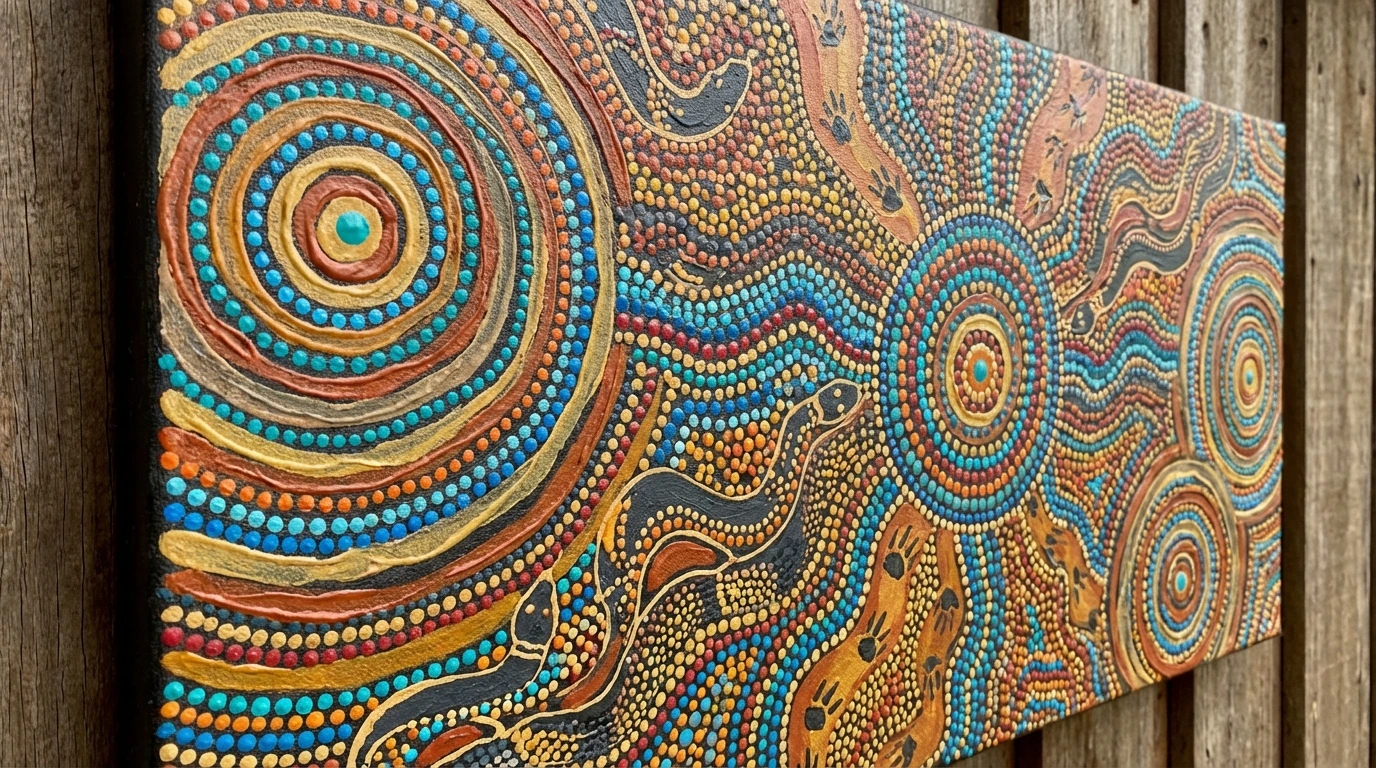
Aboriginal dot painting is a visual language that encodes Dreamtime stories, ancestral journeys, and maps of Country through carefully placed dots, circles, and lines. Each composition reveals certain layers of meaning to all viewers while concealing sacred knowledge beneath the surface. The technique dates back thousands of years through rock art, body painting, and sand drawings, but its contemporary canvas form took shape in 1971 when Aboriginal men at the Papunya settlement in Central Australia began transferring traditional designs onto board using acrylic paints.
Understanding dot painting requires looking beyond the aesthetic surface. The dots, the symbols, and even the regional differences between painting styles all carry cultural significance that shapes how this art form should be appreciated and engaged with today.
How Aboriginal Dot Painting Started
Aboriginal people have used dot motifs for millennia. Long before European contact, dots appeared on rock walls, carved objects, ceremonial body paint, and sand drawings across the Australian continent. These early forms were temporary by nature. Sand paintings were swept away after ceremonies. Body paint faded after days. The knowledge they carried persisted through oral tradition and repeated practice.
The contemporary dot painting movement traces back to a single place and year: Papunya, 1971. Geoffrey Bardon, a young art teacher posted to the Papunya government settlement in the Western Desert, noticed his students drawing intricate patterns in the sand during breaks. He recognised the cultural depth behind these designs and encouraged senior Aboriginal men to paint a large mural on the school wall. The project generated enormous interest across the community.
Elders began painting their Dreaming stories on small boards and canvases using acrylic paints. These works carried the same cultural authority as sand and body art, but they could be preserved and shared beyond the community. By 1972, the artists formed the Papunya Tula Artists cooperative. It was the first Aboriginal-owned arts business in Australia. The cooperative gave artists control over how their work was sold and represented.
The Papunya Tula movement rippled outward from there. Other Indigenous communities across the Western Desert and beyond started producing their own painted works, each drawing from their specific Dreaming narratives and regional visual traditions. What began as a local initiative became a global art movement without losing its cultural roots.
What Do the Dots and Symbols Mean?
Aboriginal dot paintings are not abstract decoration. They function as a coded visual language where each element carries specific meaning.
The dots themselves serve a dual purpose. First, they build the visual field that holds the composition together. Layered dots create the shimmering texture that draws viewers in. Second, dots conceal sacred and ceremonial information from people who have not been initiated into that knowledge. When artists began painting on permanent surfaces like canvas, this protective layering became essential. The dots allowed artists to share stories with a broader audience while keeping restricted knowledge hidden in plain sight.
This concealment technique is also what gives dot paintings their hypnotic depth. Hundreds or thousands of dots layered over one another produce a visual shimmer that suggests movement and energy. What viewers experience as aesthetic beauty is, at its source, a system of cultural security.
Beyond dots, several recurring symbols carry layered meaning in this visual language:
- Concentric circles typically represent gathering places such as waterholes, campsites, or ceremonial sites
- U-shapes depict people, derived from the imprint a person leaves when sitting cross-legged in sand. A U-shape with a small oval and straight line beside it represents a woman (the oval is a coolamon bowl, the line a digging stick). A U-shape paired with longer lines represents a man carrying spears or a boomerang
- Straight lines illustrate journeys, tracks, or paths taken by people or ancestral beings
- Animal tracks tell hunting stories or trace the movement of specific creatures across Country
- Wavy lines represent water, rain, or lightning
![[common Aboriginal dot painting symbols including concentric circles U-shapes and animal tracks on dark background]](https://koarooginal.com/blog/wp-content/uploads/2026/03/3.webp)
One critical detail that many guides miss: these symbols carry layered meanings. A concentric circle might represent a waterhole to a general viewer. To an initiated community member, the same symbol within a specific composition may encode a far deeper sacred narrative. The full meaning of a painting is rarely visible to outsiders. That is by design.
Symbol interpretations also vary between Aboriginal groups. A circle that means “campsite” in one community’s visual tradition may carry different associations in another. There is no single dictionary for Aboriginal art symbols. Each community holds its own visual vocabulary, tied to its own Country and Dreaming stories.
Regional Styles of Aboriginal Dot Painting
Dot painting is not one style. Different Aboriginal communities developed distinct visual approaches based on their Country, their Dreaming narratives, and their ceremonial traditions. Three major regional styles stand out.
Western Desert
The broader Western Desert tradition, launched by the Papunya movement, is characterised by aerial-view compositions that map ancestral landscapes. Artists depict Songlines by arranging symbols for waterholes, camps, and sacred sites as if viewed from above. These compositions trace the paths that creation beings travelled across Country.
Western Desert dot painting tends toward bold, large-scale works. Early pieces used natural ochre tones. Later artists embraced acrylics, producing more vivid palettes while maintaining the symbolic structure.
Utopia
Utopia, a region northeast of Alice Springs, developed a strikingly different approach. Utopia artists are known for exceptionally fine, layered dotting that produces subtle shifts in colour and tone across the canvas. The technique is almost pointillist in its precision.
Subject matter in Utopia paintings often centres on women’s ceremonies, bush foods like yams, and the surrounding desert landscape. Emily Kame Kngwarreye, one of Australia’s most celebrated artists, came from Utopia. She began painting on canvas in her late seventies and produced over 3,000 works in just eight years. Her large-scale compositions pushed dot painting into completely new visual territory, earning international gallery exhibitions and record auction prices.
Pintupi
Pintupi artists, part of the broader Western Desert language group, favour a minimalistic and geometric approach. Their compositions rely on pattern and repetition to depict ancestral Country, sacred sites, and the Tingari cycle. The Tingari is a major men’s ceremonial narrative describing the journeys of ancestral beings across the desert.
The result is often intensely optical. Rows of dots surrounding geometric forms create a pulsing effect that evokes the vastness of the desert itself. Johnny Warangkula Tjupurrula, a Pintupi/Luritja artist and one of the founding Papunya painters, became renowned for his “over-dotting” technique. He layered fine dots in translucent fields that produced shimmering, almost three-dimensional surfaces.
These regional differences matter because they show that dot painting is not a single monolithic tradition. It is a living system with local dialects, each shaped by its community’s relationship to Country. Understanding how styles differ by region adds depth to your appreciation of any individual piece.
Why Ethical Engagement with Dot Art Matters
The global popularity of Aboriginal dot painting has created a serious problem. Mass-produced items bearing “Aboriginal-style” dot patterns, made by non-Indigenous manufacturers with no cultural connection, flood souvenir shops and online marketplaces. These products undermine the livelihoods of genuine Aboriginal artists and strip sacred visual language of its meaning.
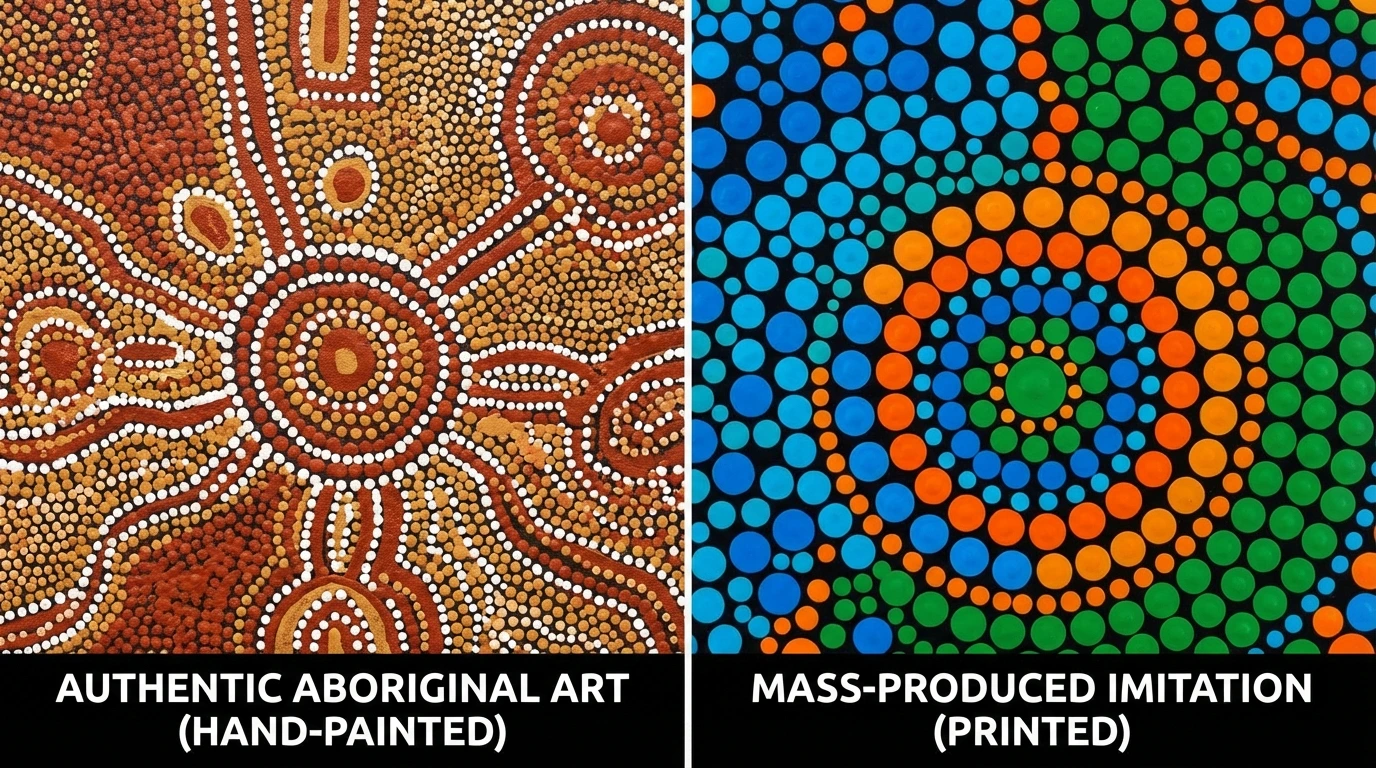
Identifying authentic, ethically sourced Aboriginal art requires asking a few direct questions. Who is the artist? Are they Indigenous? Is there provenance documentation or a certificate of authenticity from an Aboriginal-controlled art centre? Does the seller participate in the Indigenous Art Code, a voluntary industry standard for ethical dealing?
Community-run Aboriginal art centres remain the gold standard for ethical purchasing. These centres are often directed by the artists themselves, protect cultural integrity, ensure fair payment, and reinvest profits in local communities.
The distinction between appreciation and appropriation comes down to authorship, consent, and fair compensation. Supporting Indigenous-led brands and community art centres keeps the economic benefits within the communities whose culture produced the art.
FAQ
Why Do Aboriginal Artists Use Dots in Their Paintings?
Aboriginal artists use dots to build layered compositions that tell Dreamtime stories while protecting sacred cultural information. The dotting technique allows artists to share narratives with a broad audience and simultaneously conceal deeper meanings that only initiated community members are permitted to know. The technique also produces the shimmering visual texture that defines the style.
Did Aboriginal Dot Painting Start in the 1970s?
Dot motifs in Aboriginal art are thousands of years old, appearing in ancient rock art, body painting, and sand drawings long before European contact. The contemporary movement of painting on canvas and board began in 1971 at the Papunya settlement in Central Australia, when the Papunya Tula Artists cooperative formed. The 1970s marked a new medium, not a new tradition.
What Do Concentric Circles Mean in Aboriginal Art?
Concentric circles in Aboriginal dot paintings typically represent significant gathering places such as waterholes, campsites, or ceremonial sites. The exact meaning depends on the painting’s context and the specific community’s visual tradition. A concentric circle may carry a surface-level geographic meaning for general viewers and a deeper sacred significance for initiated members of that community.
Conclusion
Aboriginal dot painting is a visual language that has carried cultural knowledge across tens of thousands of years. Its contemporary canvas form, sparked at Papunya in 1971, transformed a ceremonial practice into one of the world’s most recognised art movements. The dots, circles, and lines that make up each composition encode Dreamtime stories, map ancestral Country, and protect sacred knowledge through deliberate concealment.
Engaging with this art form respectfully means understanding its depth and supporting the communities that created it. Explore Koarooginal’s Dot Painting Collection to see how Indigenous artists carry this living tradition forward through contemporary design.