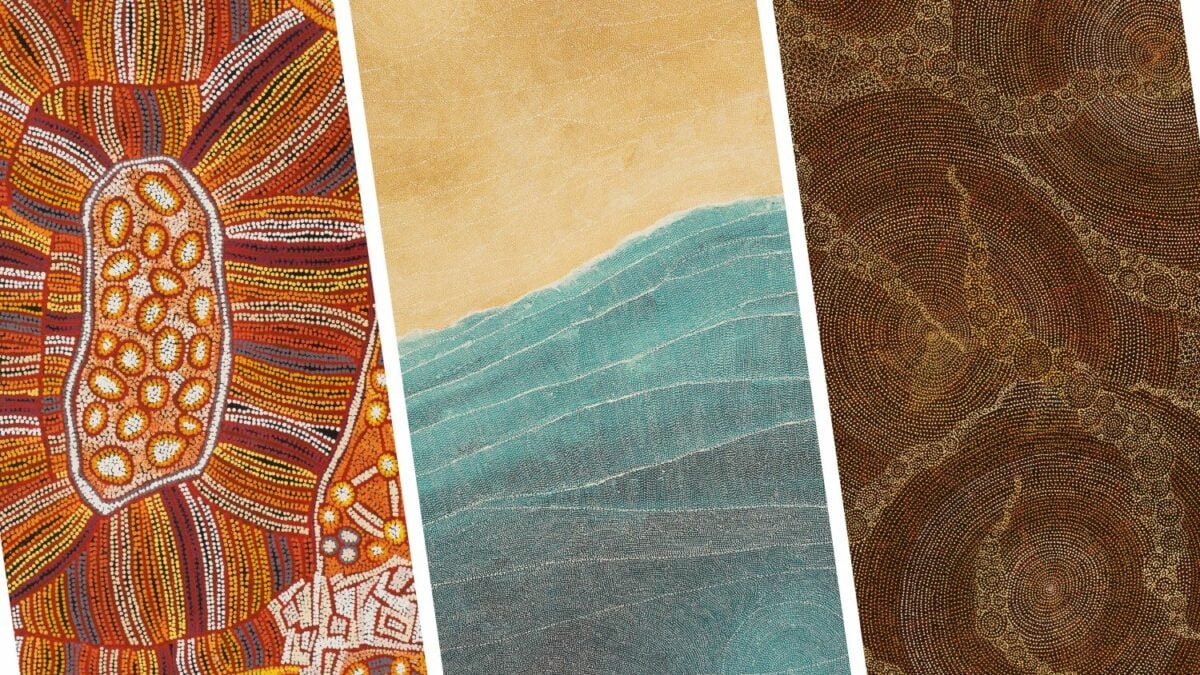
One of the most common misunderstandings about Aboriginal art is treating it as a single style. The image most people carry is of dot painting on canvas, desert colours, circular motifs. But dot painting is the tradition of one part of Australia, and a relatively recent one at that. Across the continent, more than 250 distinct language groups have developed their own visual traditions over tens of thousands of years, each shaped by the landscape, the Dreaming stories tied to that Country, and the materials the land provides. The differences between these regional styles are not superficial variations. They reflect entirely distinct cultural frameworks.
Why the Land Shapes the Style
Before looking at individual regions, it helps to understand why the styles diverge so sharply. The simplest explanation is material. In the desert, there is no bark to peel and no permanent rock shelter close to most camp life, so painting traditions adapted to ground designs and later to board and canvas. In the tropical north of Arnhem Land, stringybark eucalypts are common and the wet season forces communities indoors to rock shelters and lean-tos, where bark and wall painting flourished. In the Kimberley, the deep rock shelters of the Mitchell Plateau preserved paintings for thousands of years. In the rainforest of Far North Queensland, hardwoods support a strong carving and shield-painting tradition. The visual language of each region is built on what the country gives the artist to work with.
The Dreaming stories that the art carries are also tied to place. A waterhole story belongs to the people whose Country includes that waterhole, and the symbols used to depict it are particular to that group. This is why styles do not freely cross regional boundaries: the right to paint a story comes with connection to the Country the story belongs to. The deeper framing on this question sits in the guide to Aboriginal art techniques.
Central and Western Desert
The Central and Western Desert region stretches across an enormous area, covering much of the Northern Territory’s interior and extending deep into Western Australia. This is the heartland of what most people recognise as contemporary Aboriginal art, anchored by the dot painting tradition that moved from sand and body designs onto canvas in the early 1970s. The art produced across this region uses the symbolic vocabulary of the desert: concentric circles for fire sites, campsites, or waterholes; U-shapes for people; lines for paths and ancestral tracks; animal prints for the creatures of the Dreaming.
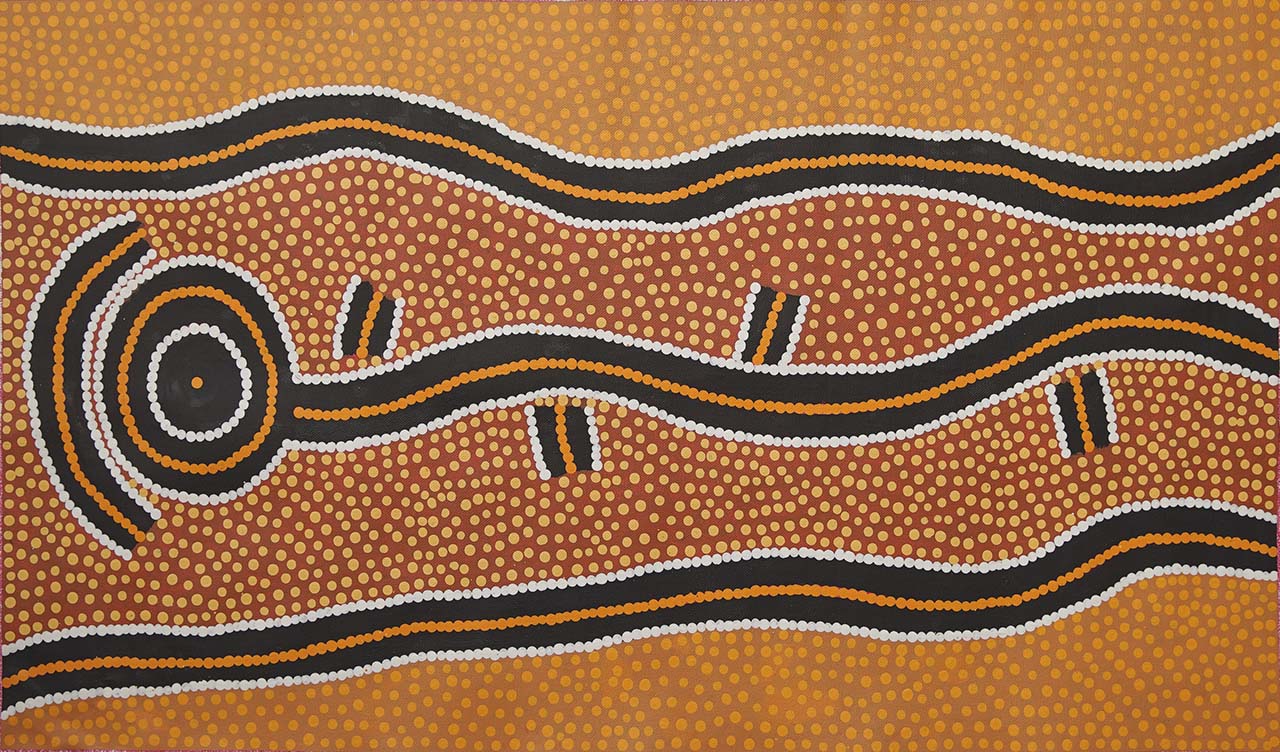
Within the desert, communities have distinct local accents. Artists from Kiwirrkurra and Kintore often work in ochre-influenced tones with tight, layered compositions. Martumili artists, further west, use freer, more fluid brushwork that echoes the movement of water across salt lakes central to their Country. The women of the Utopia region, north-east of Alice Springs, developed a related but distinct style of bush medicine leaf painting, made famous internationally by Gloria Petyarre, that draws on the colour change of healing leaves rather than on the iconographic system used at Papunya.
Arnhem Land and the Top End
Arnhem Land, in the far north of the Northern Territory, has been a protected Aboriginal reserve since 1931 and contains some of the most culturally intact artistic traditions in Australia. The art from this region looks and feels entirely different from the desert. Where desert art uses dots and symbolic abstraction, Arnhem Land art is figurative, depicting ancestral beings, animals, and ceremonial scenes with precise detail.
The defining mediums and techniques here are bark painting, rarrk cross hatching, and x-ray art. Rarrk is the fine line work that carries clan identity in western Arnhem Land among Kunwinjku-speaking artists. X-ray art is the figurative style, common across the same region, in which animals are shown with their internal anatomy visible alongside the external form. The two often share the same surface, with rarrk filling the body cavities of an x-ray animal. The northeast Arnhem Land Yolŋu people are particularly known for their geometric clan designs, called miny’tji, which carry sacred identity and are passed down through family lines.
The Kimberley
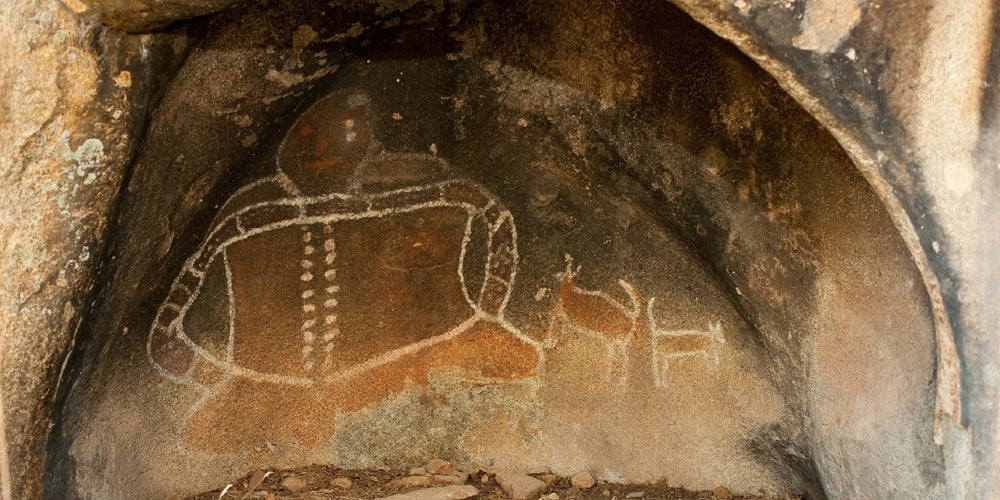
The Kimberley, in the remote northwest of Western Australia, has one of the most ancient and visually distinct rock art traditions on the continent. The two image traditions the region is best known for, Gwion Gwion (sometimes called Bradshaw) figures and Wandjina ancestral beings, are covered in depth in the guide to Aboriginal rock art. What is worth saying at the regional level is that the Mowanjum community continues to act as custodians of Wandjina law, and the practice of periodically repainting the figures in ceremony is part of how the tradition stays alive in the landscape rather than being preserved as a museum object.
Alongside the rock tradition, a distinct voice in contemporary Kimberley painting came from Rover Thomas, a Wangkajunga and Kukatja man from Warmun. His work used large expanses of ochre applied to board and canvas in a minimalist, map-like style that documented the landscape and historical events with a quiet and devastating clarity. The Warmun community he was associated with continues to produce art using ochre pigments derived from the region’s iron-rich soils, maintaining a material connection to the land that is itself a statement of identity.
The Tiwi Islands
About 100 kilometres off the coast of Darwin, the Tiwi Islands have developed a visual culture distinct from both mainland Arnhem Land and the desert. Tiwi art is characterised by bold geometric patterning, a design system known as jilamara that appears across body painting, bark, canvas, and carved objects. Unlike the figurative imagery of Arnhem Land or the symbolic landscape mapping of the desert, Tiwi design is strongly geometric and ceremonial in character.
The pukumani poles, large carved and painted burial poles used in funerary ceremonies, are among the most striking objects in all of Australian Indigenous art. Each pole is unique, carved from ironwood and painted with designs relevant to the ceremony and the individual being honoured. The Tiwi were also among the earliest Aboriginal communities to adopt printmaking, using linocut and screen printing to bring their traditional motifs into new formats. This adaptability is a consistent quality of Tiwi artistic culture, which has engaged with new materials while keeping the underlying design language intact.
Far North Queensland and Cape York
The Cape York Peninsula and the Laura region of Far North Queensland contain some of the most extensive and oldest rock art galleries in Australia. Sites associated with the Guugu Yimithirr, Kuku Yalanji, and Kuku Thaypan peoples include paintings, engravings, and stencils spanning thousands of years. The Quinkan figures, long-limbed spirit beings that inhabit the rock shelters of the Laura area, are among the most celebrated examples of Australian rock art and reflect a visual tradition quite different from anything produced in the desert or Arnhem Land.
Contemporary art from this region includes a strong sculptural tradition alongside painting. Rainforest shields, used historically in duels and large social gatherings, were painted with designs central to daily life, including fish, tools, and weather patterns. The region’s dense rainforest environment, so different from the open desert or the tropical floodplains of Arnhem Land, shapes what artists depict and the materials available to them, reinforcing how closely Aboriginal art style follows the specifics of place.
The APY Lands
In the northwest corner of South Australia, the Anangu Pitjantjatjara Yankunytjatjara lands, commonly called the APY Lands, form one of Australia’s most significant contemporary art regions. The area has a long history of organised art production: the Ernabella Mission established an art centre there in 1948, making it the oldest continuously operating Aboriginal art centre in the country. Today the region supports more than 400 active artists across groups including Tjala Arts, Mimili Maku, Iwantja, and Ninuku.
APY art sits in the desert tradition but has its own character. Works often combine the dot painting language of Central Desert art with broader brushstrokes and a vibrant colour range that sets them apart from the more ochre-dominant Papunya work. The APY communities have been particularly active in ensuring that their art centres are community-controlled and ethically managed, making the region not only artistically significant but also a model for how Aboriginal art production can remain grounded in the communities that create it.
How the Regions Compare at a Glance
| Region | Signature mediums | Visual character | Active art centres |
|---|---|---|---|
| Central and Western Desert | Canvas dot painting | Symbolic landscape mapping | Papunya Tula, Kiwirrkurra, Martumili |
| Arnhem Land | Bark, rarrk, x-ray | Figurative, fine line work | Maningrida, Buku-Larrnggay Mulka, Injalak |
| Kimberley | Rock art, ochre on board | Wandjina, Gwion Gwion, map-like compositions | Warmun, Mowanjum, Mangkaja |
| Tiwi Islands | Jilamara, pukumani poles, prints | Bold geometric | Jilamara, Tiwi Design, Munupi |
| Far North Queensland | Rock art, shields, sculpture | Quinkan figures, rainforest motifs | Erub, Wik & Kugu, Hopevale |
| APY Lands | Canvas dot painting | Vibrant colour, broader strokes | Tjala, Mimili Maku, Iwantja, Ninuku |
What Regional Variation Tells Us
Looking at Aboriginal art across these regions makes one thing clear: the continent was never a single artistic culture, and the diversity visible today is not the result of recent divergence. Each regional tradition reflects tens of thousands of years of people living in close relationship with a specific piece of Country, learning its patterns, its animals, its sacred sites, and its Dreaming stories, and finding ways to make that knowledge visible.
The differences between a Tiwi bark painting, a Central Desert dot canvas, a Kimberley Wandjina, and an Arnhem Land x-ray fish are not just aesthetic. They are expressions of different relationships to different places, made by people whose rights to make that art come from their lineage and their connection to Country. The way these regions then relate to each other across history is what the broader question of traditional versus contemporary Aboriginal art tries to answer.
Reading the Map
The regional character of Aboriginal art is not incidental. It is the core of what the art is. Strip away the geography and the cultural authority behind each style, and you are left with patterns on a surface. With that context, you are looking at some of the oldest and most sustained artistic traditions in human history, each one tied to a living culture still active in the landscape that produced it.
Whether you encounter a dot painting from Papunya, a bark from Arnhem Land, a Wandjina from the Kimberley, or a carved pole from the Tiwi Islands, the most important question to ask is not what it looks like but where it comes from. The answer to that question is where the meaning starts.