Aboriginal rock art is the oldest continuous artistic tradition on Earth. Across more than 100,000 recorded sites in Australia, First Nations peoples created paintings, engravings, stencils, and drawings on rock surfaces that span at least 50,000 years of unbroken cultural practice. These images record Dreamtime creation stories, map ancestral landscapes, mark territorial boundaries, and document species that have been extinct for millennia.
This guide covers the major techniques Aboriginal artists used, the most significant rock art sites in Australia, the regional styles that define each area, and the conservation challenges that threaten these irreplaceable records today.
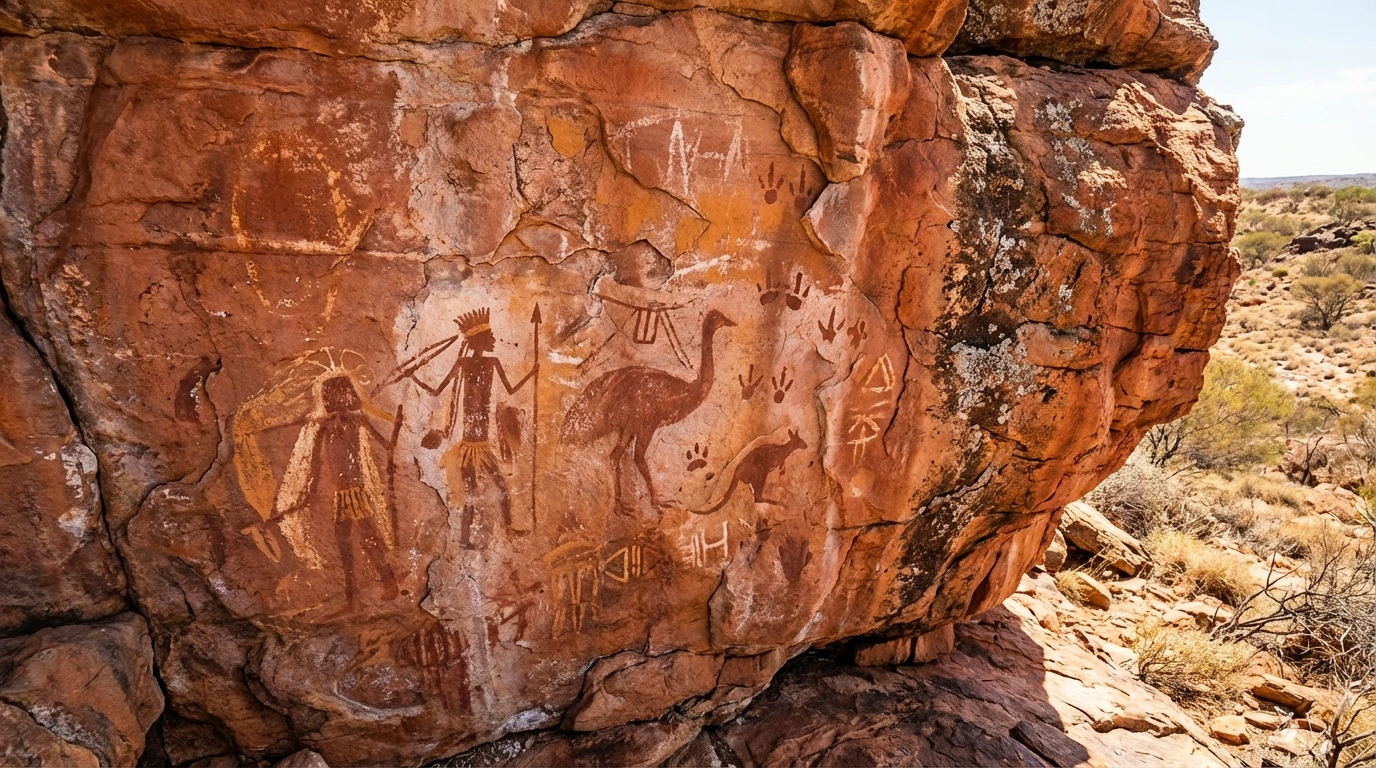
How Aboriginal Rock Art Was Created
Aboriginal rock art falls into two broad categories based on technique: pictographs (images made by adding pigment to rock) and petroglyphs (images made by removing rock material). Both methods required specialised knowledge of local geology, chemistry, and tool-making.
Pictographs: Painting and Drawing on Rock
Artists sourced pigments directly from their Country. Red and yellow ochres, iron-rich clays ground into fine powder on sandstone slabs, provided the warm earth tones that define most painted rock art. White came from kaolin clay. Black came from charcoal or manganese oxide.
Turning raw pigment into paint required a binding agent. Artists mixed ground ochre with water, saliva, animal fat, blood, or plant resin to create a paste that adhered to stone surfaces. The choice of binder affected both the colour intensity and the paint’s longevity. Fat-based binders produced more durable results than water alone.
Application methods varied by site and purpose. Artists painted with their fingers for bold strokes, with brushes made from chewed bark or human hair for fine detail, and with feather tips for precise lines. Some drew directly on rock using dry ochre or charcoal sticks, producing images closer to drawings than paintings.
Hand Stencils
Hand stencils represent one of the most recognisable forms of Aboriginal rock art. The artist placed an open hand flat against the rock wall, then blew a mist of wet pigment around it through the mouth or through a hollow bone or reed. Removing the hand left a negative silhouette surrounded by a halo of colour.
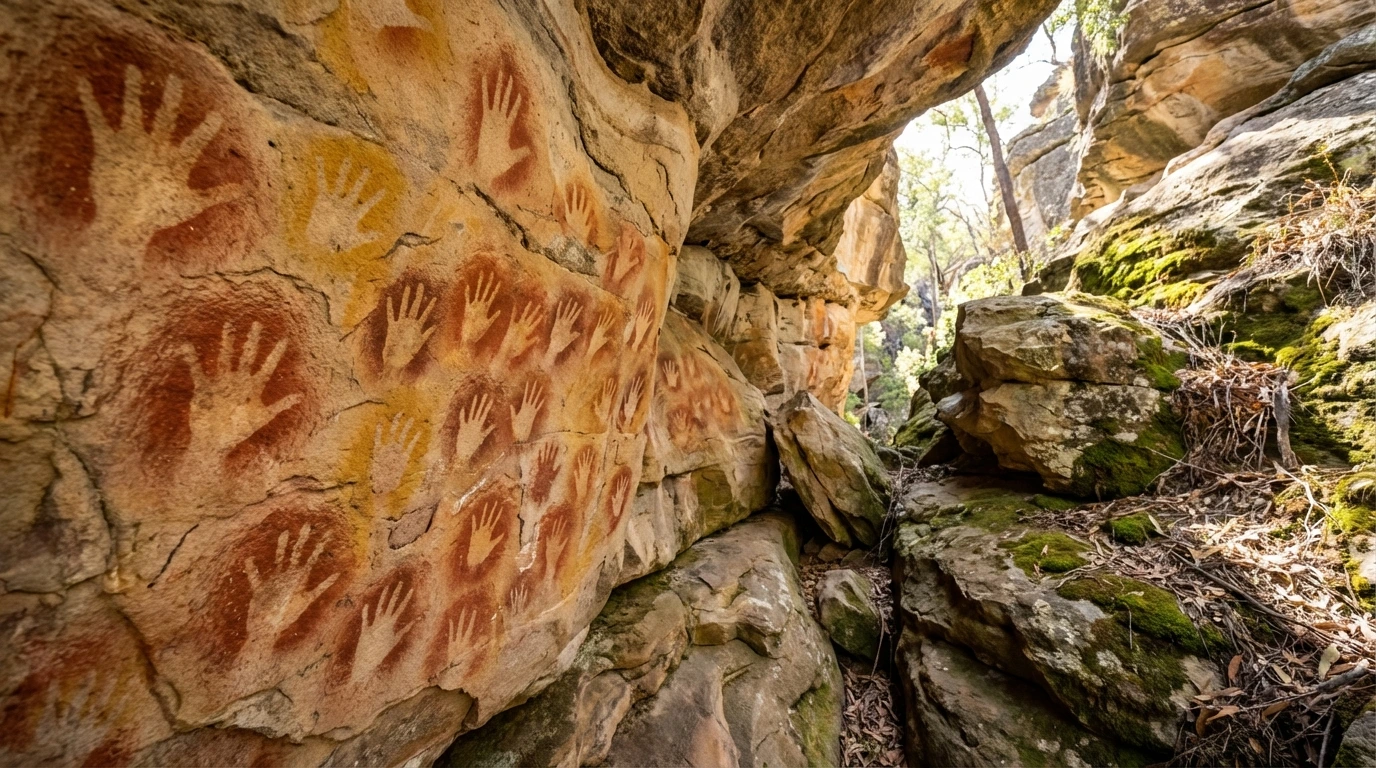
These stencils appear across the entire continent. Some sites contain hundreds of individual prints layered over each other across thousands of years. Hand stencils were not casual marks. Many researchers believe they functioned as signatures, records of presence, or components of ceremonial activity. Stencils of boomerangs, tools, and other objects also appear at many sites.
Petroglyphs: Engraving Into Rock
Petroglyphs are images carved, pecked, or abraded into rock surfaces using stone tools. The artist struck the rock repeatedly with a harder stone to create a series of small pits that outlined the design. Connecting these pits with further pecking or grinding completed the image.
Engraved rock art tends to survive longer than painted art because the image exists within the stone itself rather than on its surface. The Murujuga (Burrup Peninsula) site in Western Australia contains an estimated one to two million petroglyphs, some dating back at least 50,000 years. These engravings depict human faces, animals (including species extinct since the last Ice Age), geometric patterns, and creation narratives.
Major Rock Art Regions and Styles
Aboriginal rock art is not one style. Each region developed distinct visual traditions shaped by local ecology, Dreaming narratives, and ceremonial practices. Understanding how art styles differ by region provides essential context for recognising the diversity within this tradition.
Arnhem Land (Northern Territory)
Arnhem Land contains some of Australia’s most studied and visually complex rock art. The region’s sandstone escarpments and shallow caves provided ideal surfaces for painting. The art spans multiple distinct periods, each with recognisable characteristics.
Arnhem Land rock shelters carry both x-ray figure traditions and the fine rarrk line work that later moved onto bark. The detailed account of each technique sits in its own article. On the rock walls of Kakadu, both styles appear alongside earlier dynamic figures, hand stencils, and contact-era images that record buffalo, sailing ships, and firearms.
Beyond Arnhem Land and the Kimberley, the Sydney Basin sandstone platforms hold thousands of pecked engravings of marine and terrestrial animals, and the Murujuga petroglyph complex on the Pilbara coast holds the largest open-air engraving field in the world. Kakadu's painted galleries at Ubirr and Nourlangie remain among the most accessible managed sites for visitors, while many other shelters stay closed under Traditional Owner protection.
The Kimberley (Western Australia)
The Kimberley region hosts two of the most distinctive rock art traditions found anywhere in the world.
Gwion Gwion figures (historically called Bradshaw figures) are elegant, dynamic human forms depicted in movement. They carry ceremonial objects, wear elaborate headdresses, and appear to dance or hunt across the rock face. Radiocarbon dating of associated mud wasp nests places many Gwion Gwion figures at approximately 12,000 years old, with some evidence suggesting ages closer to 17,000 years.
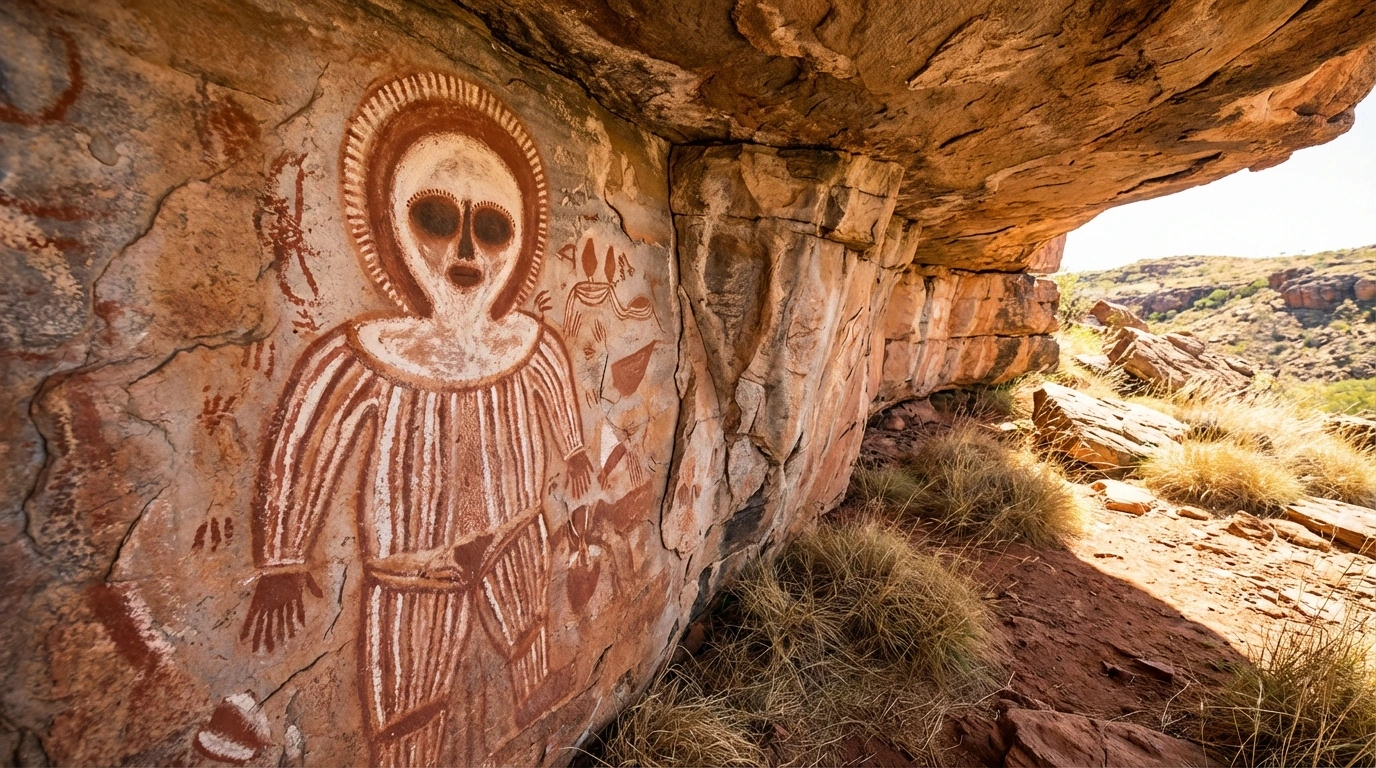
Wandjina are large, powerful spirit beings painted with distinctive round faces, halo-like headdresses, and no mouths. According to Worrorra, Wunambal, and Ngarinyin tradition, the Wandjina are creation ancestors who control weather, rain, and the fertility of the land. The paintings are not just images. They are considered physical manifestations of the spirits themselves. Traditional custodians periodically repaint Wandjina figures during ceremonial seasons to maintain the spirits’ power and ensure the return of monsoon rains. This repainting practice means that Wandjina art is a living tradition, continuously maintained rather than simply preserved.
Murujuga (Western Australia)
The Murujuga Cultural Landscape, located on the Burrup Peninsula and surrounding islands, holds the largest concentration of rock engravings in the world. The site received UNESCO World Heritage listing in 2025 for its outstanding value as a continuous record of human and environmental history spanning over 50,000 years.
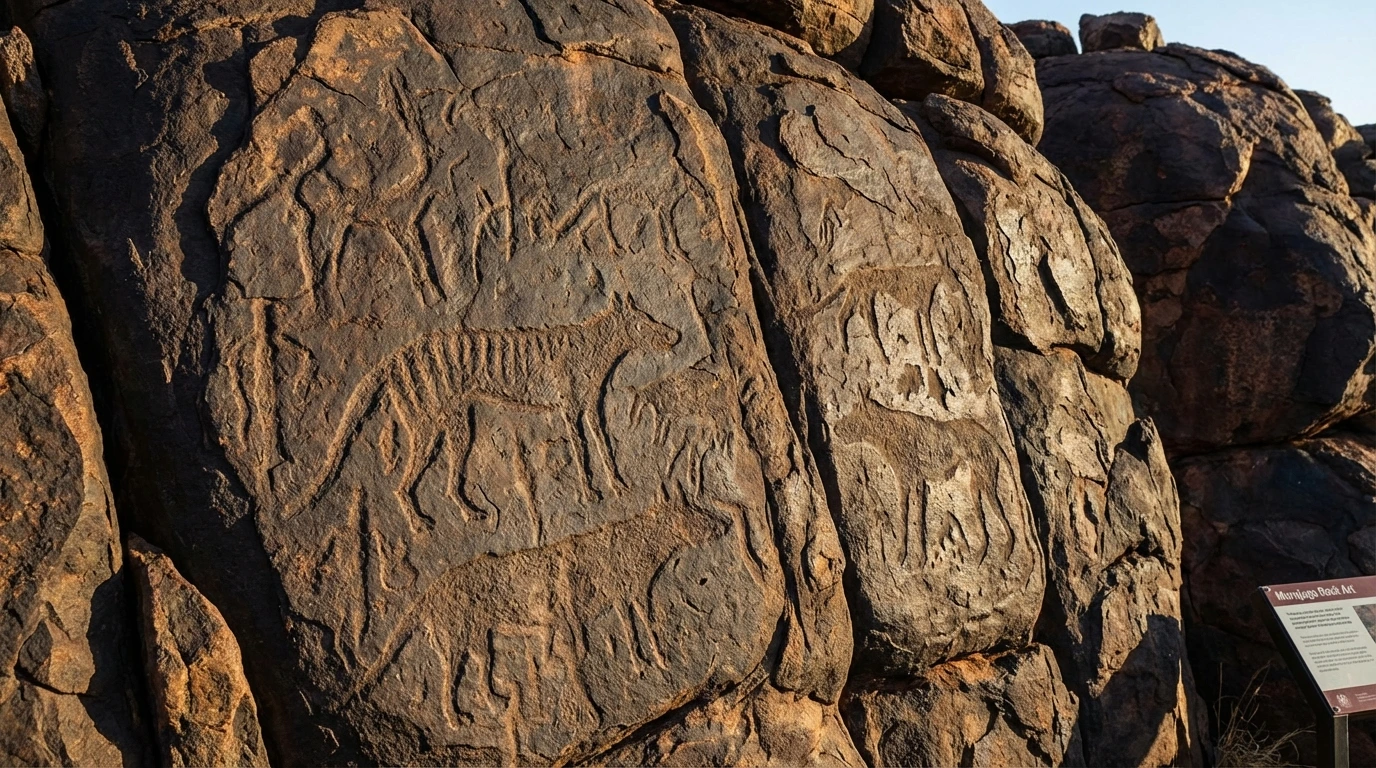
The Ngarda-Ngarli people, the Traditional Owners and Custodians of Murujuga, created petroglyphs depicting thylacines (Tasmanian tigers, extinct on the mainland for approximately 3,000 years), fat-tailed kangaroos, and other species that no longer exist in the region. These engravings provide a visual fossil record that complements and sometimes predates the archaeological evidence.
Sydney Basin (New South Wales)
The sandstone platforms around Sydney and the Blue Mountains contain thousands of engraved figures. These include whales, sharks, eels, kangaroos, echidnas, and human figures. Many engravings measure several metres in length. The Sydney Basin tradition favours outline engravings with pecked grooves that trace the contour of the subject. Infilling the outline with smaller pecked dots creates texture and visual weight.
What Aboriginal Rock Art Means
Aboriginal rock art is a communication system. Each image encodes information that functioned across multiple audiences and time scales.
At its most immediate level, rock art marked territory. Specific symbols identified which clan group held custodianship over a particular area. Paintings near water sources or hunting grounds communicated practical information about local resources.
At a deeper level, rock art recorded and transmitted Dreamtime stories. Creation ancestors who shaped the landscape, gave law to the people, and established the rules of social and ceremonial life appear throughout Australian rock art. These images served as visual texts that reinforced oral teachings during initiation ceremonies and seasonal gatherings.
Some rock art also served as an astronomical record. Sites in New South Wales and the Northern Territory contain images that researchers have linked to specific constellations, seasonal star positions, and celestial events. This connection between sky and stone adds another layer of information storage to an already complex visual system.
The meanings encoded in rock art operate on restricted access principles similar to those governing dot painting. General viewers see the surface image. Initiated community members understand deeper narrative layers that the same image contains. Access to meaning is earned through cultural education and ceremony.
Conservation Threats and Protection
Aboriginal rock art faces accelerating threats from multiple directions. Climate change, industrial development, vandalism, and unmanaged tourism all contribute to the degradation of sites that survived tens of thousands of years before European contact.
Climate change poses the most widespread risk. Increased bushfire intensity causes sandstone to expand and crack, destroying painted surfaces. Rising humidity promotes algal and lichen growth that covers and chemically degrades pigments. Salt crystallisation from shifting moisture patterns causes rock surfaces to crumble, detaching painted layers from their substrate.
Industrial development has directly destroyed rock art at several Australian sites. The Murujuga petroglyph field sits adjacent to one of Australia’s largest natural gas processing facilities. Acid emissions from industrial operations have been linked to accelerated weathering of the engraved rock surfaces, though the extent of damage remains contested.
Vandalism includes graffiti over ancient paintings, chiselling pieces from engraved surfaces, and target shooting at rock shelters. Recreational damage from vehicles driven over engravings and campfires built near painted surfaces adds to the degradation.
Unmanaged tourism compounds these risks. Early tour operators sometimes sprayed water onto dry pigments to make colours more vivid for photographs, accelerating deterioration. Modern site management now includes viewing platforms, boardwalks, and barriers to keep visitors at safe distances.
Preservation increasingly involves collaboration between Traditional Owners, scientists, and heritage organisations. Indigenous ranger programs combine traditional land management with modern monitoring technology, including 3D laser scanning that creates permanent digital records of at-risk sites.
FAQ
How old is Aboriginal rock art?
The oldest confirmed Aboriginal rock art dates back at least 50,000 years. Petroglyphs at Murujuga in Western Australia and painted shelters in Arnhem Land contain images from this period. A 2021 study confirmed that a naturalistic kangaroo painting in the Kimberley is approximately 17,300 years old, making it one of the oldest dated individual paintings in Australia. Rock art creation continued into the 20th century in some regions.
Can you visit Aboriginal rock art sites?
Several major sites are open to visitors with managed access. Kakadu National Park and Uluru-Kata Tjuta National Park in the Northern Territory offer guided walks to significant rock art locations. The Kimberley region hosts tour operators who visit Wandjina and Gwion Gwion sites with Traditional Owner permission. Always follow access guidelines, stay on marked paths, and avoid touching painted or engraved surfaces.
What is the difference between a pictograph and a petroglyph?
A pictograph is an image created by adding pigment to a rock surface through painting, drawing, or stencilling. A petroglyph is an image created by removing rock material through pecking, carving, or grinding. Both techniques appear across Australia, sometimes at the same site. Petroglyphs generally survive longer because the image is carved into the stone rather than applied to its surface.
Conclusion
Aboriginal rock art records over 50,000 years of continuous cultural practice across more than 100,000 sites. These paintings, engravings, and stencils carry Dreamtime narratives, ecological records, and astronomical knowledge that make them one of humanity’s most significant cultural achievements. Supporting the Indigenous communities who protect these sites preserves a living heritage that belongs to all of us.