Aboriginal colour field painting is one of the most visually striking and culturally substantial forms in the contemporary Aboriginal art tradition. Unlike the highly detailed dot work or cross-hatching that most people associate with Australian Indigenous art, colour field works present vast, layered expanses of colour across a single canvas. The results are paintings that can stop you in your tracks, not because of surface complexity, but because of what they carry within them.
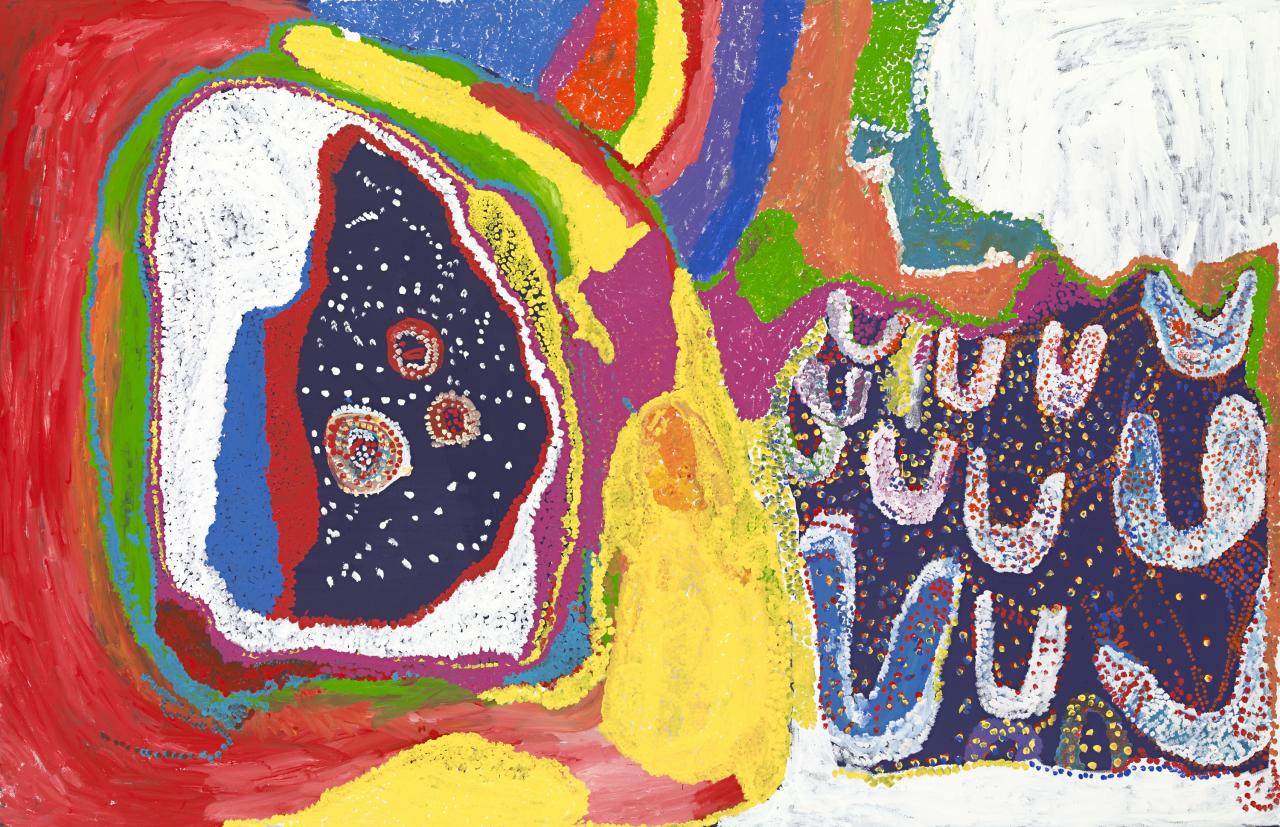
Kudditji Kngwarreye and the Beginning of a Movement
The style is inseparable from one name: Kudditji Kngwarreye. An Anmatyerre man from Alhalkere Country in Central Australia, Kudditji was born around 1928 and grew up on the same Country as his famous sister, Emily Kame Kngwarreye. Long before the Western art world took notice, he was a hunter, a ceremonial custodian, and a respected Elder with cultural authority over men’s business connected to the Emu Dreaming. His rights to depict the stories he painted were inherited through law, responsibility, and kinship, not assumed or invented.
Kudditji became the first Indigenous artist to work in colour fields, beginning this approach in 1993. When he started, the style was not welcome in the world of Aboriginal art. He was actively encouraged to return to dot painting, which the market recognised and expected at the time. It was not until 2002 that his work found a different kind of audience, among collectors and critics drawn to abstraction on its own terms, people who recognised an emotional force and compositional intelligence that placed his canvases alongside the most significant painting of the twentieth century.
From Dot Work to Broad Colour
Kudditji had started painting during the Papunya Tula movement in the 1980s. Those early works followed the dotted, iconographic style that characterised the movement at the time, a tradition with deep cultural roots in Aboriginal dot painting. But that language was never the full story for him. Years later, he made the shift to the bold, sweeping colour fields that would define his legacy.
The transition was not simply a stylistic choice. It was cultural. He was painting as he felt, not as the market expected. The resulting works feature large blocks of deep reds, purples, blues, blacks, yellows, and sandy pinks that represent Emu Dreaming, Country, and the ceremonial sites of his birthplace. These canvases reflect the heat of the desert, the shimmer of mirages, the seasonal movements of the land, and the pathways traced by ancestral beings across Alhalkere Country.
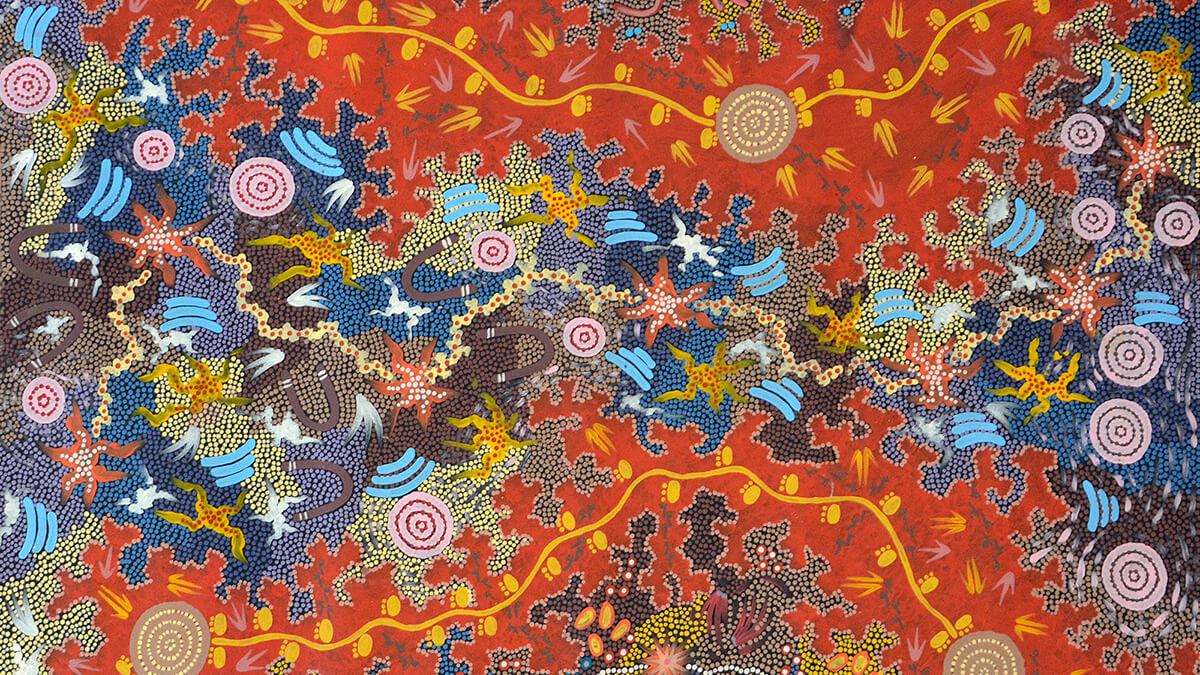
What Colour Field Means in an Aboriginal Context
Western audiences often encounter these paintings through comparisons to Mark Rothko, whose austere colour field canvases are so celebrated that the Tate Modern in London built an entire room to house them. The comparison has some surface logic. Both involve large expanses of colour that seem to vibrate and envelop the viewer. But to stop there is to miss what Kudditji’s work actually is.
His paintings do not emerge from Western abstraction or modernist theory. They come directly from Country, ceremony, and ancestral narratives rooted in 65,000 years of continuous cultural life. The better frame is not that Kudditji resembles Rothko, but rather that global audiences can recognise a similar emotional intensity in his work, while his vision stands entirely on its own terms and entirely on its own ground.
Stand in front of a major Kudditji canvas and you feel it before you think about it. The colours do not decorate a surface. They surround you in landscape. They carry the deep reds and purples of the desert after rain, the warmth of Country at sunset, the ancestral presence held within the land itself. His works are not abstractions of nature. They are nature remembered, felt, and translated through a cultural lens that has no equivalent in Western art history. Titles such as My Country, Emu Dreaming, and Boundary Bore are not labels after the fact. They are the paintings telling you exactly where they come from.
Cultural Permission and What It Means
The integrity of Kudditji’s paintings depends on something that is easy to overlook: he painted only what he had cultural authority to paint. His Emu Dreaming responsibilities gave him the right to depict certain sites and stories. In the world of Indigenous Australian art, this is not a formality. Cultural protocols govern who can paint what, how stories are represented, which designs belong to which families, and how Country is expressed on canvas.
This is part of what separates Aboriginal colour field painting from any attempt to replicate the visual style without the cultural grounding. The surface appearance of broad colour can be reproduced. The cultural authority behind it cannot. For this reason, when collecting or engaging with this kind of work, provenance matters deeply. Reputable galleries, transparent sourcing, and fair payment to artists and their communities are not optional considerations.
Aboriginal colour field painting sits within a tradition that includes not only the acrylic works of the desert but also the ancient ochre painting techniques used across the continent for tens of thousands of years, connecting contemporary practice to its deepest roots.
The Broader Desert Art Movement
While Kudditji’s style is unique, it belongs to a larger story. Artists from Utopia and the Central Desert regions have collectively reshaped how the world understands what abstraction can be. His sister Emily Kame Kngwarreye came closest to the colour field tradition among her contemporaries, though no other artist reached quite the same degree of pure, sweeping expression that Kudditji achieved in his late work.
His paintings sit comfortably alongside other artists of comparable cultural and artistic weight from the same region, people who also brought the interior Australian landscape into dialogue with global contemporary art without ever departing from Country. That late career shift into sweeping colour fields is what solidified his place as one of the genuinely great artists of the last century.
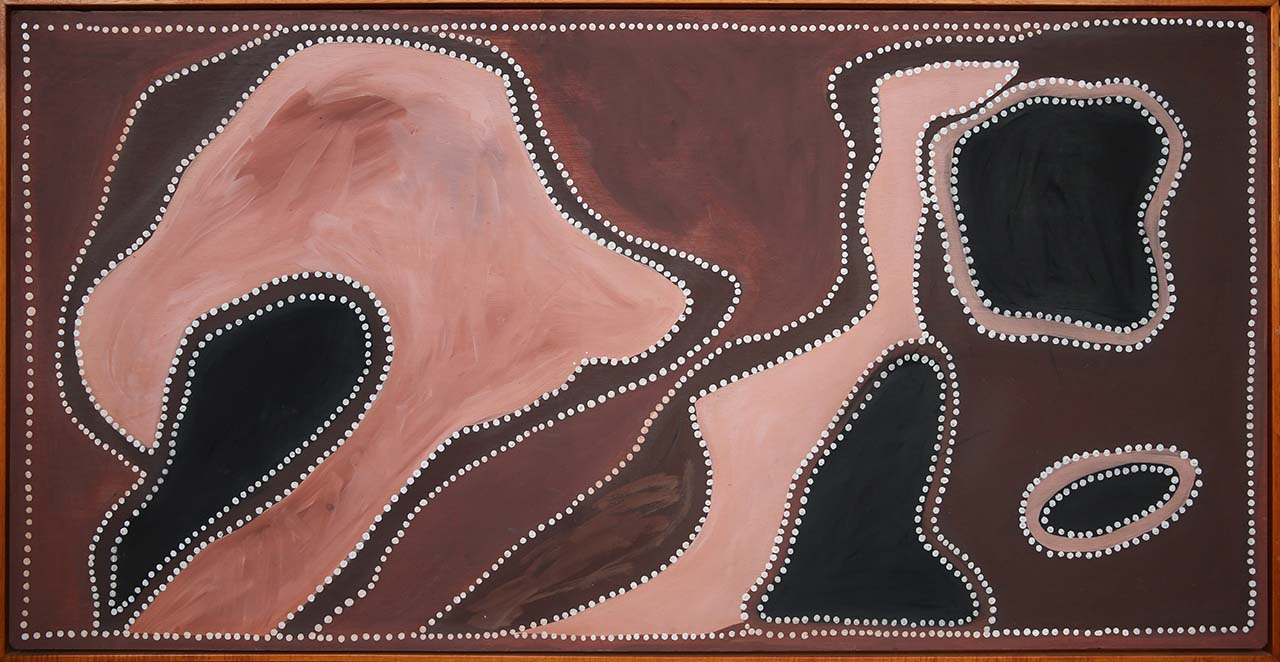
Legacy and Why the Work Endures
Kudditji passed away in 2017. Because his late period was relatively short, major colour field paintings from his hand are becoming increasingly rare on the market. Collectors seek out his work for reasons that go beyond visual beauty. Every canvas is a continuation of Country. The colour fields are visceral and immersive in ways that still stop viewers cold. He is a foundational figure in the evolution of desert art and his late style is now considered one of the most important shifts in Indigenous contemporary art in Australia.
His legacy lives not only through the paintings themselves but through the cultural knowledge he carried, the artists he influenced, and the ongoing responsibility of galleries and collectors to honour the stories his work represents. As with all significant Aboriginal art forms, from the intricate rarrk cross-hatching of Arnhem Land to the ancient rock art traditions stretching back tens of thousands of years, colour field painting in an Aboriginal context is not a movement frozen in time. It is a living expression of culture, Country, and a way of seeing the world that the land itself produced.
In every block of colour, there is land speaking. That is what Aboriginal colour field painting is.