When people picture Aboriginal art, they often picture one of two things: fields of intricate dots arranged over a canvas, or a slim sheet of bark covered with fine parallel lines. Both images are correct, and both are incomplete pictures of a much wider story. The first belongs to the Western Desert tradition; the second to Arnhem Land. They developed on opposite sides of the Australian continent, under entirely different conditions, and the differences between them run much deeper than the surface of the work.
Two Movements, Two Timelines
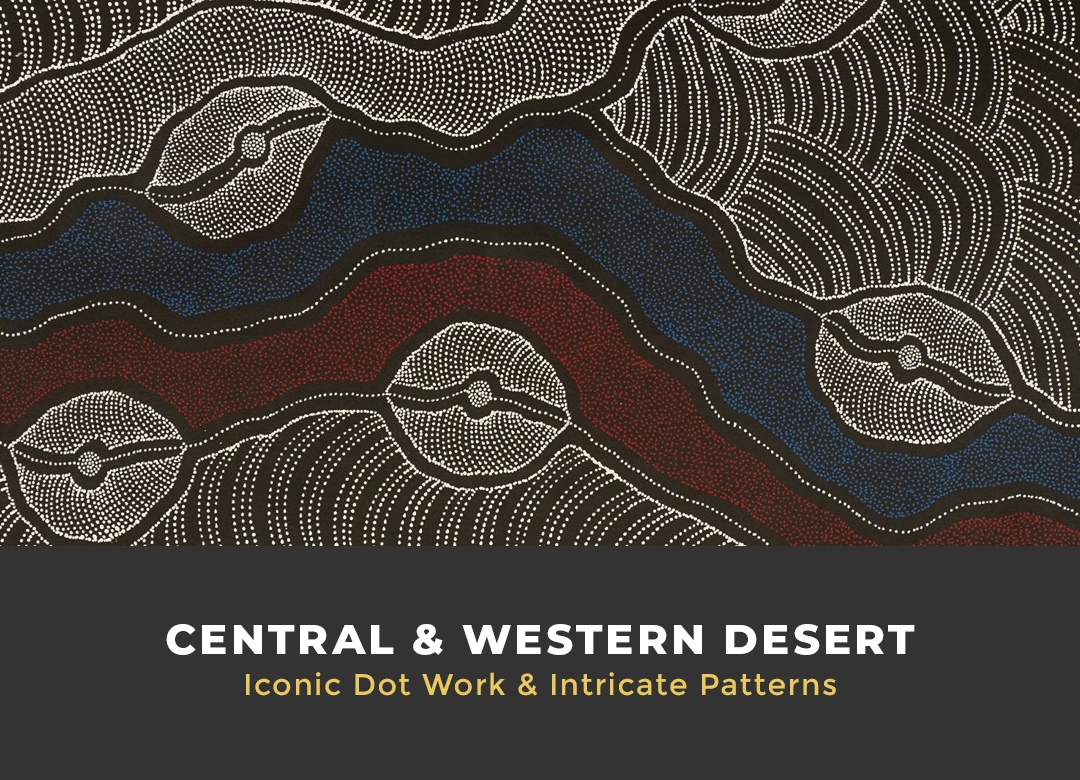
The most important contrast between these two traditions is when they entered the contemporary art world. Western Desert dot painting moved onto canvas as a contemporary movement at a specific moment in the early 1970s at Papunya. The shift was rapid: ceremonial sand and body designs translated to acrylic on board within a few years, the Papunya Tula Artists cooperative formed in 1972, and within a decade the work was being exhibited internationally. Arnhem Land bark painting, by contrast, was already being documented by anthropologists in 1912, when Walter Baldwin Spencer collected works at Oenpelli (now Gunbalanya), and the tradition itself is considerably older than that documentation. The transition to selling bark paintings was an extension of an existing ceremonial practice onto an existing surface, not the invention of a new medium.
That timeline difference matters. Western Desert work emerged as a contemporary movement out of negotiation with an outside audience. Arnhem Land work continued on a track that had already been running for generations.
Different Surfaces, Different Authorities
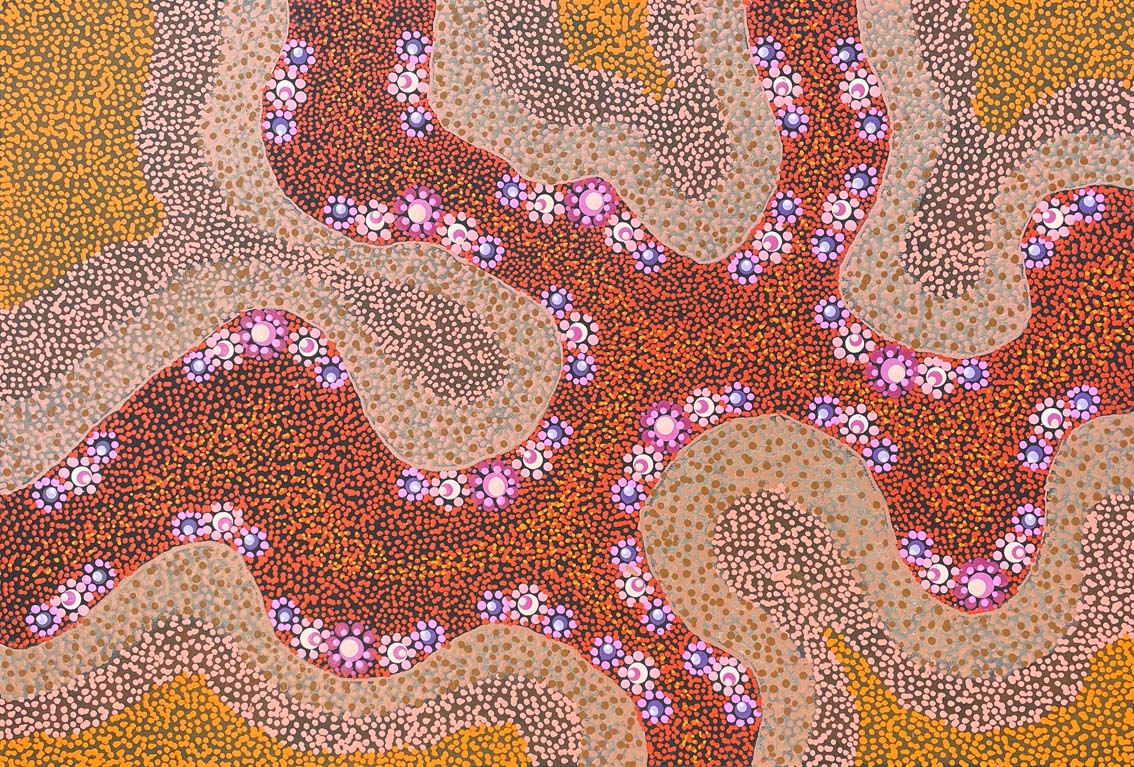
Western Desert art works in acrylic on canvas and board. The visual vocabulary is symbolic: concentric circles for fire sites, waterholes, or camps; arcs for people; lines and tracks for ancestral routes. The paintings work as aerial maps of Country, telling Dreaming stories through a shared iconography that varies in meaning depending on the story being told. The icons themselves are broadly shared across desert communities, with the meaning resting on the specific story and the artist’s authority to tell it.
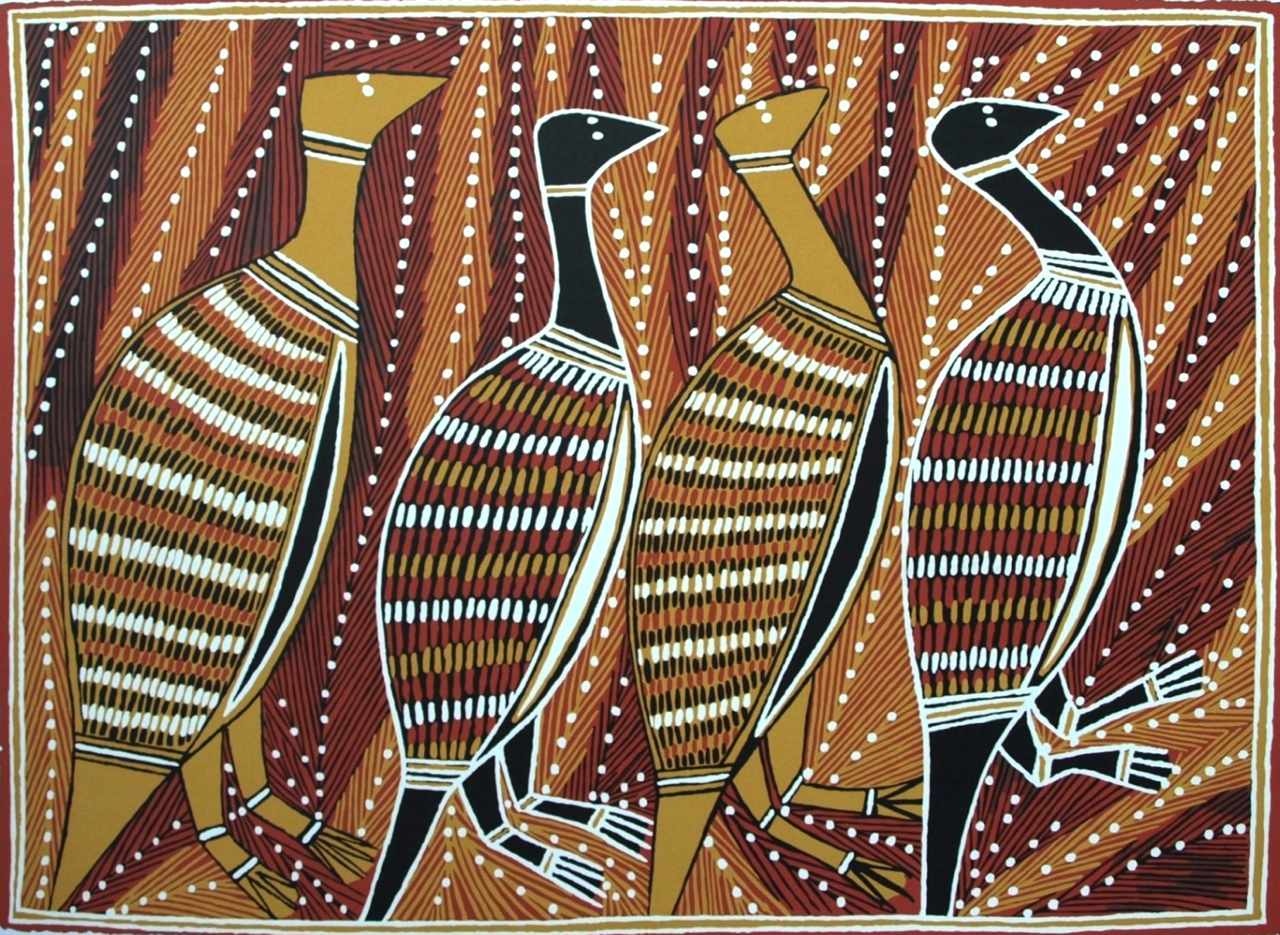
Arnhem Land works on bark, with natural ochres, using techniques covered in detail in the bark painting guide, rarrk cross hatching, and x-ray art. The distinctive feature here is how visual elements work as legal documents. In north-east Arnhem Land, the Yolngu clan designs called Minytji are owned by specific families. An artist is authorised to paint the patterns belonging to their own clan and no other. The work is both a personal signature and a record of rights to land and connection to Country in a way that Western visual traditions have no direct equivalent for.
Side by Side: How the Two Traditions Compare
| Category | Western Desert Art | Arnhem Land Art |
|---|---|---|
| Geographic region | Central and Western Australia | Northern Territory (Top End) |
| Primary surface | Canvas and board (acrylic) | Bark, canvas, larrakitj poles |
| Core technique | Dot painting, geometric iconography | Rarrk (cross-hatching), Minytji, X-ray art |
| Dominant pigments | Acrylic paint | Natural ochres (red, yellow, white, black) |
| Visual characteristic | Aerial map of Country with concentric circles and tracks | Fine parallel lines, figurative subjects, internal anatomy |
| Cultural function | Maps ancestral travel routes and sacred sites | Expresses clan identity, law, and spiritual presence |
| Modern origin point | Papunya, 1971 | Documented from 1912; tradition is much older |
| Key language groups | Pintupi, Warlpiri, Luritja, Anangu | Kunwinjku (west), Yolngu (northeast) |
The surface differences are real, but they reflect something deeper. Western Desert art emerged as a contemporary movement at a specific moment, when artists were encouraged to translate ceremonial designs into a new medium for a new audience. The dot painting style developed out of that negotiation between tradition and opportunity. Arnhem Land bark painting was never a modern invention. The transition to selling bark paintings was an extension of an existing practice onto an existing surface, with much of the ceremonial form intact.
Both traditions, despite their differences, share a common foundation. Both are rooted in the Dreaming, the ancestral order through which the world was created and continues to be sustained. In each case the art is not simply a representation of that order but a participation in it, a way of maintaining connections that have existed across thousands of years. Both continue to evolve, producing work that speaks in contemporary visual languages while remaining grounded in the cultural knowledge and Country from which they came.
Reading the Two Side by Side
Western Desert art and Arnhem Land art are sometimes spoken of as if they represent all of Aboriginal art, partly because they are the best known internationally. They are both major traditions, and they are genuinely distinct: one emerging from the desert interior in a specific political and cultural moment, the other continuing a coastal and river tradition in the tropical north that was already old when European documentation began. Looking at the two side by side clarifies not only what separates them but how much variety exists within a living artistic culture that spans an entire continent. The wider regional context, including the Kimberley, Tiwi Islands, and Cape York, is set out in the guide to how Aboriginal art styles differ by region.