Ochre has been at the centre of Aboriginal artistic and ceremonial life for longer than any other known medium on earth. Long before canvas, before paper, before any manufactured pigment reached Australian shores, people across the continent were grinding yellow, red and white stones into powder, binding them with fat or water, and applying them to rock walls, bark, skin and sand. What is ochre painting in Aboriginal art? It is not simply a technique. It is the visual language through which the world’s oldest continuous culture has communicated its stories, laws and spiritual knowledge across at least 65,000 years.
This guide covers what ochre is, where it comes from, how it was prepared and used, which artists built their reputations on it, and why it remains a living medium today.
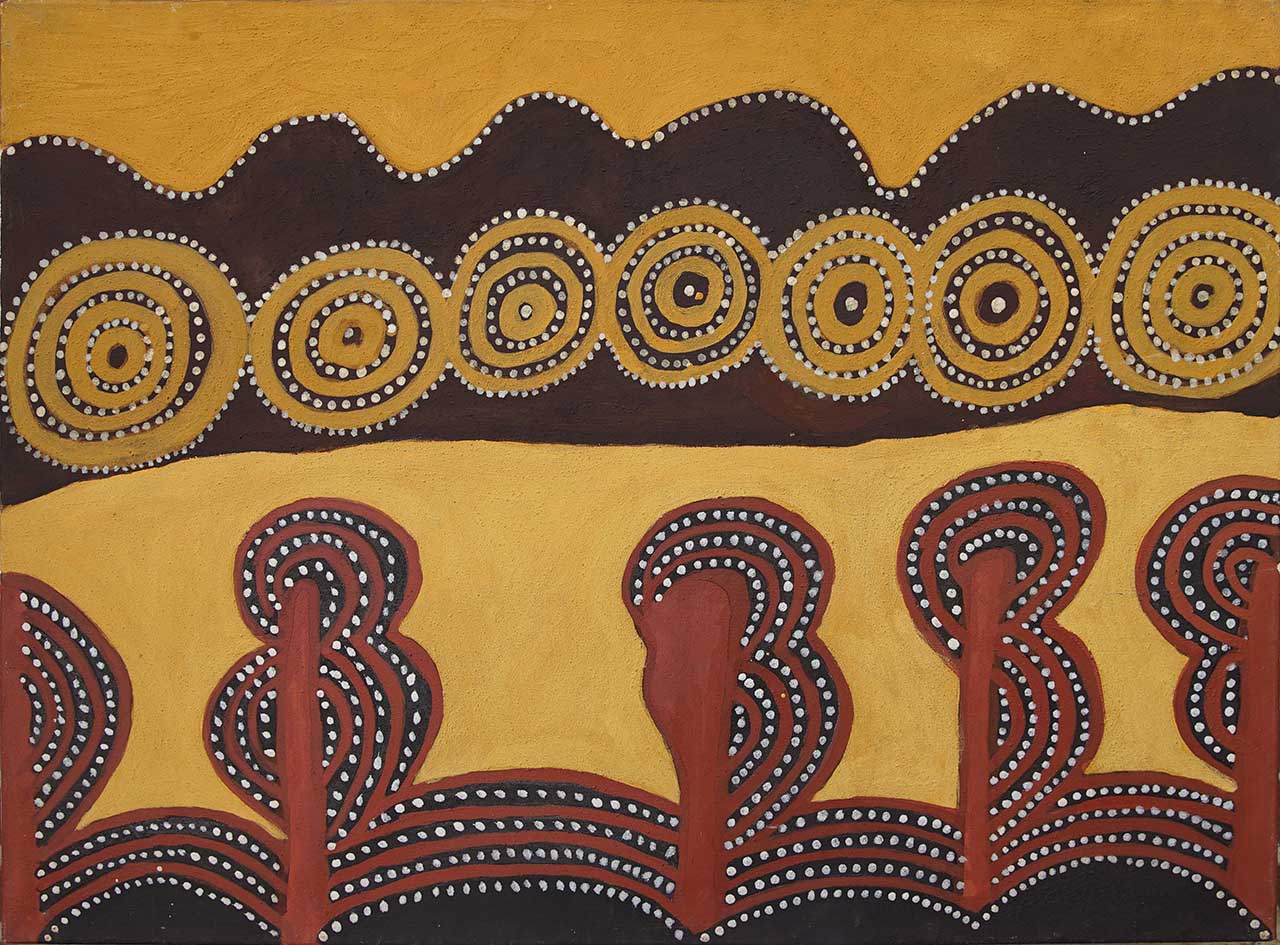
A Pigment Born From the Earth
Ochre refers to naturally occurring clay and mineral deposits that yield earthy pigments ranging from pale yellow and deep red to white and brown. In Australia, these minerals are found in surface soils and rock outcrops across the continent, though their quality and availability vary enormously by region. The most prized deposits were often mined rather than simply gathered, which tells us something important about how seriously these materials were treated by the communities that used them.
The colour of ochre depends on its iron oxide content and how it has been heated or weathered. Yellow ochre owes its tone to limonite. When heated, that same mineral converts to haematite and turns red. White pigments came from kaolin or calcium carbonate, while black and dark brown shades were often derived from manganese or charcoal. Artists across different regions developed detailed knowledge of local deposits and understood how processing them changed their properties and their behaviour on different surfaces.
How Was Ochre Prepared for Painting?
Preparing ochre for use was a skilled process passed down through generations. The raw stone was ground on a flat surface using a harder grinding stone until it became a fine, consistent powder. That powder was then mixed with a binder to make it adhere to the intended surface. The choice of binder depended entirely on the application. Animal fat was used for body painting, giving the colour a warmth that caught firelight during ceremony. Water served for many rock surface applications. Tree resin, egg white and blood were also used in specific contexts, each bringing its own properties and, where blood was involved, its own ceremonial meaning beyond simple adhesion.
Application tools included fingers, shaped sticks, feathers used as brushes, and chewed plant fibres that formed a natural bristle tip. Different regions developed distinct methods suited to their own artistic traditions. In body painting, patterns were applied freehand with a directness and confidence that came from a lifetime of practice and cultural instruction.
The Oldest Art Medium Still in Use
The earliest evidence of ochre use at an Australian site comes from Madjedbebe rock shelter in Arnhem Land, where deposits have been carbon-dated to at least 65,000 years ago, placing the ochre tradition at Madjedbebe among the oldest documented art-making practices anywhere on the planet. It also means Aboriginal Australians have been working with this material continuously for longer than modern humans have been present in Europe.
The cave paintings that survive across Australia represent only a portion of what was created. Many works were painted on rock surfaces open to the weather, or on bark, skin and sand, where they did not last. Carbon dating of ochre-based cave paintings has been fundamental to understanding the timeline of both artistic practice and human occupation across the continent. The ochre pits of the West MacDonnell Ranges, the rock shelters of the Pilbara, the galleries of the Kimberley: these sites preserve traces of an unbroken practice that continued in those same places for millennia before European contact. High-resolution analysis by ANSTO has helped researchers map those cultural trails without disturbing the works.
What those early works share with paintings made today is not the medium alone but the purpose behind it. Aboriginal art has never been purely decorative. The rock paintings that still exist were made to record Dreamtime stories, to mark significant sites, and to communicate information about water sources, hunting grounds and seasonal movements. They were functional in the deepest sense, carrying knowledge across generations in a society without a written language. Ochre was the ink in which that knowledge was set down.
A Commodity Traded Across the Continent
Ochre was so valued that it moved through trade networks spanning the entire continent. Different communities had access to different deposits, and some regions had little or none at all. This created a sustained demand that linked language groups separated by hundreds of kilometres. Trade routes that functioned almost like the silk routes of Asia crossed Australia in every direction, but instead of silk, the valuable product was natural ochre pigment in its various colours and qualities.
The ochre pits of the West MacDonnell Ranges were known and visited by groups from far beyond the immediate region. Some journeys undertaken specifically to obtain high-quality ochre covered distances that would have taken weeks on foot through difficult country. The relationships that made such travel safe and possible were themselves sustained by the same networks of exchange. You did not simply arrive at another group’s ochre deposit uninvited. The access was negotiated, ceremonially sanctioned, and embedded in ongoing obligations between the groups involved.
The value placed on particular ochres also reflected their spiritual significance. Certain deposits were associated with specific Ancestral Beings and carried ceremonial authority that was independent of their practical utility as pigment. To obtain and use such ochre was to participate in a living relationship with country and with the Ancestors who shaped it. This is why the trade in ochre was never simply commercial and why protocols around its use remain in place in many communities today.
The Palette and the Discipline It Imposed
One of the most revealing aspects of ochre painting is how its constraints shaped the tradition. The available colours were limited: the yellows and reds of iron-bearing clay, the white of kaolin, the black of charcoal and manganese, and occasional brown and orange tones achievable through mixing. Even with blending, the palette rarely extended beyond half a dozen distinct colours. There was no shortcut to variety; everything depended on what the earth offered and what skill could do with it.
That restriction was not a limitation in the negative sense. It was a discipline. Working within a narrow palette forces decisions about placement, proportion and contrast. Artists learned which combinations created depth and which created harmony. They learned to make red work against white, to use black to anchor or define a composition. The spare, direct quality that characterises a great deal of ochre-based Aboriginal art comes in part from this enforced economy of means. When you have only a few colours, every colour choice carries weight.
This is one reason why the ochre tradition produced artists of such concentrated formal intelligence. The palette did not make their work easier. It made their thinking more rigorous. And when some of those artists later encountered the full range of acrylic colours, they brought with them an understanding of colour relationships built through years of working under constraint. Their instincts for what worked were sharper for having developed in conditions that permitted no waste.
Ochre in Ceremony and Body Painting
Beyond its role in paintings on fixed surfaces, ochre has always been central to ceremonial life. Body painting for initiation ceremonies, corroborees, rain dances and other significant gatherings has used ochre pigments for as long as oral tradition can reach. The patterns applied to the body in these contexts are not decorative in any simple sense. They carry clan affiliations, Dreaming connections and instructions about a person’s standing and responsibilities within their community. They are a kind of text written on skin.
The Seven Sisters story, one of the most widely distributed Dreaming narratives across Aboriginal Australia, was and continues to be expressed through ochre body painting in women’s ceremonies. The specific patterns, their placement on the body and the colours used encode information about the story and its regional variations. This is one of the reasons ochre has remained the material of ceremony even in communities that shifted to acrylic paint for canvas-based gallery work decades ago. The two practices serve different purposes, and the ceremonial purpose has never stopped requiring ochre.
Vast distances are still travelled to reach high-quality ochre deposits needed for ceremony. This is not heritage tourism or a performance of tradition for outside audiences. It reflects the continuing spiritual significance of the material itself, not merely the paintings it produces. The ochre from a particular source carries the country it comes from into every ceremony where it is applied, maintaining a physical connection between people and place that no substitute can replicate.
The Great Artists of the Ochre Tradition
The Warmun Community in the East Kimberley, known until the 1990s as Turkey Creek, has been the most significant single source of internationally recognised ochre-based painting in the contemporary Indigenous fine art movement. It was here that Rover Thomas, Queenie McKenzie, Jack Britten, Hector Jandanay and Freddie Timms developed the sparse, landscape-oriented style that brought global attention to ochre painting from the 1980s onward. The community’s art came out of a specific ceremonial tradition and remained close to it.
Rover Thomas Joolama came to painting relatively late in life after experiencing a series of visions following the death of a woman from his community. The paintings he produced to accompany the Krill Krill ceremony he initiated became the foundation of his artistic practice. His approach was to use broad areas of flat ochre colour and minimal detail to evoke the spirit of particular country rather than its surface appearance. That restraint, which the limited palette enforced and which his own instincts extended, produced work of extraordinary authority. His paintings feel inevitable, as though no other arrangement of colour could have captured the particular weight of that landscape.
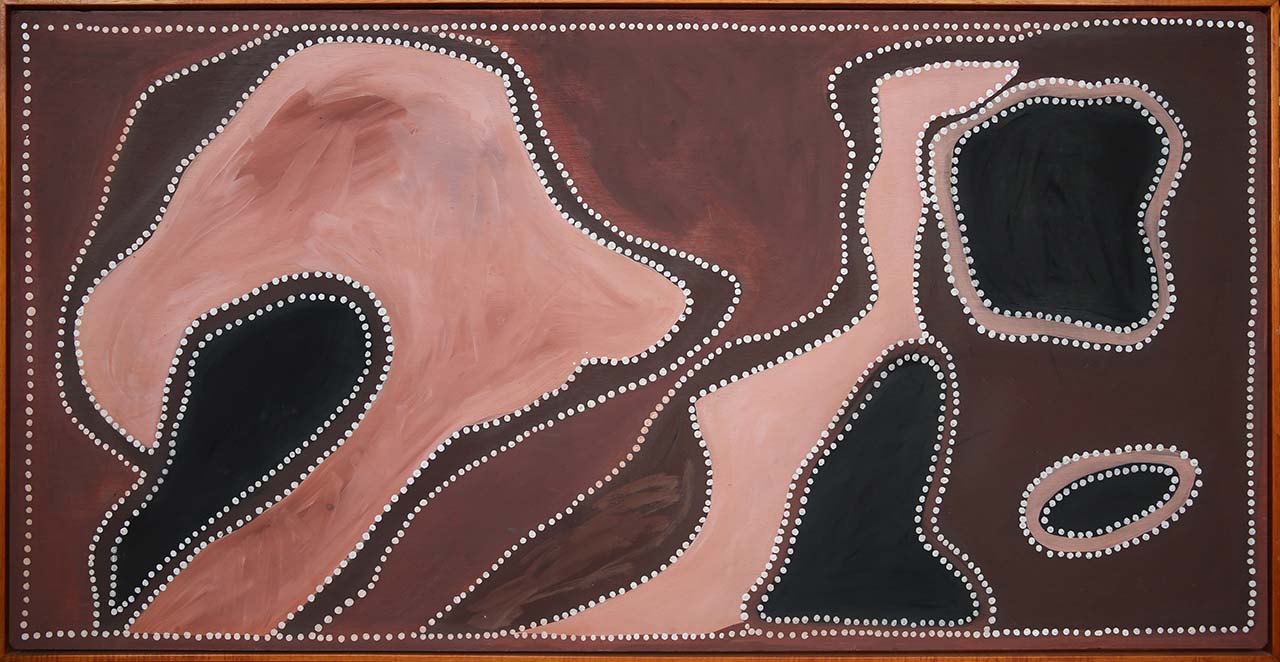
Paddy Bedford, another Warmun painter, brought a bold and confident stroke to his ochre work. He used broad, abstracted forms to capture the essence of a story or a place rather than its topographic detail. The interplay of ochre shades in his compositions creates a sense of movement and depth that rewards time spent looking. Queenie McKenzie painted her ancestral country around Texas Downs station with a directness and specificity that made her work function almost like detailed maps of the spirit world. Jack Britten combined precise ochre pigment work with compositional intelligence that has placed his paintings in major public and private collections. Each of these artists worked in a shared visual language but each had their own identifying mark within it, their own particular way of making ochre speak.
Ochre Across Arnhem Land Bark and Canvas
While the Kimberley developed its distinctive landscape-based ochre style, the communities of Arnhem Land and the Tiwi Islands maintained their own ochre-based traditions on bark painting, where ochre is the only pigment used. The fine rarrk line work and the figurative x-ray tradition are both built up entirely in ochre, and the techniques themselves are covered in their own articles. What is worth noting at the level of the pigment is that bark painting has stayed closer to its historical materials than most other regional traditions: there has been less pressure on Arnhem Land artists to substitute acrylics, which has kept ochre at the centre of the practice in a way that has become rarer elsewhere.
The Shift to Acrylics and What Was Preserved
The early 1970s brought a change to Aboriginal art that moved through most communities within a generation. The establishment of the painting movement at Papunya in the Central Desert in 1971 introduced acrylic paints on a wide scale. Acrylics were easier to use, required no binder preparation, and opened up a palette of hundreds of colours that ochre could never offer. Many artists embraced them quickly. The results in Papunya and in communities across the Western and Central deserts were transformative, producing the dot painting tradition that became globally associated with Aboriginal art in the following decades.
When Walmajarri artist Jimmy Pike from the Kimberley began using intensely saturated acrylic colours and even marker pens in the 1980s, he opened a door that many artists walked through. The use of colour that followed underpinned the Indigenous fine art movement reaching its international peak around 2007. The worldwide impact that movement achieved would almost certainly have been harder to realise had it remained confined to the ochre palette. The new colours gave artists tools that allowed them to reach audiences who might otherwise have looked past work in earth tones.
But the communities that retained ochre did not do so out of an inability to change. Warmun continued to paint primarily in ochre not because acrylics were unavailable but because the artists there understood that their relationship to country and to ceremony was inseparable from the material they used. Even communities that shifted to acrylics for canvas work have in most cases maintained ochre for ceremony. The two practices serve different functions, and ochre’s function in ceremony has never been replaceable.
Ochre in Contemporary Practice
The contemporary Indigenous art world encompasses everything from desert acrylics and urban conceptual work to photography and installation. Within that range, ochre continues to be a living medium rather than a historical one. Several communities, including Warmun and many in Arnhem Land, maintain ochre as their primary medium for both bark and canvas work. The reasons are simultaneously cultural, spiritual and aesthetic: ochre grounds the work in a specific relationship with country that synthetic paint cannot replicate, regardless of how closely it approximates the colour.
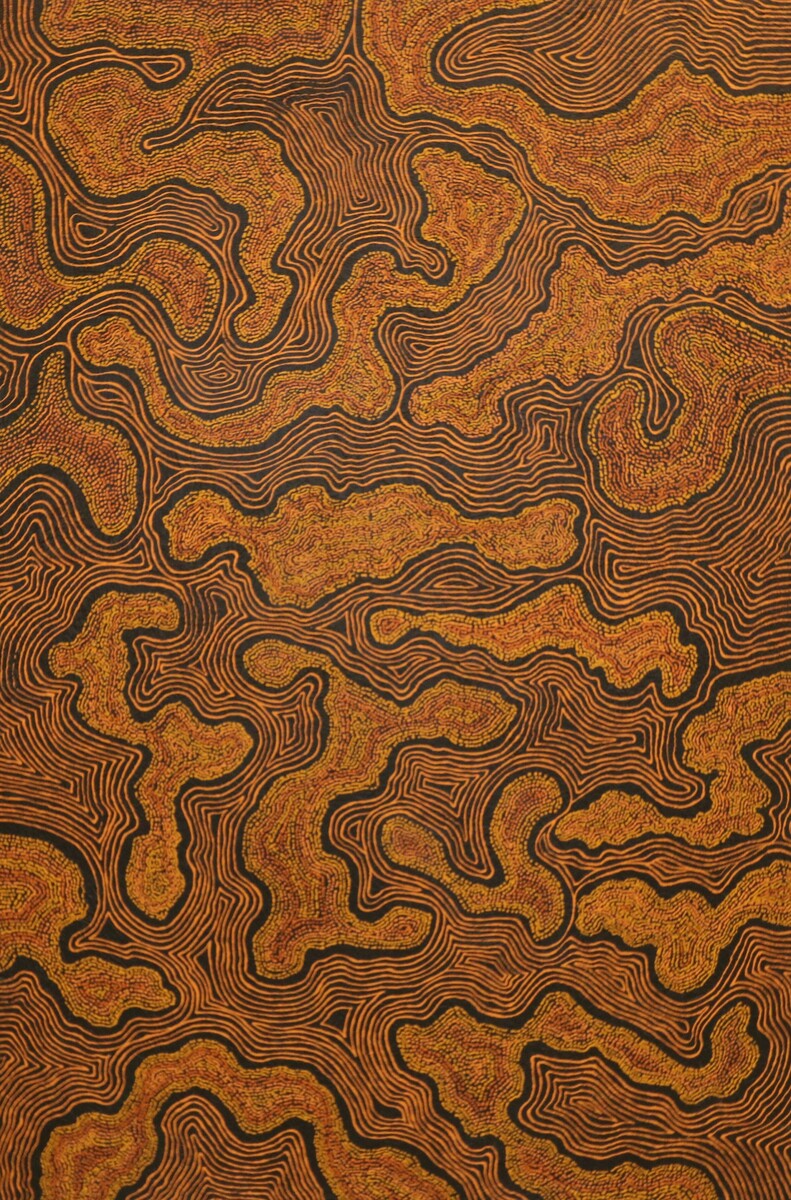
Scientific engagement with ochre has grown significantly over recent decades. Geochemical analysis of the pigments used in rock paintings has been used to trace ancient trade networks, identifying the specific mineral deposits from which particular ochres were sourced and mapping the distances over which they moved. This research has confirmed what oral traditions have always maintained: that the ochre trade was continental in scale and deeply structured by cultural relationships. Each source has a chemical signature, and matching that signature to paintings across the continent has produced a detailed picture of how knowledge and material moved through Aboriginal Australia before European contact.
Why Ochre Still Matters
Ochre connects Aboriginal artists today to an unbroken practice stretching back at least 65,000 years, through rock shelter and bark and canvas, through ceremony and trade and the most significant moments of a person’s life. No other art tradition still in active practice can claim a comparable continuity of material. If you want to understand Aboriginal art at any depth, ochre is the place to begin.