Contemporary urban Aboriginal art is a movement of Indigenous Australian artists working in cities who blend traditional cultural knowledge with modern mediums like photography, installation, video, and mixed media. These artists create work that addresses colonisation, identity, land rights, and the lived experience of Aboriginal people in metropolitan Australia. The movement gained momentum in the 1980s through artist-run collectives and major exhibitions that challenged narrow definitions of what Aboriginal art could be.
This guide covers the origins of the urban art movement, the artists who shaped it, the themes that define it, and how it connects to older visual traditions like dot painting and rarrk cross hatching.
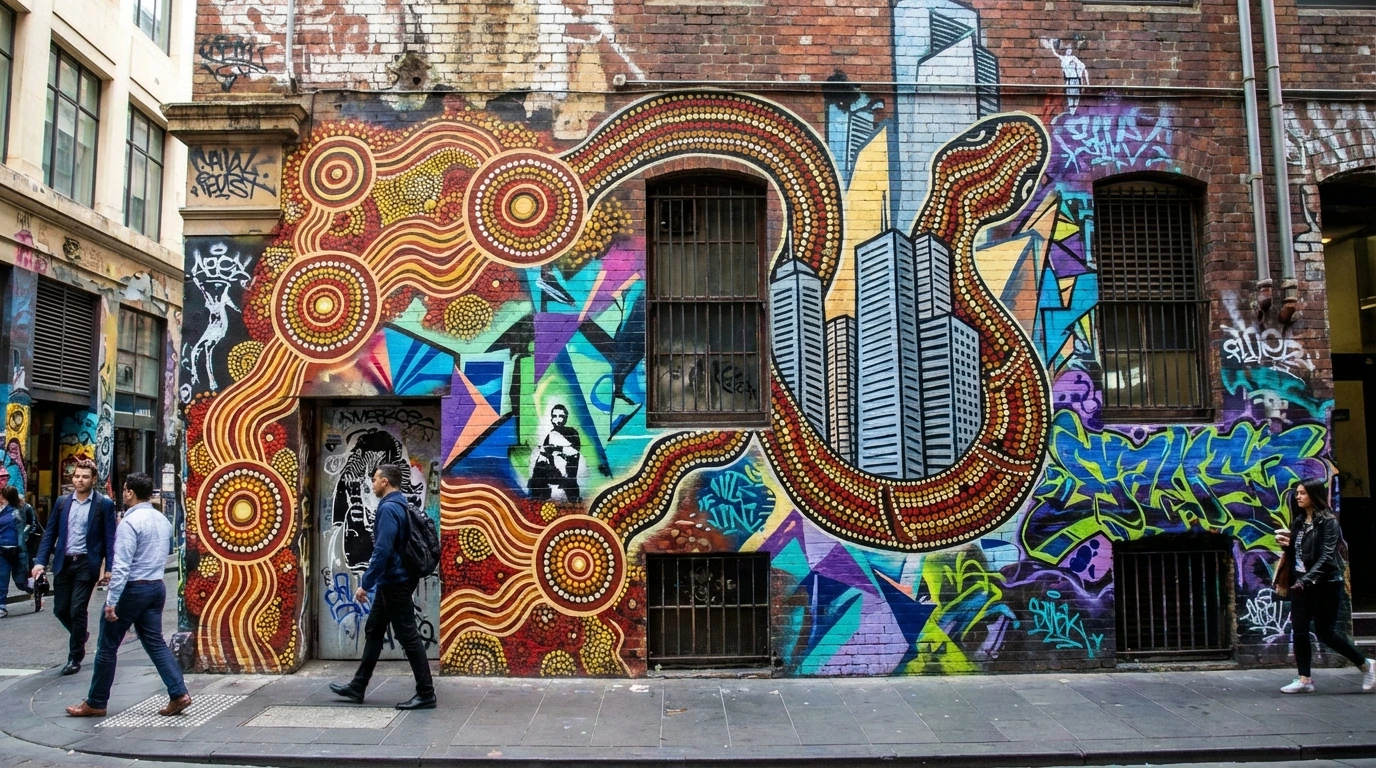
How the Urban Aboriginal Art Movement Began
The story of contemporary Aboriginal art often centres on the 1971 Papunya movement in the Central Desert. That narrative leaves out a parallel development in Australian cities. Throughout the 1970s and 1980s, Aboriginal people living in Sydney, Melbourne, Brisbane, and other urban centres were creating art that drew from their cultural heritage while engaging directly with the political realities of city life.
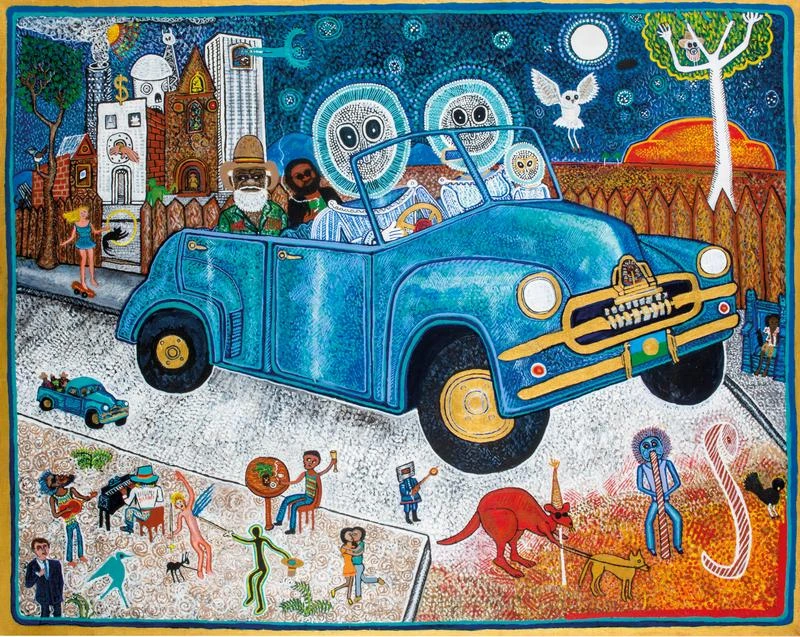
Trevor Nickolls, a Ngarrindjeri artist based in Adelaide and later Canberra, is widely recognised as the father of urban Aboriginal art. His 1977 solo exhibition, titled “From Dreamtime to Machinetime,” introduced a visual framework that placed Western Desert dot patterns and Arnhem Land cross hatching alongside urban industrial imagery on a single canvas. Nickolls used this contrast to illustrate the collision between ancestral tradition and technological modernity.
[Trevor Nickolls painting showing Dreamtime symbols colliding with urban industrial imagery]
The movement found its organisational backbone in 1987 when ten Aboriginal artists in Sydney founded the Boomalli Aboriginal Artists Co-operative. Boomalli, a word meaning “to strike” in multiple Aboriginal languages, gave urban Indigenous artists a dedicated exhibition space and a collective voice at a time when galleries and institutions largely excluded them. Founding members included Bronwyn Bancroft, Euphemia Bostock, Fiona Foley, and Tracey Moffatt. These artists worked across painting, photography, printmaking, and installation, rejecting the idea that Aboriginal art had to look a certain way to be considered authentic.
What Makes Urban Aboriginal Art Different From Remote Community Art
The distinction between urban and remote Aboriginal art is geographic and contextual, not hierarchical. Both forms carry cultural authority. They differ in the circumstances that shape them.
Remote community art movements like Papunya Tula grew from artists painting their specific Dreaming narratives within their ancestral Country. The visual language of dots, circles, and map-like compositions reflects intimate relationships between artists and the landscapes they have inhabited for thousands of years. These works encode Dreamtime stories through visual systems passed down across generations.
Urban Aboriginal art emerges from a different set of pressures. Many urban Indigenous artists were raised away from their traditional Country, some as a direct result of the Stolen Generations policies that forcibly removed Aboriginal children from their families. For these artists, creating art became a way to reclaim, reconstruct, and assert an identity that government policy tried to erase.
The mediums differ as well. Where remote artists often work with natural ochres on bark or acrylic on canvas, urban artists frequently use photography, video, printmaking, digital media, sculpture, and large-scale installation. The choice of medium is itself a statement. Using the tools of contemporary Western art practice to express Aboriginal narratives positions Indigenous artists as participants in the global contemporary art conversation, not as producers of ethnographic curiosity.
Key Themes in Contemporary Urban Aboriginal Art
Identity and Reclamation
Identity sits at the core of the urban movement. Artists who grew up in cities often encountered a damaging stereotype that “real” Aboriginal people lived in remote communities, not in suburbs. Their work dismantles that assumption by asserting that Aboriginal identity is not tied to geography. Living in Sydney does not make an Aboriginal person less Aboriginal.
Gordon Bennett, a Brisbane-based artist of Aboriginal and Anglo-Celtic descent, spent much of his career interrogating how colonial narratives construct and constrain Indigenous identity. His 1990 painting “Possession Island” deconstructed Captain Cook’s arrival by fragmenting the composition into a grid that exposed the violence hidden beneath the official historical account. Bennett created an alter ego called “John Citizen” to explore how mainstream Australian society defines and categorises Aboriginal identity.
Political Resistance and Social Justice
Richard Bell, a Kamilaroi/Kooma/Jiman/Gurang Gurang artist from Brisbane, describes himself as “an activist who masquerades as an artist.” His 2003 Telstra Art Award win with the painting “Scientia E Metaphysica (Bell’s Theorem)” carried the text “Aboriginal Art: It’s a White Thing.” The work challenged the commercial art industry’s control over how Aboriginal art is produced, valued, and consumed 1.
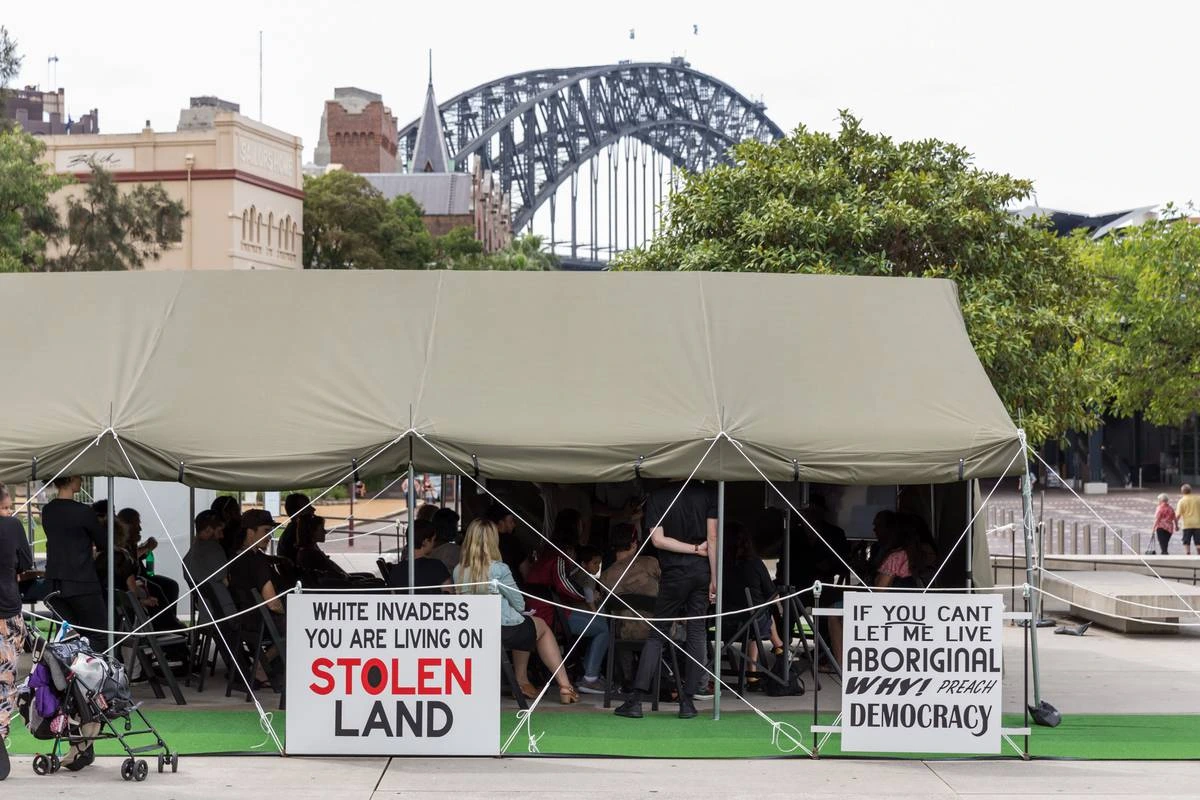
Bell’s ongoing installation “Embassy” recreates the original 1972 Aboriginal Tent Embassy on the lawns of Parliament House. The work functions simultaneously as art, protest, and meeting space. It has been exhibited at international biennales, bringing Australian Indigenous political concerns to a global audience.
The Stolen Generations
The forced removal of Aboriginal children from their families between the 1900s and the 1970s left deep trauma across generations. Urban artists have produced some of the most powerful visual responses to this history. Tracey Moffatt’s 1989 photographic series “Something More” used cinematic staging to explore displacement, desire, and racial violence in rural Australia. Her work avoids documentary directness in favour of constructed narratives that force viewers to confront uncomfortable truths through symbolism and ambiguity.
Connection to Country From a Distance
Even artists raised far from their ancestral lands maintain a relationship with Country through art. Judy Watson, a Waanyi woman working from Brisbane, creates paintings and installations that reference her matrilineal Country in northwest Queensland. Her work uses translucent washes and natural pigments to evoke the presence of landscapes she carries culturally rather than inhabits daily. The layered surfaces suggest buried histories rising back toward visibility.
Notable Artists Who Shaped the Movement
| Artist | Nation/Language Group | Key Medium | Contribution |
|---|---|---|---|
| Trevor Nickolls (1949-2012) | Ngarrindjeri | Painting | Created “Dreamtime to Machinetime” framework. First Aboriginal artist at Venice Biennale (1990) |
| Gordon Bennett (1955-2014) | Aboriginal/Anglo-Celtic | Painting, installation | Deconstructed colonial history through postmodern visual strategies |
| Richard Bell | Kamilaroi/Kooma/Jiman/Gurang Gurang | Painting, installation, video | Activist art challenging the Aboriginal art industry |
| Tracey Moffatt | Aboriginal Australian | Photography, film | Cinematic narratives exploring race, gender, and displacement |
| Fiona Foley | Badtjala | Sculpture, installation, photography | Explored frontier violence and cultural erasure |
| Tony Albert | Girramay | Mixed media, found objects | Uses “Aboriginalia” (kitsch representations) to critique racial stereotyping |
[Indigenous artist working on a large-scale mixed media canvas in a contemporary art studio]
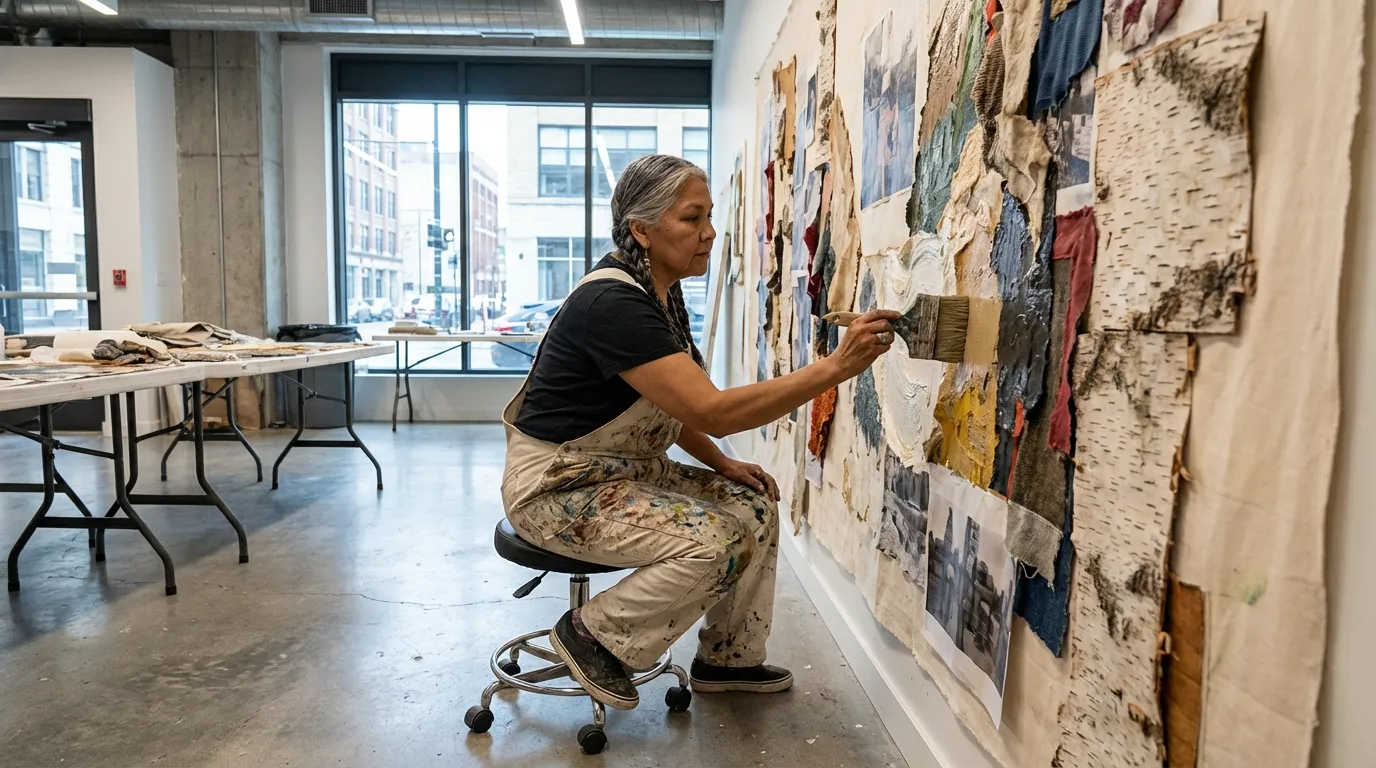
Each of these artists expanded the definition of Aboriginal art by proving that cultural authority does not depend on a single medium, a single location, or a single visual style. Their collective impact reshaped how Australian and international institutions engage with Indigenous creative practice.
How Urban Aboriginal Art Connects to Traditional Practices
Urban Aboriginal art does not replace traditional practices. It extends them. Many urban artists incorporate traditional symbols and techniques into their contemporary work. Trevor Nickolls painted Western Desert dots alongside circuit board imagery. Bronwyn Bancroft, a founder of Boomalli, uses bold patterns and colour to create children’s book illustrations rooted in Aboriginal visual storytelling.
The connection runs deeper than visual reference. The same cultural principles that govern remote art production apply in urban contexts. Artists maintain protocols around sacred content. They consult with elders and community members about what can and cannot be depicted. Cultural permission remains essential regardless of the medium or the postcode.
This continuity matters because it challenges the false binary between “traditional” and “contemporary” Aboriginal art. Both exist on the same continuum. A digital video installation by an Aboriginal artist in Melbourne shares the same cultural foundation as a bark painting in Arnhem Land. The language differs. The authority does not.
Why This Movement Matters Today
Contemporary urban Aboriginal art has achieved international recognition. Aboriginal artists now exhibit at the Venice Biennale, documenta, the Tate Modern, and the Metropolitan Museum of Art. This global presence ensures that Indigenous Australian perspectives enter conversations about colonisation, identity, and resistance at the highest institutional levels.
Within Australia, the movement has reshaped cultural policy and arts funding. Organisations like Boomalli demonstrated that Aboriginal artists needed spaces managed by Aboriginal people. Community-controlled exhibitions and residency programs now operate across every major Australian city.
For consumers and collectors, understanding this movement matters because it broadens what ethical engagement with Aboriginal art looks like. Supporting Indigenous artists means supporting the full spectrum of their practice, from ochre paintings on bark to political installations in white cube galleries. Koarooginal contributes to this spectrum by working directly with Indigenous creators across multiple artistic traditions, ensuring fair compensation and cultural authenticity in every design.
FAQ
Is urban Aboriginal art considered “real” Aboriginal art?
Urban Aboriginal art carries the same cultural authority as art from remote communities. Aboriginal identity is not determined by geography. Artists working in cities maintain cultural connections, follow community protocols, and create work that reflects their heritage and lived experience. The art world and major institutions now recognise urban Aboriginal art as a vital part of the broader Indigenous art canon.
What mediums do urban Aboriginal artists use?
Urban Aboriginal artists work across a wide range of mediums including painting, photography, video, digital media, printmaking, sculpture, installation, and mixed media. This diversity reflects the contemporary art training many urban artists receive and their engagement with global contemporary art practices. The choice of medium often carries intentional meaning about the relationship between traditional and modern creative expression.
How is contemporary urban Aboriginal art different from street art?
Contemporary urban Aboriginal art is created by Indigenous artists who draw on cultural knowledge, community protocols, and lived experience as Aboriginal people. Street art is a broader category defined by location and method rather than cultural identity. Some Aboriginal artists do create public murals and street-level work, but their practice is grounded in specific cultural authority and community accountability that distinguishes it from general street art.
Conclusion
Contemporary urban Aboriginal art proves that Indigenous creative practice thrives in every landscape, from desert Country to city streets. The movement gave voice to artists who were told their experience was not Aboriginal enough and built platforms that now shape global conversations about art, identity, and justice.