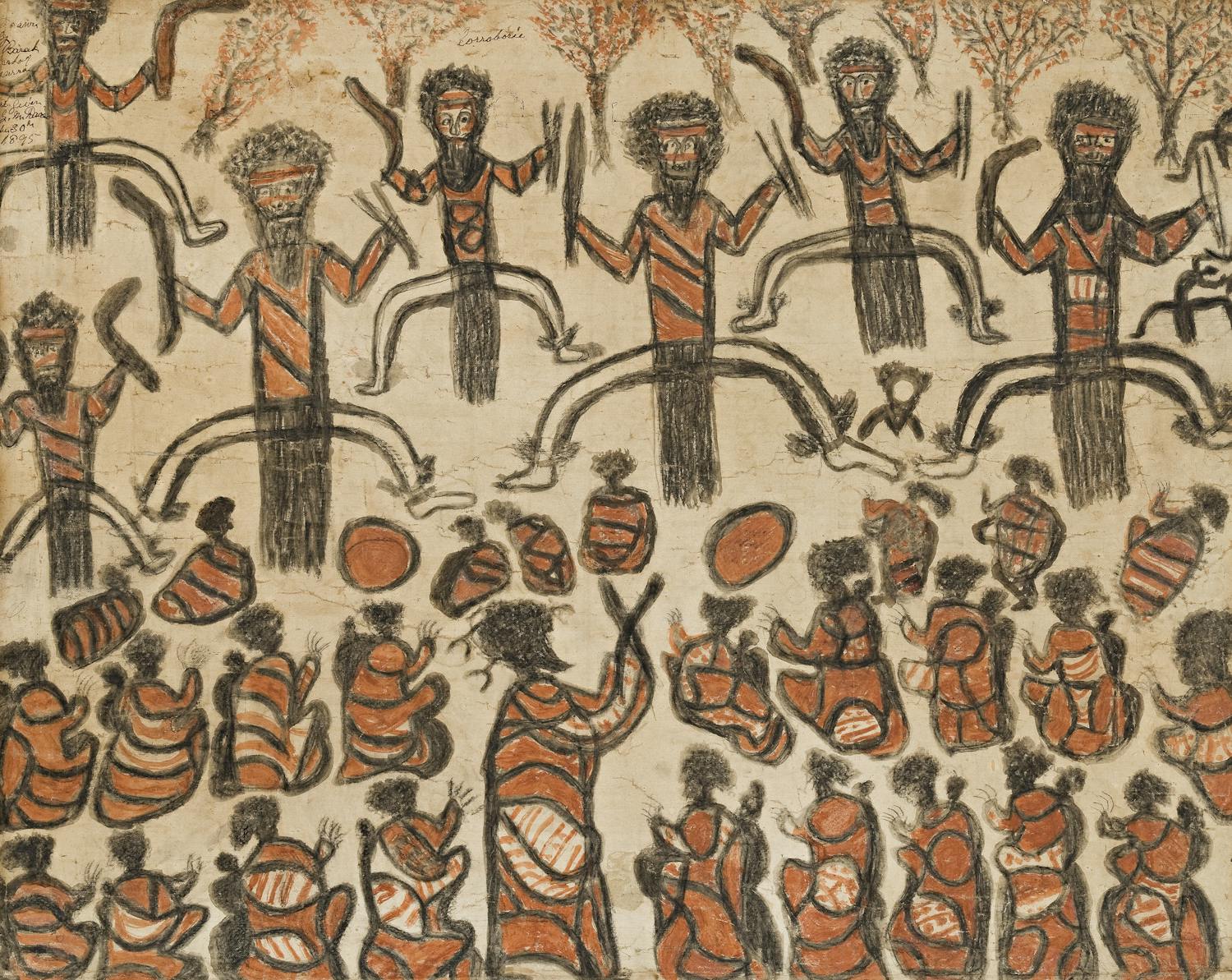
For most of the twentieth century, what Australian galleries called Aboriginal art meant ochre, dots and bark from remote desert and northern communities. Aboriginal people who lived in Brisbane, Sydney and Melbourne were not supposed to make that kind of work, and when they did make their own, it was treated as inauthentic. Urban Aboriginal art is the long fight against that idea. It moved from the margin to the centre of Australian contemporary art over roughly forty years, and it changed what counts as Aboriginal art in the process.
The 1980s break with desert orthodoxy
Urban Aboriginal art first reached a wider audience in the 1970s, but it became a real movement in the 1980s. The Aboriginal people who made it lived in the parts of Australia most affected by European colonisation, the south-east, south-west, coastal South Australia and the north-east, and identified by local terms like Koori, Nyoongah, Nunga and Murri. Their work was stylistically mixed, often combining traditional motifs with European forms, and dealt with subjects the desert movement rarely touched: the Stolen Generations, land rights, deaths in custody, and the long argument with colonial accounts of Australian history. The shift was not a rejection of the 1970s revolution at Papunya; it was a parallel revolution by people whose stories did not fit the Western Desert template.
Koori Art 1984 and the start of the urban scene
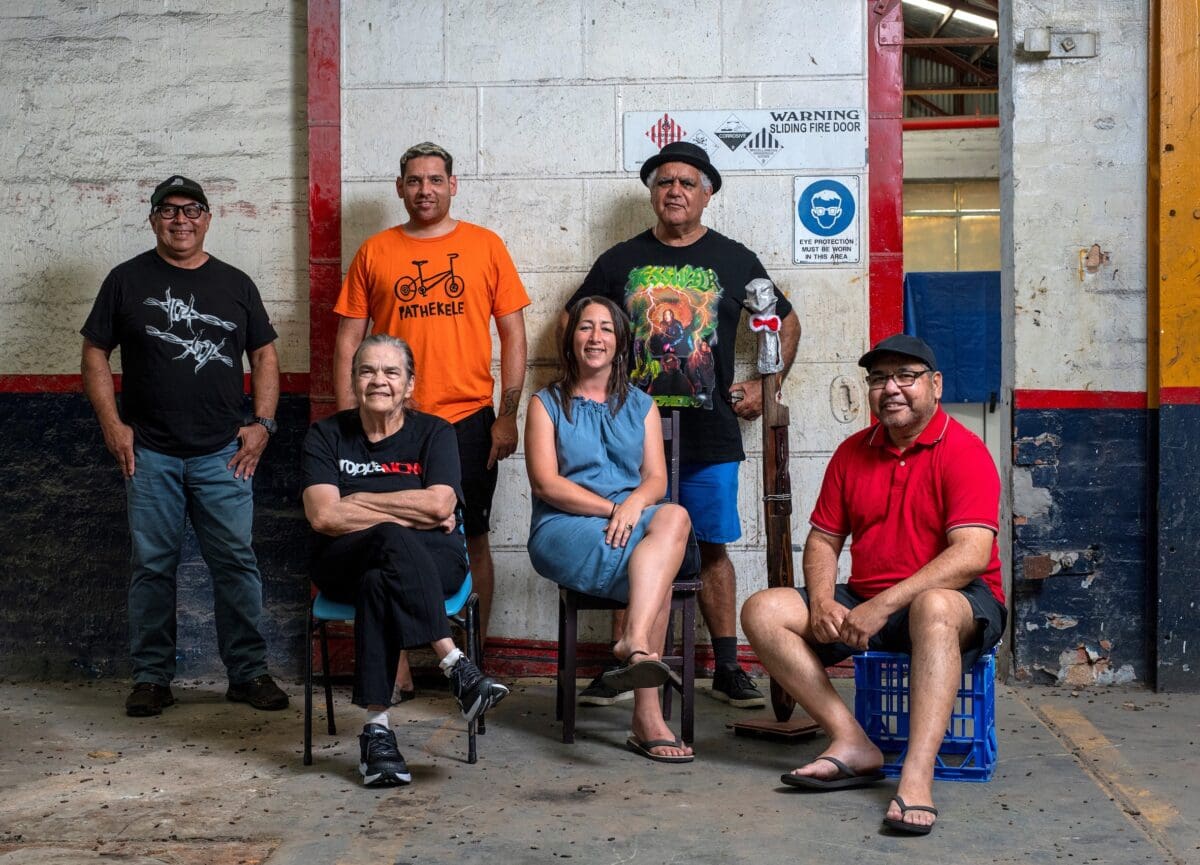
The watershed moment for the urban scene was the Koori Art 1984 exhibition at the Contemporary Art Space in Sydney. It brought together twenty-five artists, including Avril Quaill, Fiona Foley, Gordon Syron, Michael Riley, Lin Onus, Trevor Nickolls and Arone Raymond Meeks, who had been working in isolation across the country. Most of the work was social realist in tone rather than aesthetically experimental, and it was met with mixed reviews. Critics dismissed it as not really Aboriginal art and not really mainstream art either. Almost no key art journal covered it. What it did, though, was put a generation of city-based Aboriginal artists in the same room for the first time, and they realised they were not alone.
Boomalli and the artists co-operative
Three years after Koori Art, ten of the artists associated with that show founded the Boomalli Aboriginal Artists Co-operative in Sydney. The ten founders were Bronwyn Bancroft, Euphemia Bostock, Brenda L Croft, Fiona Foley, Fernanda Martins, Arone Raymond Meeks, Tracey Moffatt, Avril Quaill, Michael Riley and Jeffrey Samuels. Boomalli provided studio space, exhibition opportunities and, just as importantly, advocacy with public institutions. Its founding is the point where the urban movement gained the kind of self-organisation the Western Desert movement had built into Papunya Tula Artists Pty Ltd more than a decade earlier. Boomalli also normalised something the institutions had been avoiding: that work made by city-based Aboriginal artists about contemporary politics belonged inside the Aboriginal art conversation, not outside it.
Gordon Bennett, Tracey Moffatt and the city as subject
The names that broke through into mainstream Australian contemporary art in the late 1980s and 1990s were artists who treated the city, photography, postmodern theory and Australian colonial history as their material. Brisbane-born Tracey Moffatt, working in photography and video, became one of Australia’s most internationally recognised artists. Her 1989 image Something More #1 places the artist in a torn red cheongsam dress in an outback colonial setting, a deliberate confrontation with race and gender in Australian history. Gordon Bennett, also Brisbane-based, used the postmodern toolkit of appropriation, irony and pastiche to comment on race relations; his Australian Icon (Notes on Perception No. 6) from the same year inverts the romantic First Fleet ship image into a pixel-dot composition seen from the Aboriginal side of the beach. Both artists preferred to be placed inside Australian contemporary art rather than corralled into an Aboriginal art ghetto.
proppaNOW and the question of authentic Aboriginal art
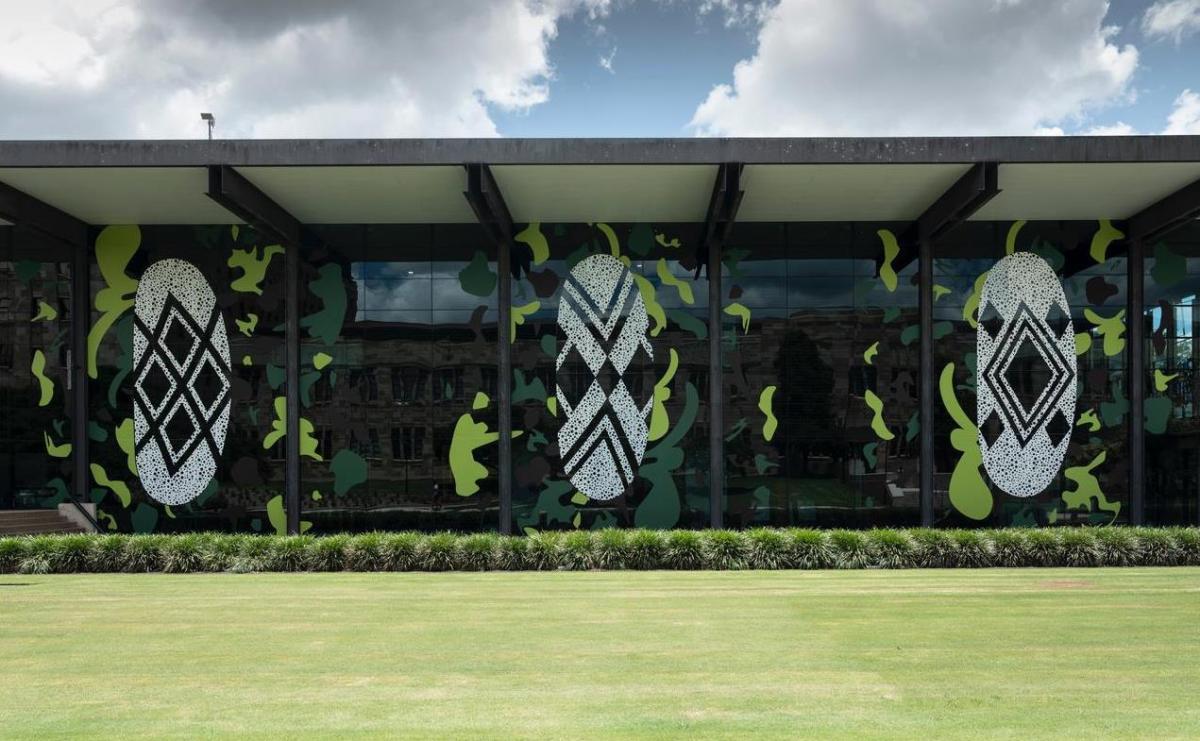
By the early 2000s, urban Aboriginal artists in Brisbane had built up enough critical mass to organise. proppaNOW launched in 2004 with the explicit aim of serving as a voice for urban Aboriginal artists. Founding members included Vernon Ah Kee, Richard Bell and Jennifer Herd; the collective later expanded to include Gordon Hookey, Tony Albert, Megan Cope and Laurie Nilsen. Their position was confrontational. The idea of authentic Aboriginal art, they argued, had been defined by white curators, galleries and dealers, and it conveniently excluded the eighty per cent of Aboriginal people who lived in cities. As Herd put it, they were not the sort of group who did dot paintings and crosshatching, and they did not have the right to those stories. Their story was an urban story, and they wanted the right to call it proppa Aboriginal art on their own terms.
Richard Bell’s challenge to the gatekeepers
The clearest single statement from this generation came from Richard Bell. His 2003 Telstra Painting Award winner Scientia e Metaphysica (Bell’s Theorem) is plastered with the line Aboriginal art it’s a White Thing over a background that quotes both colour-field painting and Jackson Pollock. The same year he published an essay with the same title, an unsubtle attack on the way non-Indigenous gatekeepers controlled the market and presentation of Aboriginal culture. Bell’s point sits inside the wider conversation about appropriation, but it goes one step further: the structure of the Aboriginal art market itself, he argues, is the problem. As that essay spells out, the country’s institutions had departments of Australian art under which Aboriginal art was an afterthought, even though Aboriginal art was many times bigger by sales value.
The legacy on Australian gallery walls today
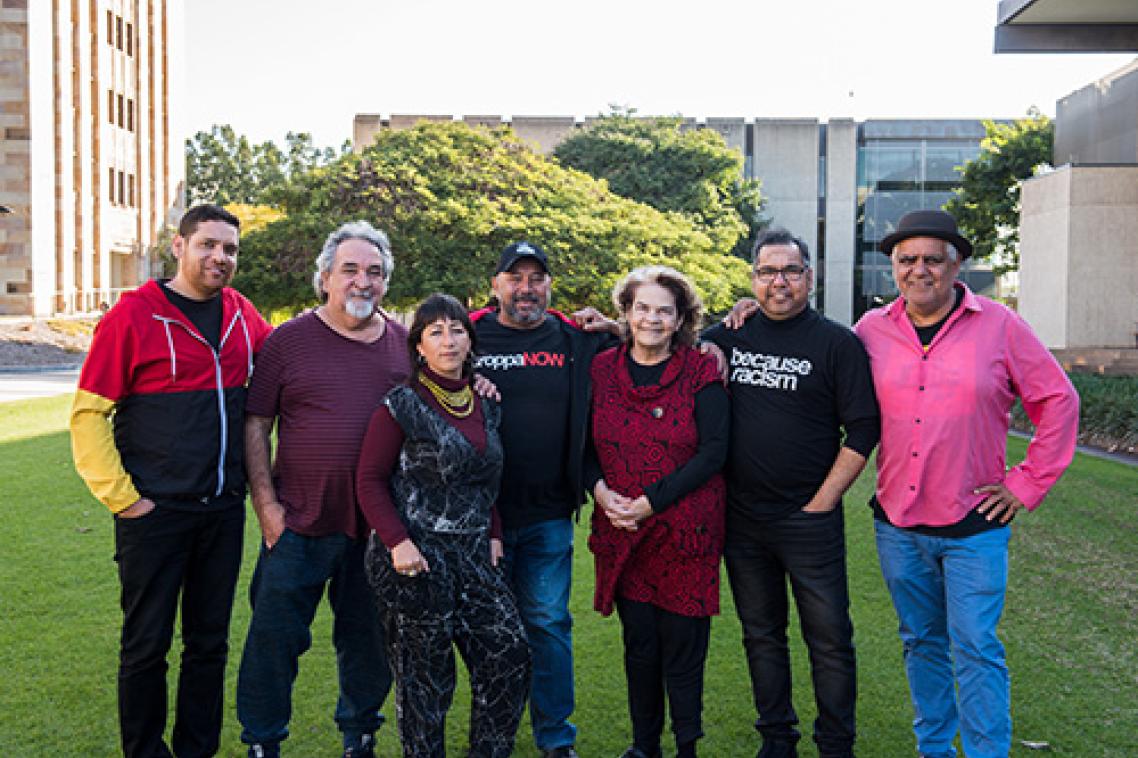
Forty years after Koori Art 1984, the urban movement has changed what hangs on Australian gallery walls. Living urban artists like Bell, Vernon Ah Kee and Tony Albert are well represented in major state collections that once treated them as outsiders. Megan Cope and Tony Albert came up through proppaNOW and now work internationally. Indigenous curators have moved into senior positions at state galleries; the 2020 Archibald Prize went to Vincent Namatjira. The original demand for autonomous Aboriginal art departments inside major institutions has not been fully met, but the centre of gravity has shifted. The wider history of Aboriginal art in this country can no longer be told as a desert-only story, and that is the practical legacy of the urban movement.
Things Worth Knowing
What counts as urban Aboriginal art?
It refers to work made by Aboriginal artists who live in Australian cities or regional towns rather than remote communities, and who often deal with subjects the desert movement rarely paints: colonial history, identity, racism, the Stolen Generations and contemporary politics. Stylistically it is mixed, ranging from figurative painting and printmaking to photography, video and installation.
Who started the proppaNOW collective?
proppaNOW was launched in Brisbane in 2004 with founding members Vernon Ah Kee, Richard Bell and Jennifer Herd. Other key members have included Gordon Hookey, Tony Albert, Megan Cope and the late Laurie Nilsen. The collective set out to push back against the idea that only desert and Arnhem Land art counted as authentic Aboriginal art.
Why was Boomalli important for the urban movement?
Boomalli Aboriginal Artists Co-operative, founded in Sydney in 1987 by ten urban Aboriginal artists, was the first dedicated platform for city-based Aboriginal artists in the country. It gave them studios, exhibition space and advocacy with public institutions, and is the moment the urban scene gained the kind of self-organisation that the Western Desert movement had at Papunya Tula. Many of its founders, including Tracey Moffatt and Fiona Foley, went on to define Australian contemporary art.