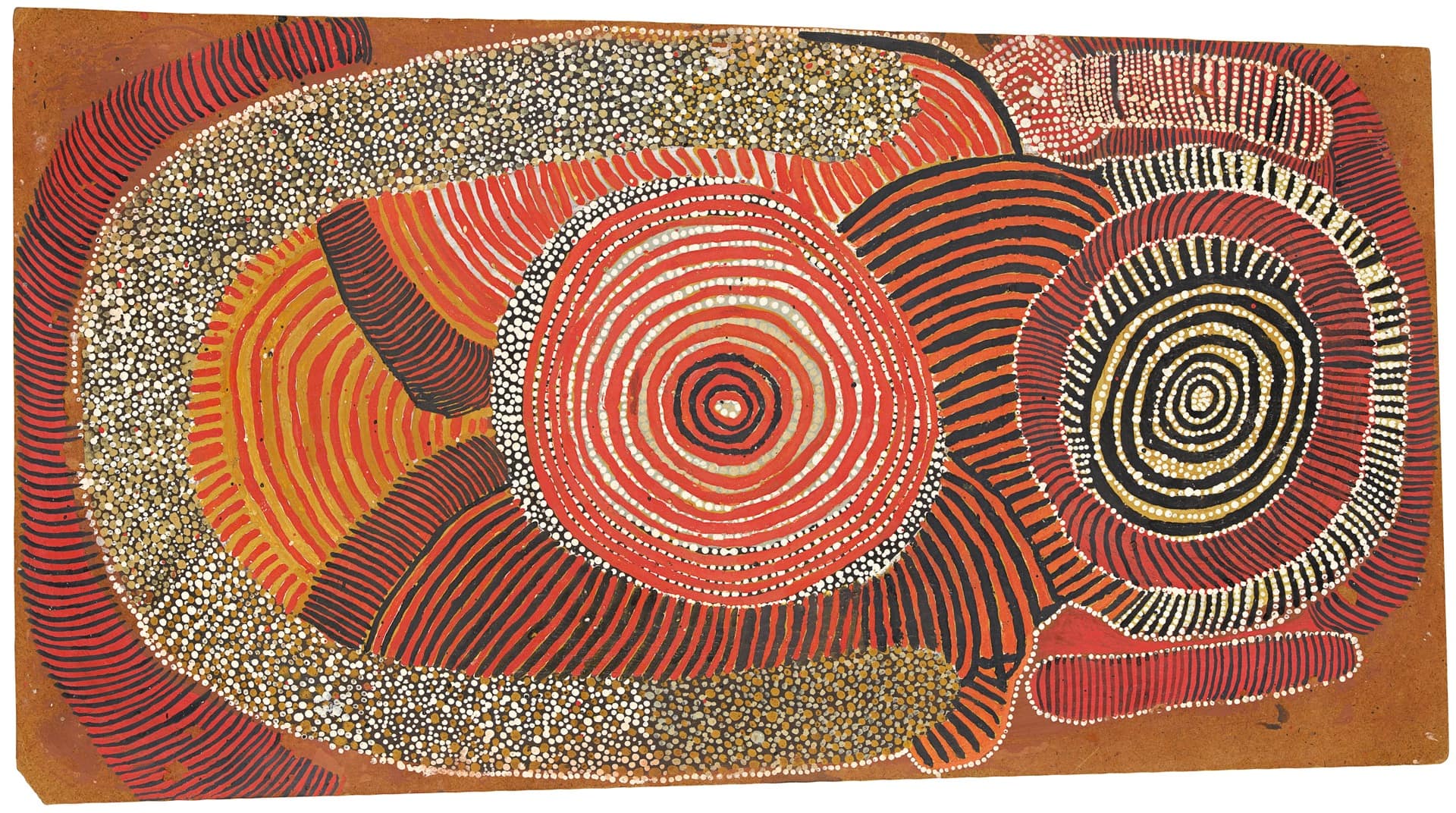
Aboriginal art is tens of thousands of years old, but the version most people meet today, dots, ochre stripes and aerial-view canvases, is really the child of one decade. The 1970s did not invent Aboriginal art. What they did was turn ceremonial designs that had lived on rock, skin, sand and bark for millennia into something the rest of Australia, and then the world, finally treated as art. This piece walks through what actually happened in that decade and why it still shapes what hangs in galleries now.
The decade that started the modern movement
Before 1971, the records of Aboriginal painting that non-Indigenous collectors actually owned were dominated by Albert Namatjira’s watercolours from the Hermannsburg school and the bark paintings that anthropologists had been carrying out of Arnhem Land since the 1890s. These works lived in museums, not in art galleries. The Aboriginal art movement, as a market, an industry and a national conversation, simply did not exist yet. Namatjira’s success from his late-1930s exhibitions onward had at least proved one thing: there was a world outside the desert that would buy paintings. The artists who picked up brushes in 1971 had watched him. They knew the audience existed. The wider history of Aboriginal art on this continent is a 65,000-year story; this decade is one of its loudest hinges.
A young teacher, an elder, and a school wall
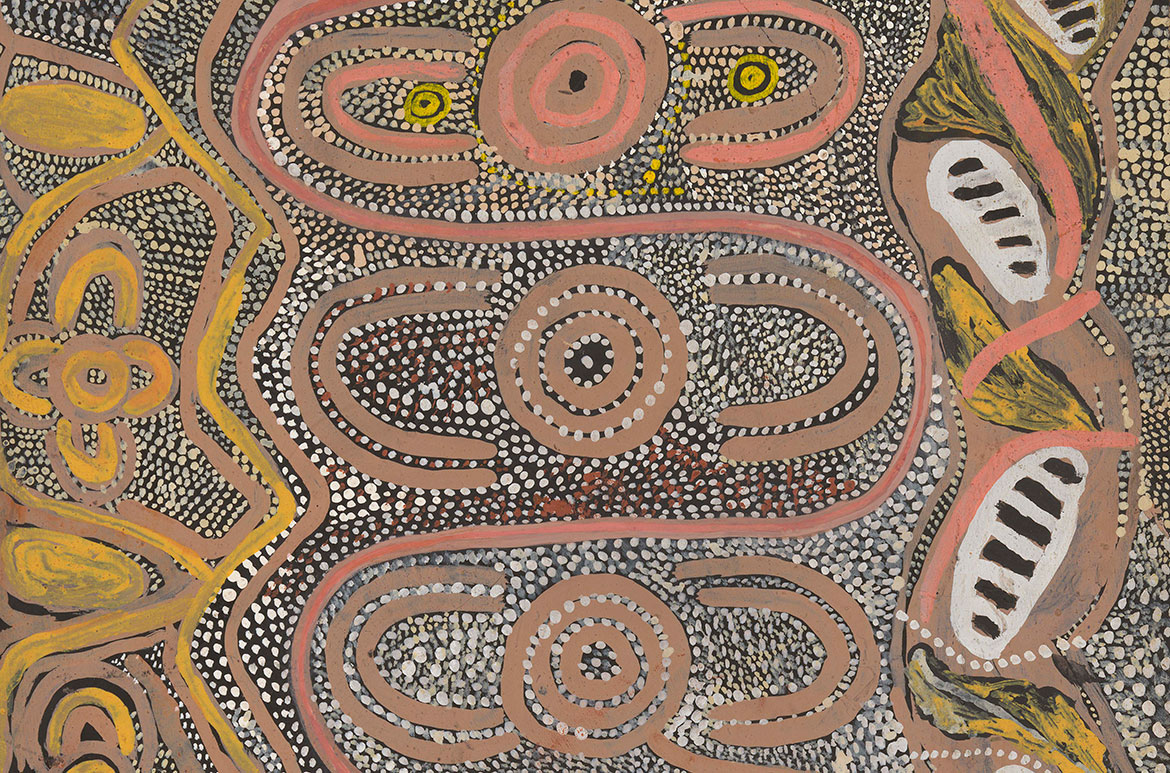
The pivot happened in a tiny remote settlement. In 1971 a young schoolteacher named Geoffrey Bardon arrived at Papunya, a government community about 250 kilometres west of Alice Springs that had been built to assimilate displaced desert families. He encouraged the local children to draw the stories from their culture. Tribal elders noticed and intervened, taking over the project themselves. The result was the famous Honey Ant Dreaming mural on a school wall, then a flood of smaller works on board. By the time Bardon left in August 1972, only eighteen months later, the senior men had created more than a thousand paintings and incorporated themselves as Papunya Tula Artists Pty Ltd. The full story behind that incorporation belongs in the Papunya Tula movement piece; the headline is that an art company in the desert now existed.
From sand designs to acrylic on board
What made Papunya a turning point and not just another mission school is what the elders did with the materials Bardon handed them. They used acrylic paints and Masonite boards to record designs that until then had only been drawn in sand for ceremony or worn on the body for dance. The act of putting a sacred design on a permanent surface that strangers could carry away was, in cultural terms, a serious choice; the artists worked out how to mask the most restricted information using layers of dots so the painting could exist publicly without giving away what was not meant to be shared. The full story of how the medium changed from rock to canvas runs through the rock-to-canvas shift, but the 1970s is where it landed.
Land rights and the wind behind the paintings
The paintings did not appear in a political vacuum. The 1967 referendum had only just recognised Aboriginal people as citizens. By 1973 the Whitlam government had set up the Aboriginal Arts Board, an all-Indigenous body that for the first time put public money behind the artists themselves. Out of that came community-owned and community-operated art centres, the same structure that still feeds thousands of remote artists today. The homelands movement, in which displaced people walked back from settlements to their traditional Country to start small communities like Kintore, ran in parallel and was helped along by the income artists were starting to earn. Painting did not just record stories of Country; it also paid for the trucks that took families back to Country.
The slow climb from settlement to gallery
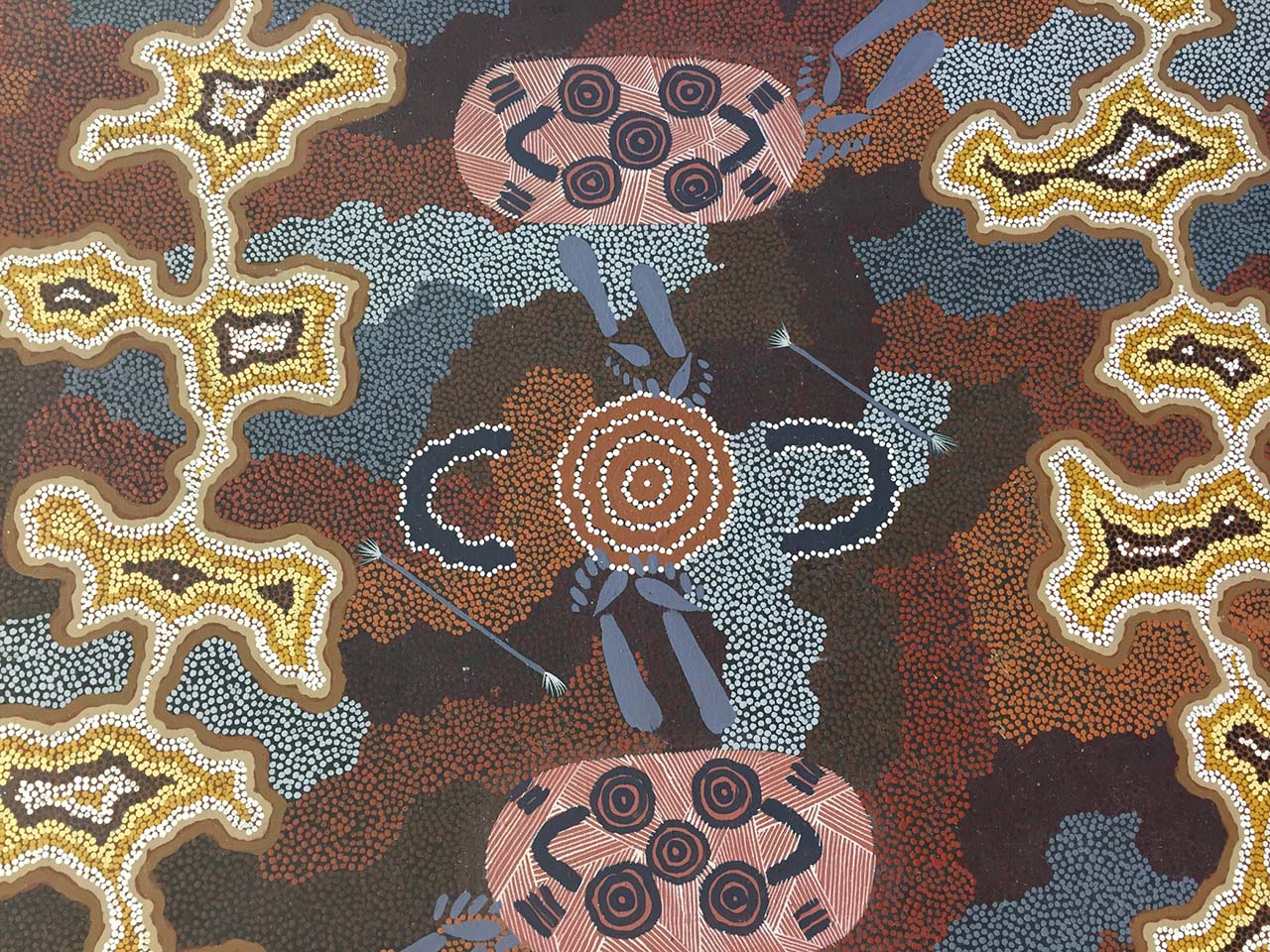
Recognition from the white art world did not arrive on schedule. The first five or six years after 1971 were lean. Materials were scarce, the income was thin, and many of the paintings that are now treated as masterpieces were sold for almost nothing and stored in garden sheds. Inside Aboriginal communities the new work was not universally welcomed either, and some elders elsewhere thought painting sensitive material onto boards was inappropriate, which is part of why obscuring techniques became standard practice. The first real crossover moment came in 1981, when Clifford Possum Tjapaltjarri and Tim Leura Tjapaltjarri were included in the Australian Perspecta exhibition at the Art Gallery of New South Wales. By the mid-1980s, painters from Yuendumu had run their own private exhibition in Sydney and set up their own artists’ organisation. The movement was finally widening from one settlement into a country-wide phenomenon.
From the school wall to state galleries and parliament
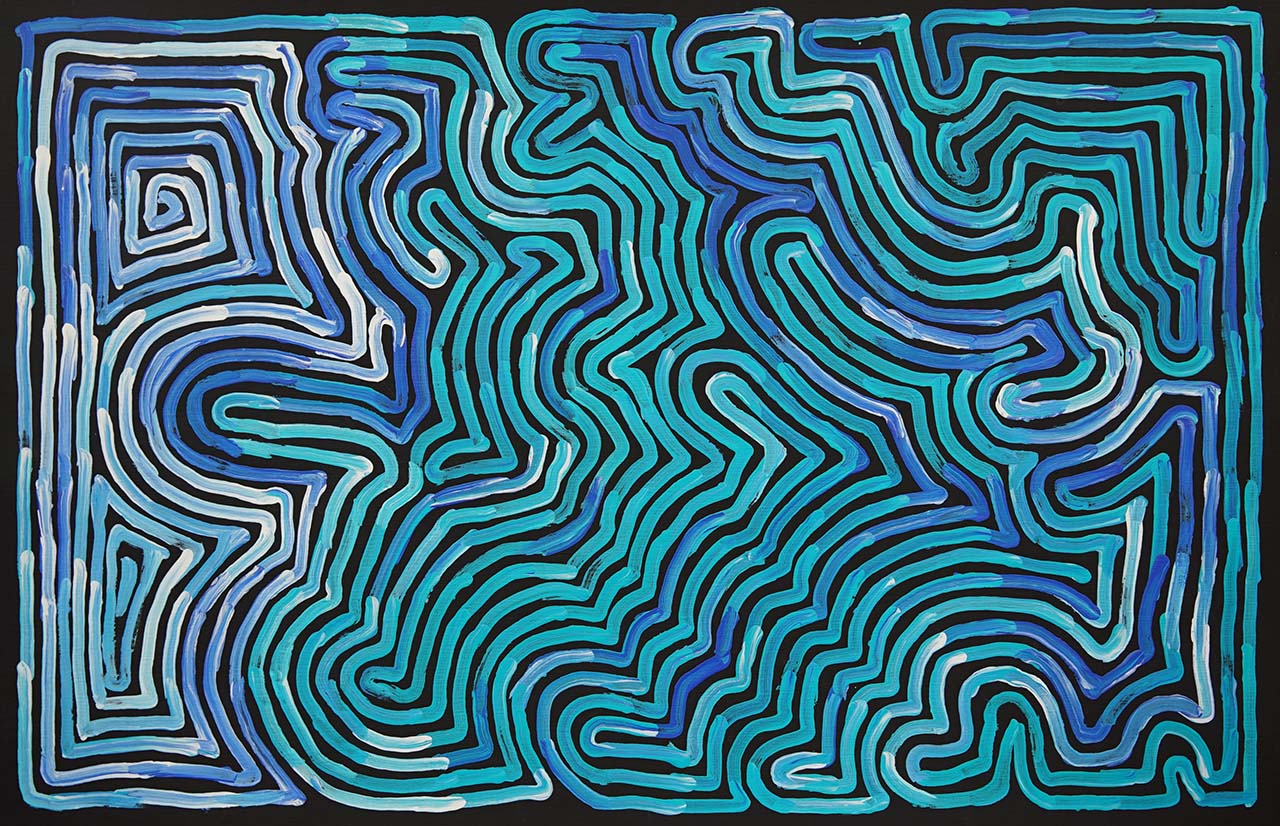
In 1973 a small group of senior men at Papunya could not yet sell a board for grocery money. Fifteen years later, in 1988, the Australian Federal Government accepted Michael Nelson Jagamarra’s mosaic design for the forecourt of the new Parliament House in Canberra, the country’s literal civic centre. Rover Thomas, working in the Kimberley with ochre on canvas, represented Australia at the 1990 Venice Biennale alongside Adelaide-based Trevor Nickolls. Specialist galleries had sprouted across the capitals. Across the same period, urban Aboriginal artists were forcing their own conversation: in 1987 ten Sydney-based artists, including Tracey Moffatt, Fiona Foley, Brenda L Croft and Bronwyn Bancroft, founded the Boomalli Aboriginal Artists Co-operative, making politically charged work about racism and dispossession. That parallel rise of urban Aboriginal artists is a story of its own.
The legacy of a decade
Look at any contemporary list of major Aboriginal artists, the record auction prices, the gallery wings, the national exhibitions, and almost all of it traces back to choices made in a small desert school between 1971 and 1973. The dot painting technique that the world now recognises as Aboriginal art in shorthand was developed in early Papunya. The art-centre model that supports remote artists today started with the Whitlam-era Aboriginal Arts Board. The cooperative governance that protects sacred information was forged through arguments inside those first communities. The paintings that came out of the Western Desert in those years are not just historically important. They are the reason there is an Aboriginal art market at all.
Short Answers to Big Questions
How did art change in the 1970s for Aboriginal artists?
For Aboriginal artists the 1970s was the decade when ceremonial designs that had lived on rock, sand and skin moved onto acrylic paint, boards and canvas, and entered an art market for the first time. Outside that context the 1970s also reshaped Western art broadly, with feminism, performance and conceptual practice all rising, but for Aboriginal painting the shift was its own story.
What was the Aboriginal dot painting in the 1970s?
In early developments at Papunya in the 1970s the dot painting technique started to be used by artists. Dots were used to in-fill designs, and just as importantly to obscure certain associations and sacred information that lay underneath the dotting, so the work could be shown publicly without giving away the restricted layer of meaning.
Why did the 1970s Papunya movement matter so much?
It was the first time desert artists transferred ancient ceremonial designs onto a permanent, portable surface, set up their own art company, and earned an income from the work. Everything that came afterwards, the Yuendumu doors, the Kimberley canvases, the Boomalli urban movement and the 2007 million-dollar auctions, grew out of that founding decision.