Looking at an Aboriginal painting without understanding what a Dreaming is means reading without an alphabet. The composition is not illustrative in the way Western narrative painting is. It does not depict a scene that happened at a fixed point in the past. It records a living body of law, geography, and spiritual knowledge that runs from the deep past through the present and into the future simultaneously. Understanding how that works is the first step toward reading any Aboriginal painting with Dreamtime content.
The Dreaming Is Not a Time, It Is a Presence
The English word “Dreamtime” has been in use since the 1890s, developed from an Aranda word by anthropologist Baldwin Spencer. In the Arrernte language, Tjukurrpa is sometimes translated as “to see and understand the law.” In Warlpiri, the equivalent is Jukurrpa. These are not precise equivalents of “time” — they describe something closer to a living framework that connects people, land, and the behaviour of Ancestor Beings all at once.
None of the hundreds of Aboriginal languages contain a word for time as a linear concept. The Dreaming is not thought of as something that happened and ended. The Ancestor Spirits who moved across the land, creating rivers, mountains, waterholes, and animals as they went, did not disappear when the world was formed. They transformed into those features of the landscape. A sacred waterhole is not just a location; it is the ongoing presence of an Ancestor. Because of this, the Dreaming is never-ending. It links the past, the present, and the people to the land in a continuous, unbroken connection that shapes daily life, family obligations, and the right to paint certain stories.
Who Has the Right to Tell a Story
Not every artist paints every story. Rights to particular Dreamtime narratives are inherited within family groups, and using another group’s story without the right to do so is a serious cultural breach. Stories belong to the group, not to individuals. Elders choose which storytellers will carry specific narratives forward, and it is their responsibility to ensure those stories are passed accurately to the next generation. Artists often need explicit permission from those who hold ownership of a mythology before they can paint its stories.
The same story told through a painting can mean something different depending on who is receiving it. A painting made for a child communicates the accessible outer layer of the narrative. The same painting, read by initiated elders, carries a deeper level of meaning embedded in the symbols and their placement. This is not ambiguity — it is how a system without written language manages to hold complex, layered knowledge and transmit it appropriately to different audiences. The story is structured so that it reveals more to those who have the cultural preparation to receive it.
The Visual System: How Symbols Carry the Story
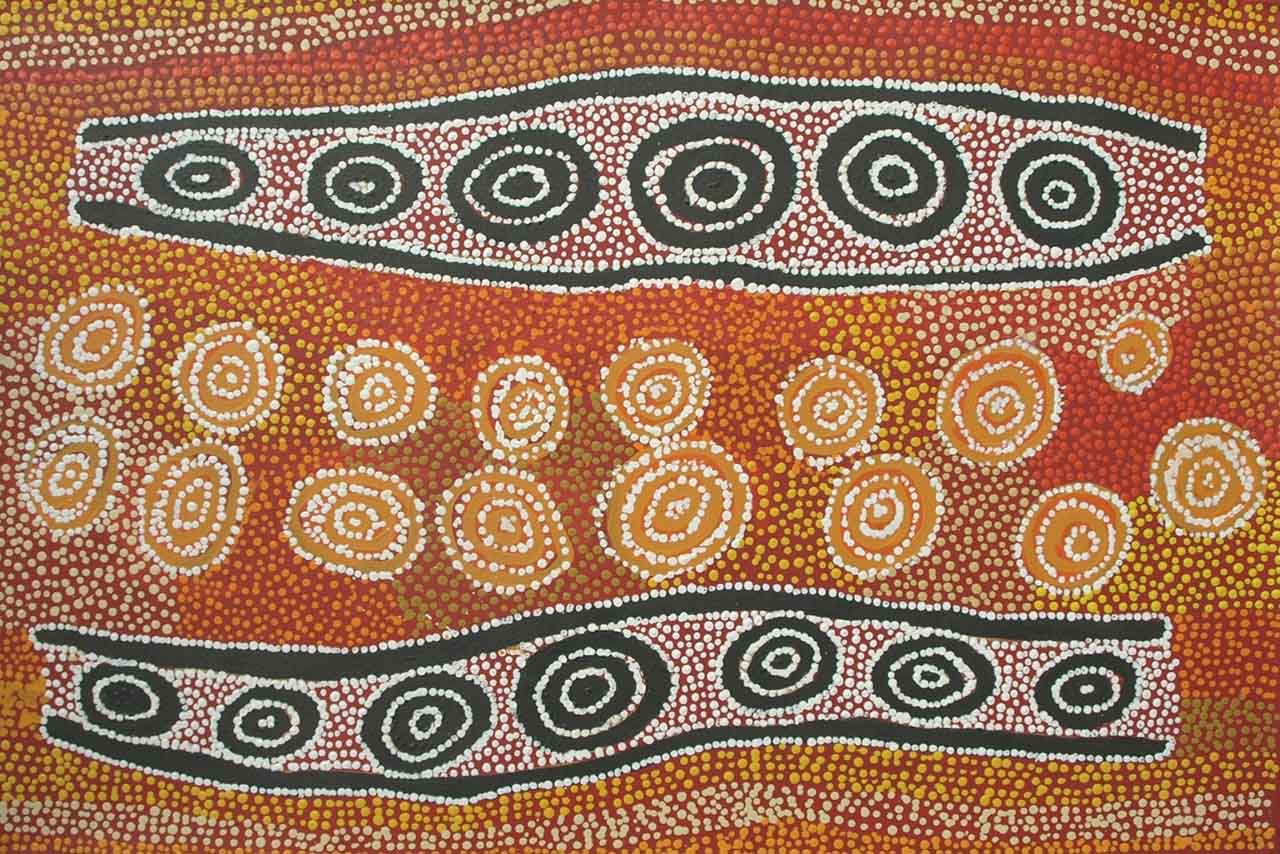
The symbols used in contemporary Aboriginal paintings are the same ones found in rock art and cave paintings dating back tens of thousands of years. Concentric circles mark waterholes, campsites, meeting places, and ancestral pathways. Lines represent travel routes, rivers, and the paths taken by Ancestor Beings. Dots can indicate topography, stars, or add depth and texture to the composition. U-shapes represent seated people, and the objects placed beside them — digging sticks, coolamons, spears — identify them by gender and role. Animal tracks replace direct depictions of animals in many Western Desert compositions, identifying the creature through what it leaves behind rather than what it looks like.
Some of these symbols carry consistent meaning across all language groups. Concentric circles, U-shapes, and digging sticks tend to communicate the same general meaning regardless of which community a painting comes from. Others are specific to a particular group’s visual tradition. Understanding which symbols have shared meaning and which are community-specific is part of reading the Aboriginal art symbols system correctly. The same visual element can carry different information depending on what surrounds it and which tradition it comes from.
Dreaming Tracks: Maps of an Ancestral World
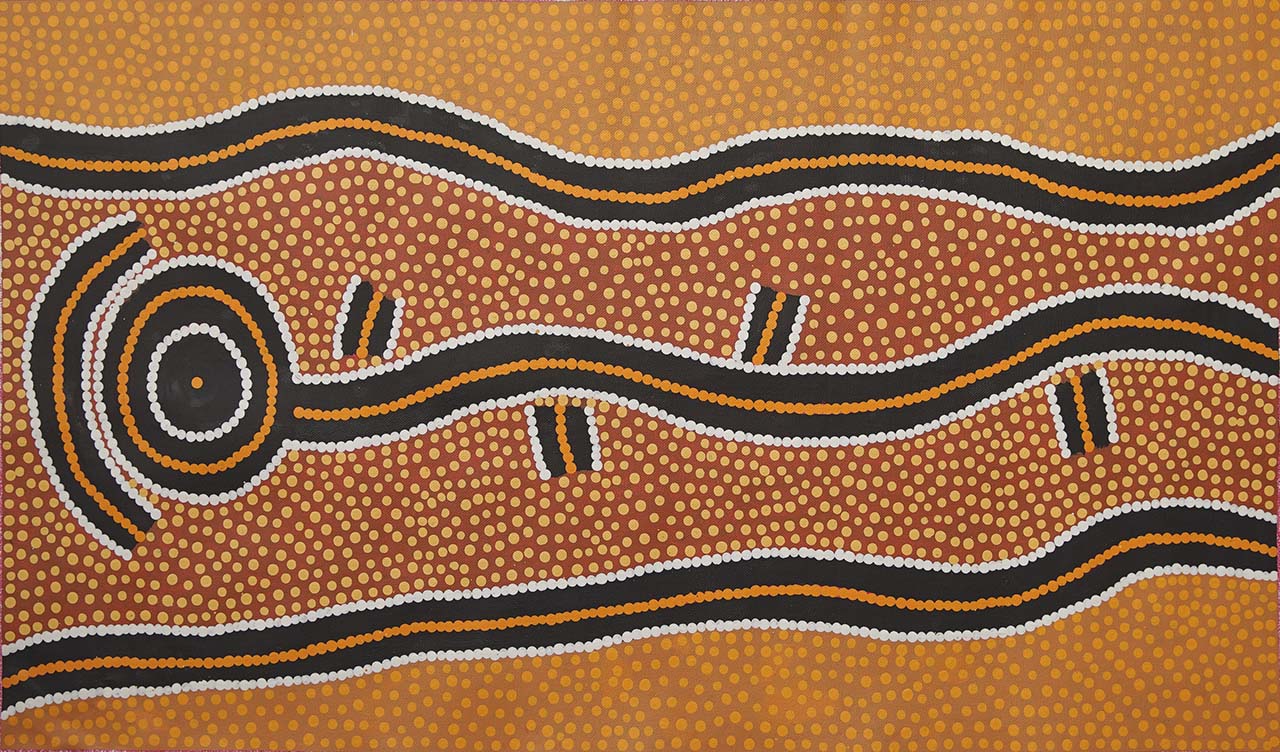
One of the most important concepts for understanding how Aboriginal art encodes Dreamtime is the Dreaming track. As Ancestor Beings moved across the land during the creation period, they formed its features: the rivers, hills, sand dunes, and waterholes that exist today. The path of an Ancestor’s journey links a series of sacred sites, and that path is a Dreaming track.
Aboriginal paintings frequently map these tracks. A composition of concentric circles joined by lines is not abstract decoration; it is a map of a journey, showing the sites where an Ancestor stopped and the routes taken between them. The circles mark the sacred places where the Ancestor’s presence is still embedded in the landscape. The lines trace the paths between them. This is why what circles mean in Aboriginal dot painting and what the connecting lines represent are inseparable questions. The story only makes sense when both elements are read together within the same composition.
The Figures That Appear Across Australian Art
Certain Dreaming figures appear across many communities and language groups because their stories and their Dreaming tracks cross vast stretches of Country. The Rainbow Serpent is one of the most widely recognised: associated with water, rain, and the creation of rivers and waterholes, it appears in paintings from remote desert communities to Arnhem Land and the Kimberley. The Wandjina figures are particular to the Kimberley region, depicted as large faces with halo-like headdresses, associated with the weather and the rains. The Mimi Spirits of Arnhem Land are elongated ancestral figures recorded in bark paintings and rock art, understood as teachers who passed knowledge of hunting, fire, and law to the first people. The Seven Sisters, the Pleiades star cluster, travel across the sky in stories shared by communities across the continent.
These figures are not mythological characters in the Western sense, separate from the physical world. Their journeys are recorded in the landscape itself, and they remain present in the sacred places they formed. A painting depicting any of these figures is also pointing to specific places in Country and the obligations that connect people to those places. For how individual animals in Aboriginal Dreamtime art carry the same layered structure, the same principle applies: the figure in the painting and the place in the landscape are the same thing.
Frequently Asked Questions
What is the difference between Dreamtime and Dreaming?
Dreamtime was an English word coined in the 1890s to describe Aboriginal creation mythology. Dreaming is now preferred by many because it better captures the ongoing, cyclical nature of the concept. Rather than a fixed period in the past, it describes a continuous spiritual framework connecting past, present, and future. Both words are widely used, but Dreaming more accurately reflects how Aboriginal people understand what the concept describes.
Can non-Aboriginal people learn to read Dreamtime stories in paintings?
The outer layer of Dreamtime storytelling — the symbols, the major figures, the basic visual vocabulary — can be learned and understood by anyone. The deeper levels of meaning encoded in specific paintings are reserved for initiated community members with the cultural authority to receive them. Acknowledging the existence of what lies beyond the accessible layer is part of engaging with the work honestly.
Do all Aboriginal artists paint Dreamtime stories?
Not all contemporary Aboriginal art explicitly depicts Dreamtime narratives. Some artists work with landscape, autobiography, or contemporary social themes using traditional techniques. But the cultural framework of the Dreaming underpins Aboriginal identity broadly, so even work that does not directly depict an ancestral story typically operates within the obligations and connections that the Dreaming describes.
How old are the symbols used in Dreamtime paintings?
The same symbols found in contemporary Aboriginal paintings — concentric circles, lines, tracks, U-shapes — appear in rock art that is tens of thousands of years old. The continuity of this visual language across such an enormous span of time reflects how central the obligation to pass these stories forward has been to Aboriginal culture. The Aboriginal art techniques used to make these works have evolved, but the symbols themselves have not.
The Story Does Not End
Dreamtime stories told through Aboriginal art are not records of events that are over. The Ancestor Beings who shaped the land are still present in the places they created. The obligations that connect people to those places are still active. When an artist paints a Dreaming story, they are not illustrating something that happened — they are participating in an ongoing act of cultural maintenance, passing the story forward in exactly the way it was passed to them.
What makes this remarkable as a storytelling system is its continuity. The same symbols in use today were in use before European contact, before bark painting, before canvas. The visual language has survived because it is not separate from the culture it carries — it is the culture, expressed in a form that can be shared, taught, and read by those who have the knowledge to receive it.