In Aboriginal Dreamtime art, no animal is simply a picture of a creature. Whether painted in fine ochre linework on bark or rendered through dot patterns on canvas, each animal connects to a web of ancestral stories, totemic relationships, and knowledge about Country. Understanding what any particular animal means in a painting depends on knowing which tradition the work comes from and what story is being told.
Animals as Dreaming Beings and Totems
In the Dreaming, the foundational system of Aboriginal belief, animals were among the first beings to shape the land. They travelled across Country, created waterways and landforms, and in many cases became the ancestors of human clans. This is why the same animal can carry both a practical identity as a food source and a sacred identity as an ancestral figure. The two meanings are not in conflict; they are layers of the same creature.
Totems formalise this relationship. Almost every Aboriginal community assigns animals to individuals, families, and clans at birth. These totems are inherited and carry obligations. A person with the emu as their totem will not eat emu. In Warlpiri culture, being born with the skin name Nangala or Jangala means your birthright is Emu Dreaming, and artists from this group return to this narrative throughout their lives. The connection is not symbolic in any loose sense. It governs what a person eats, who they can marry, and how they relate to the land and the broader community.
The Rainbow Serpent, the Kangaroo, and Other Dreaming Figures
The Rainbow Serpent appears in Dreaming stories across virtually all regions of Australia, making it one of the most widely recognised figures in Aboriginal art. It is associated with water, rain, and the creation of rivers and waterholes. Its presence in a painting typically signals the forces of creation and renewal, though in some traditions it can also represent destruction. Wherever rivers and permanent water exist in the landscape, the Rainbow Serpent is likely connected to those places in story.
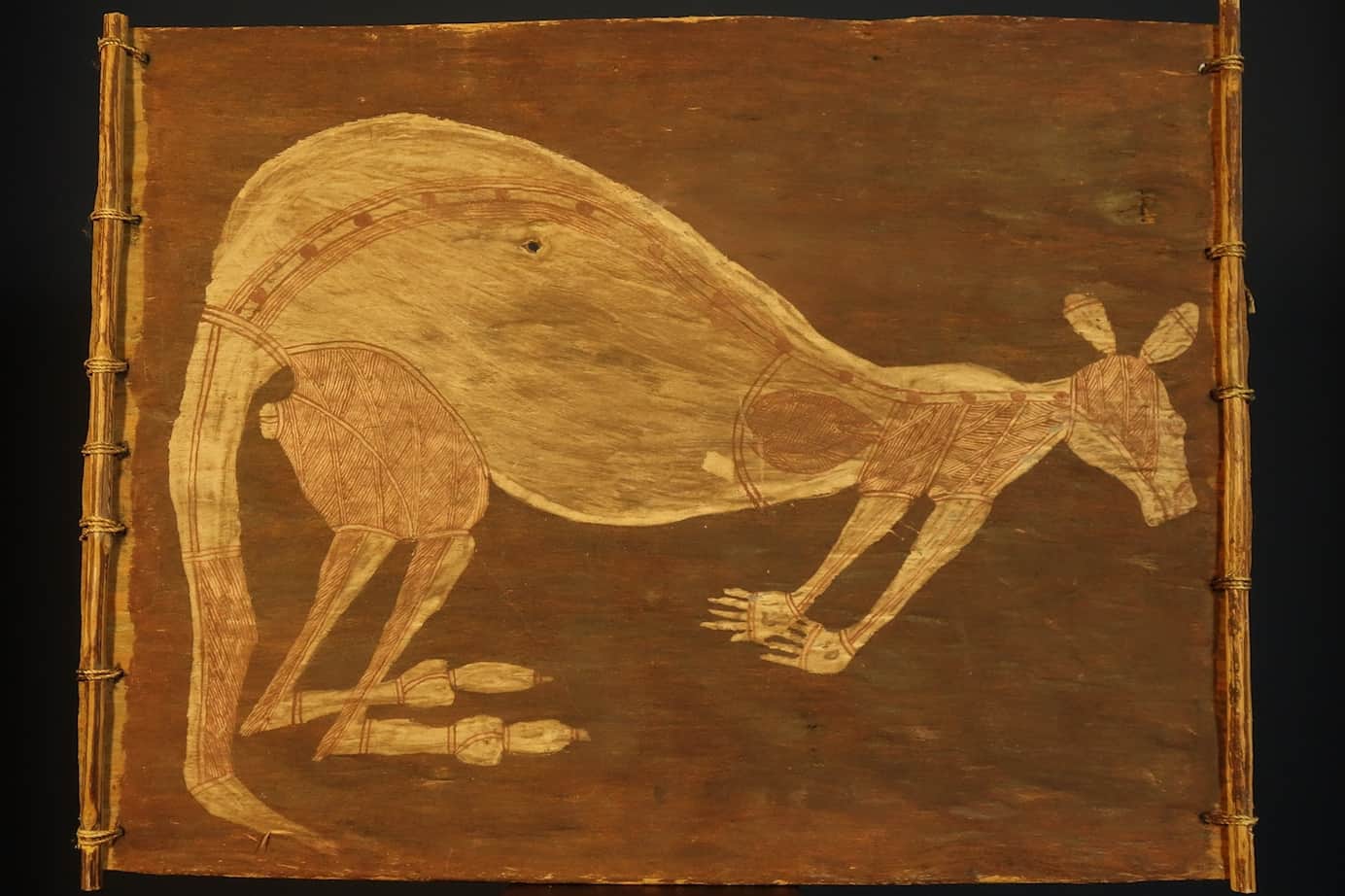
The kangaroo carries different weight in different traditions. In some Dreaming stories, kangaroos were the first beings created before humans, and in certain narratives they were imbued with human spirit to become the first people. This connection to the origins of human life means a kangaroo in a painting may represent far more than an animal or a food source. The emu carries its own significance, particularly in the context of male initiation ceremonies, where its behaviour of protecting and nurturing young is drawn upon to frame the transition from boyhood to adulthood.
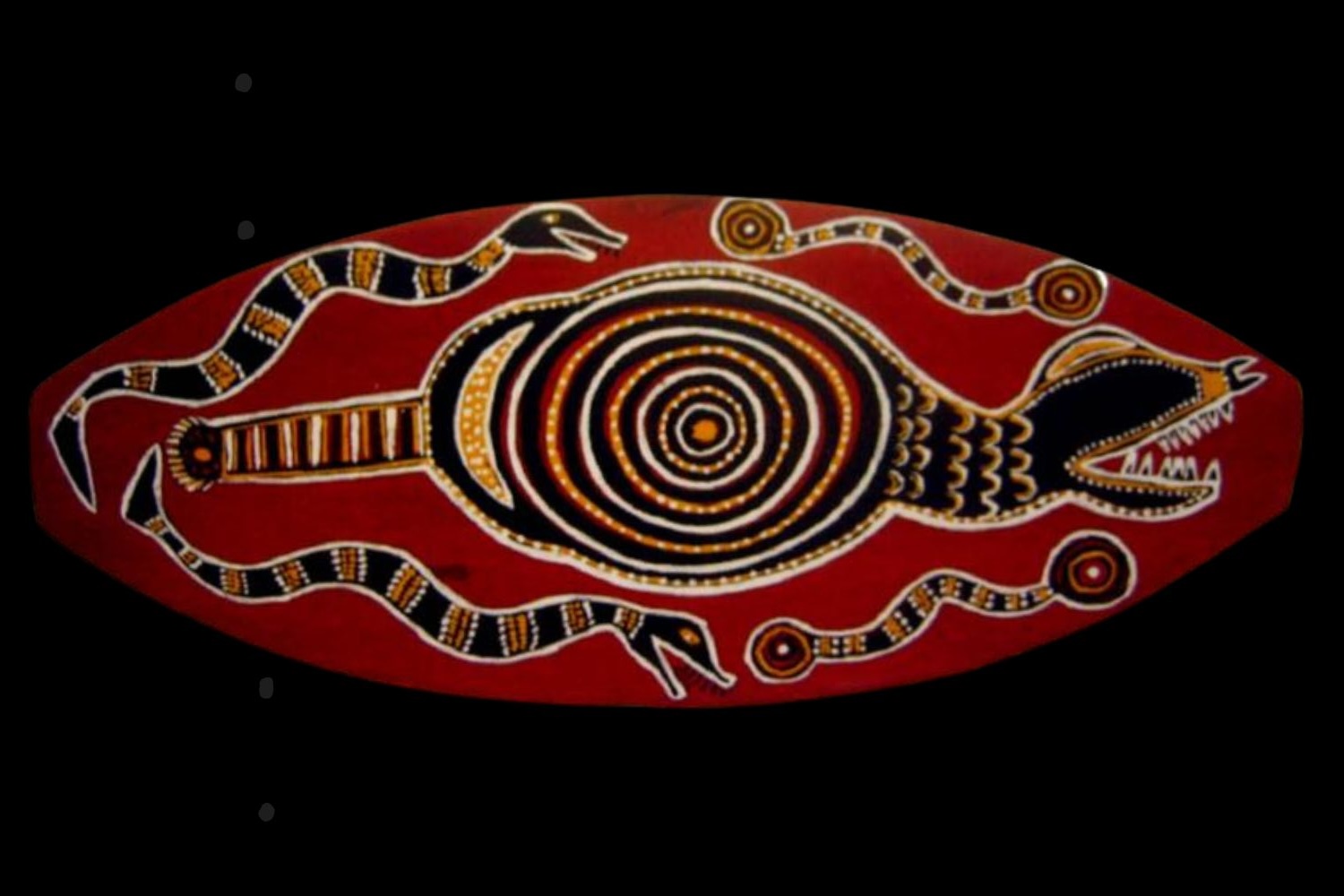
The crocodile operates differently again. In Arnhem Land, the crocodile is not simply an animal but Baru, the ancestral fire-bringer whose journeys through Country are recorded in bark paintings. A crocodile painted on bark in this tradition is also a map of Baru’s path. In the art of northern Australia more broadly, large crocodiles carry particular spiritual weight because they are believed to embody the spirits of ancestors.
How Animals Are Depicted Across Regions
The visual language used to show animals shifts significantly across different parts of Australia. In the bark painting traditions of western Arnhem Land, animals are frequently rendered in x-ray style, showing the internal organs, bones, and musculature within the outline of the body. This is not an artistic flourish but a way of encoding deeper knowledge about the animal’s nature, its connection to the Dreaming, and what it means to the clan. For more on how rarrk cross-hatching art functions in these works, the technique and its spiritual significance are inseparable from the animals it depicts.
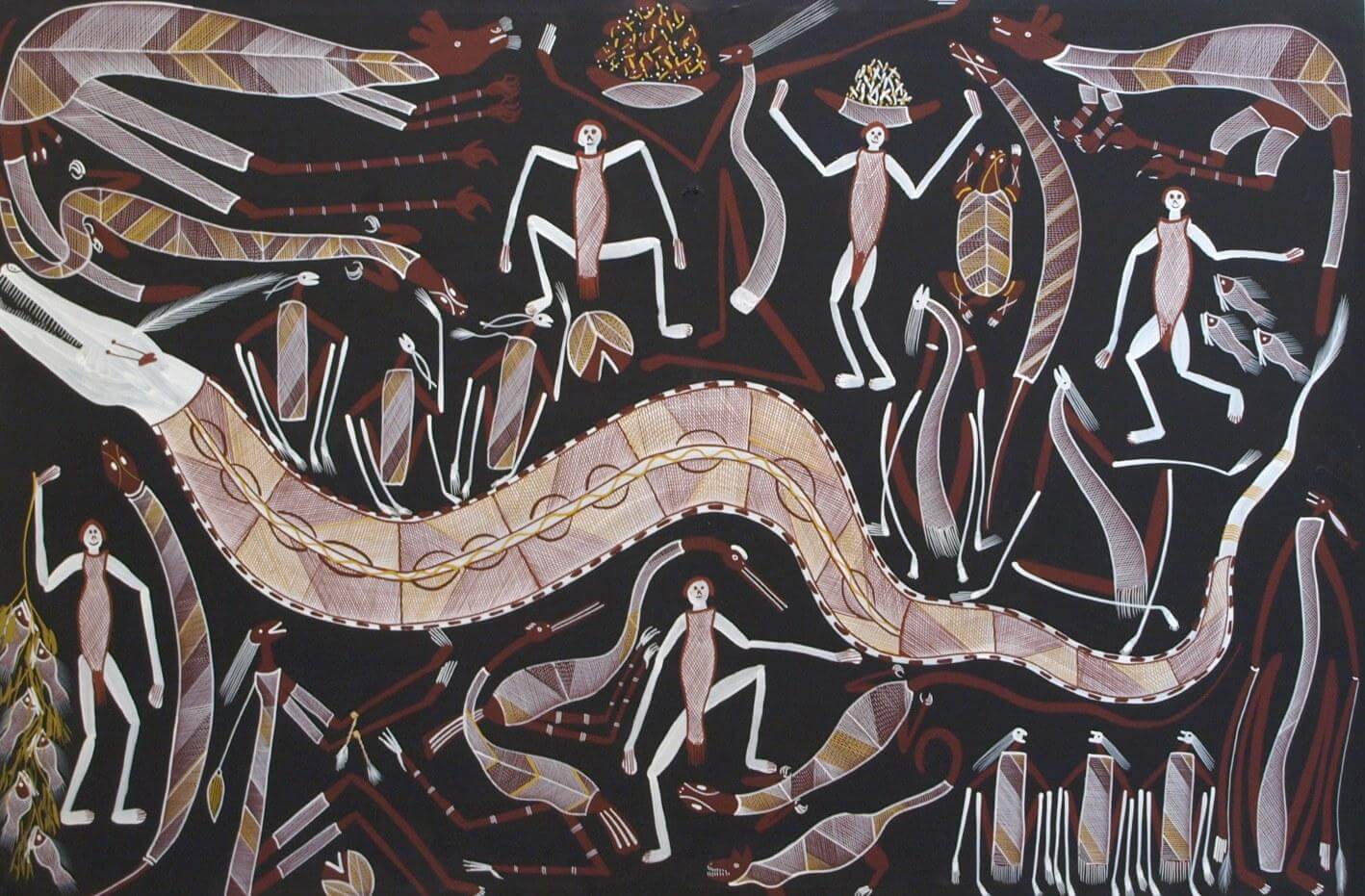
On Groote Eylandt, animals in bark paintings are connected to the totemic identity of the artist. These are spiritual relatives rather than subjects, and the obligations of that relationship typically include a prohibition on eating the animal. At Yirrkala, animals appear more economically, as elements within a larger ancestral composition rather than as primary subjects. The animal’s meaning comes from its role within the narrative structure and the clan designs that surround it.
In Central Australia, the visual approach is different again. Animals are often not depicted directly in Western Desert dot painting. Instead, their presence is indicated through track symbols: footprints, movement lines, and signs of activity that identify the creature through its impact on the landscape rather than its physical form. The animal is present in the painting through what it leaves behind. Understanding this range of approaches is part of what the regional differences in Aboriginal art styles reveal about how meaning is constructed differently across Australia.
What the Patterns Inside Animals Encode
In many Aboriginal works, the patterns applied within the outline of an animal carry information that is separate from what the animal itself represents. In Arnhem Land bark paintings, the internal crosshatching can encode clan identity, sacred site associations, and restricted ceremonial knowledge. To someone outside the tradition, these appear as fine geometric decoration. To someone with the appropriate cultural knowledge, they are a precise record of connection to land and story.
This layering is intentional. Aboriginal art has always operated at multiple levels of meaning simultaneously, with the outer layer accessible to all and the deeper layers reserved for those with the right to receive them. Artists have long used abstract patterns and animal forms as a way of carrying protected knowledge in a visible medium. The Aboriginal art symbols system across all regions reflects this relationship between what is shown and what is held back.
Frequently Asked Questions
What animals appear most often in Aboriginal Dreamtime art?
Kangaroos, crocodiles, snakes, turtles, fish, birds, and lizards are among the most commonly depicted animals. These appear frequently because they are either important food sources, subjects of major Dreaming stories, or totemic figures for specific clans across different regions of Australia.
Do the same animals mean the same thing across all Aboriginal art?
No. The meaning of an animal depends on the regional tradition, the specific story being told, and the cultural context of the artist. A crocodile in Arnhem Land bark painting carries a completely different set of meanings from a kangaroo in a Central Australian dot painting. There is no universal symbol key that applies across all Aboriginal art.
What is the difference between a totem animal and a Dreaming animal?
A Dreaming animal is a figure from the ancestral stories that shaped the land and law. A totem is an inherited connection that ties an individual or clan to a particular animal. In many cases they overlap, with a person’s totem being the same animal as a major Dreaming figure. The two concepts describe different dimensions of the same relationship between people, animals, and Country.
Why are some Aboriginal animals shown through tracks rather than drawn directly?
In Western Desert dot painting, animals are often represented through the tracks they leave rather than through a direct image of the creature. This reflects a broader visual language in which movement, presence, and connection to Country are shown through what an animal does rather than what it looks like. It is part of the same system that uses circles for waterholes and lines for journeys rather than realistic landscape depictions.
Closing Thoughts
Animals in Aboriginal Dreamtime art are not decorative subjects. Each one brings a set of relationships: to an ancestral story, to a specific place in Country, to a clan or individual through totemic inheritance. A kangaroo might be the first being before humans, a food source, and a Dreaming figure all at once. A crocodile might be the fire-bringer whose journey is mapped in bark. The meaning is never fixed to a single layer.
The visual approach, whether x-ray style, symbolic inclusion in a clan composition, or track symbol, reflects the tradition the artist belongs to and the knowledge they hold. For a broader picture of how Aboriginal art techniques differ across regions and what those differences communicate, the animals in any painting are a good place to start reading the work from the inside out.