Bark painting is one of the most distinctive art forms to come out of Australia, made by painting on the interior surface of a strip of tree bark. It belongs to a broader tradition of Aboriginal art that stretches back thousands of years, though the form that collectors and institutions recognise today took its current shape through the encounter between Indigenous artists in the Top End and European observers in the early twentieth century.
While examples of painted bark shelters were documented as far back as the early 1800s across Tasmania, Victoria, and New South Wales, the practice as a continuing artistic tradition is now found primarily in Arnhem Land and other areas of Australia’s Top End, including parts of the Kimberley region in Western Australia.
A Living Tradition With Deep Roots
The earliest European record of bark painting dates to around 1800, when French artist Nicolas-Martin Petit, travelling with Nicolas Baudin, recorded a painted bark shelter over a grave in Tasmania. Other bark shelters found in Victoria and New South Wales during the nineteenth century showed designs drawn in charcoal and scratched or painted onto bark that had been blackened by smoke. The earliest surviving bark paintings date from this period, among them a bark etching of a kangaroo hunt now held by the British Museum, collected in northern Victoria by explorer John Hunter Kerr.
In Arnhem Land and the Kimberley, the paintings on bark shelters were closely related to designs found in rock shelters, used to tell stories to young people during the wet season when communities were confined for long stretches. Bark coffins and belts were painted in northeast Arnhem Land, and painted bark baskets appeared in death rituals on the Tiwi Islands.
The shift toward bark painting as a standalone art form began in 1912, when anthropologist Baldwin Spencer commissioned paintings at Gunbalanya, then known as Oenpelli. He selected works on the basis of artistic and aesthetic merit rather than purely as ethnographic specimens, and provided examples to the Museum of Victoria. From the late 1920s, missionaries at Milingimbi Island and later at Yirrkala encouraged artists to produce paintings for sale, partly to fund the missions and partly as a way of educating non-Indigenous Australians about Yolngu culture.
Through the 1930s to the 1950s, anthropologists and missionaries dominated the collecting of bark paintings, including figures such as Charles P. Mountford, Ronald and Catherine Berndt, and the Belgian collector Karel Kupka. Demand grew steadily through the 1960s, when most works were sold through mission shops.
How Bark Paintings Are Made
The material at the centre of bark painting is the stringybark tree, known botanically as Eucalyptus tetradonta. The bark must be free of knots and blemishes, and it is best cut during the wet season when the sap is rising. Artists make two horizontal cuts and a single vertical slice before carefully peeling the bark away with a sharpened tool. Only the inner, smooth bark is kept. It is placed in fire, flattened underfoot, and weighted with stones or logs to dry flat. Once dry, it becomes the canvas.
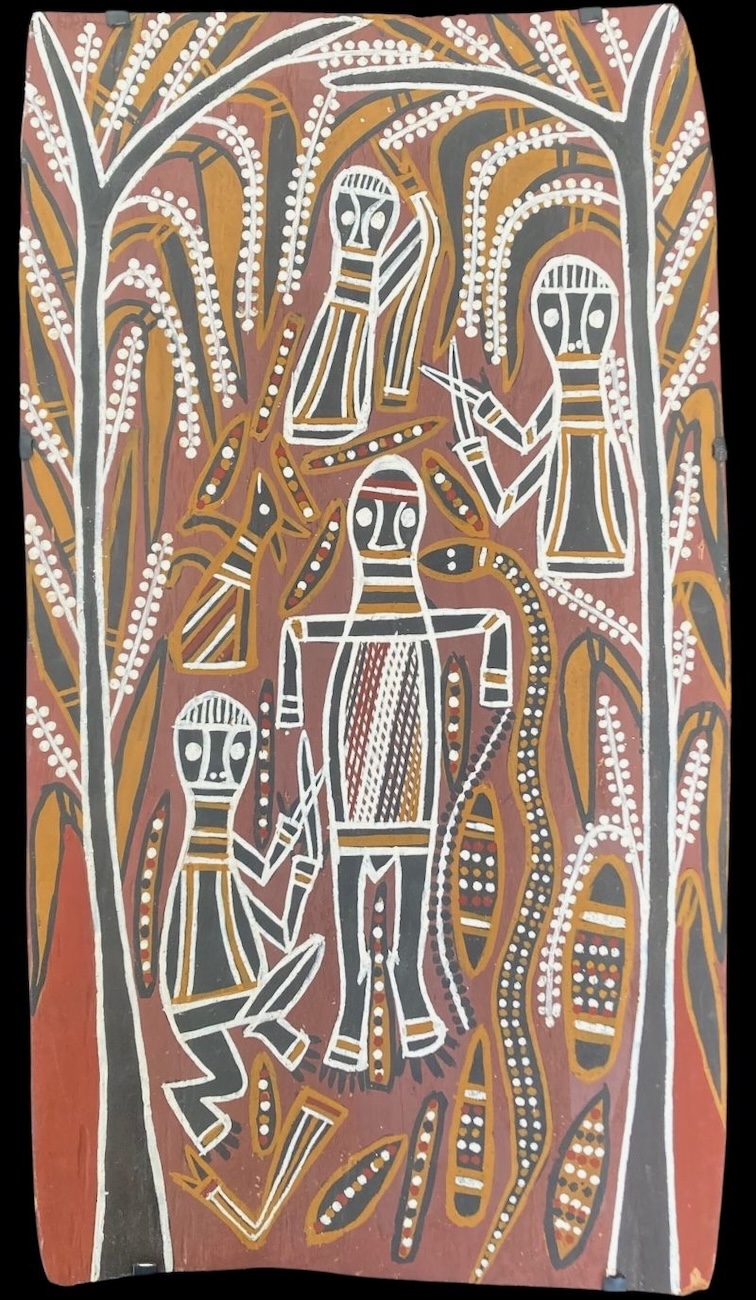
Pigments are the standard Arnhem Land ochres, bound with traditional plant resins or modern fixatives. The finished painting is splinted at both ends to keep it flat and sealed with a fixative over the surface so the pigment does not lift off the bark.
The major Arnhem Land art centres play a central role in how bark painting reaches the wider world today. Maningrida Arts and Culture in central Arnhem Land, Buku-Larrnggay Mulka at Yirrkala in the northeast, and Injalak Arts at Gunbalanya in the west all work as artist-owned community organisations that handle stretching, documentation, sale, and provenance. Buying through these centres is the most reliable way to know an artist was paid fairly and that a painting carries the cultural authority it claims.
What the Paintings Depict
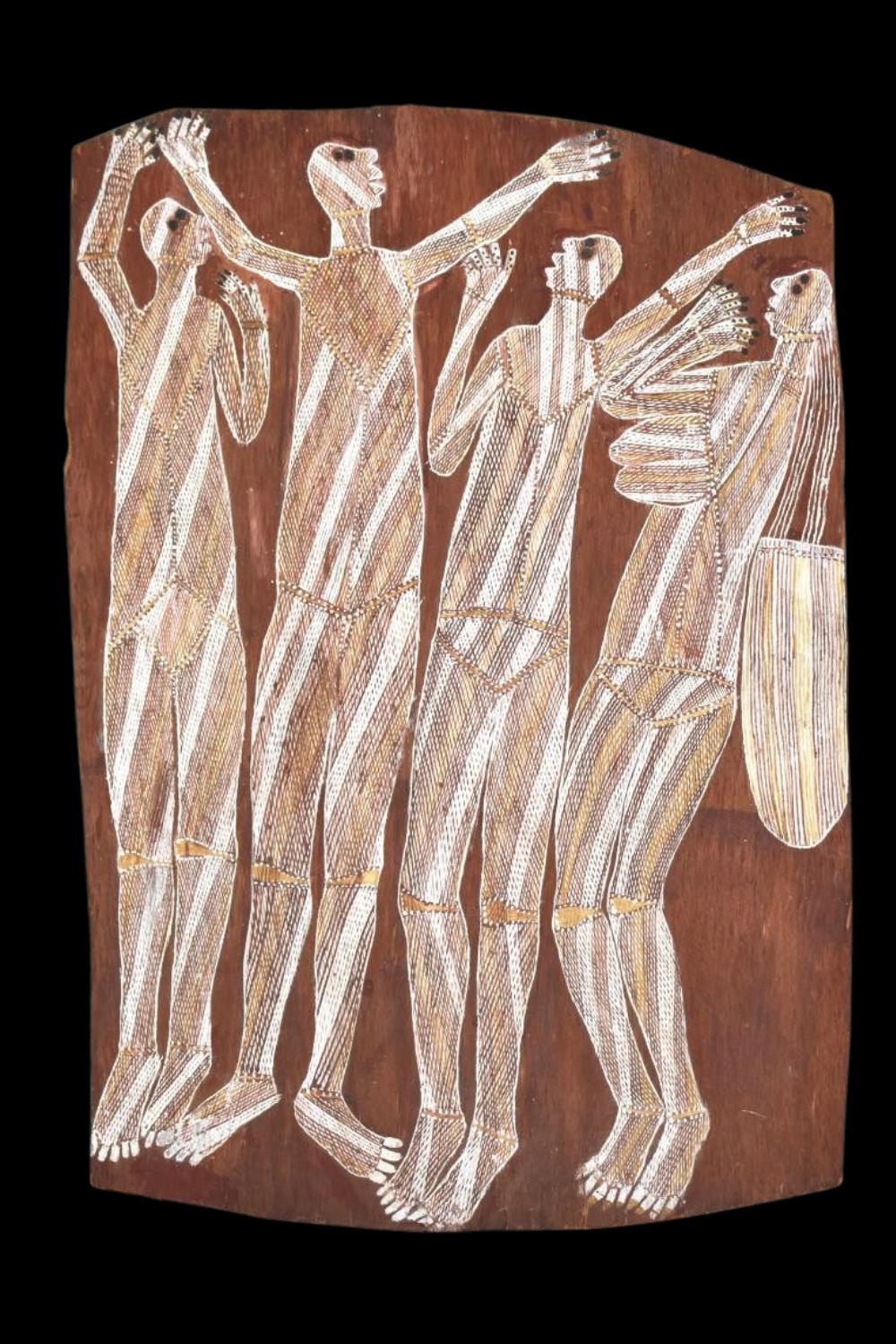
Bark paintings are built on sacred designs that carry layered meaning. A painting typically includes some combination of a ground layer of ochre, border lines, dividing sections, figurative imagery, geometric patterns, and clan designs. Many Arnhem Land barks carry the fine rarrk cross hatching that fills figure bodies and background fields, and the x-ray tradition of showing animals with internal anatomy. Both belong to bark painting's repertoire without being the bark tradition itself. The work of artists like John Mawurndjul has brought these techniques to international recognition as bark painting, even though the techniques themselves are older than the bark medium and appear in rock art and body painting as well.
Symbols, Stories and Sacred Knowledge
Geometric symbols within a painting are context-dependent. A circle may represent a water hole, a campsite, a campfire, a nut, or an egg depending on the story being told. Yolngu culture holds a holistic view of the world in which these different meanings are not considered contradictory. What appears to an outside viewer as an abstract arrangement of lines and shapes may be tracing the path of a creator spirit across Country, recording the same landscape as a map and as a Dreaming story simultaneously.
There are also strict rules around who is permitted to paint what. An uninitiated person may only paint the outer, public layer of a story. An initiated person has rights to deeper knowledge, which may be encoded in the painting without being verbally communicated. A work can be displayed publicly even when the story behind it cannot be told to those who have not been initiated.
The subjects drawn from the Dreaming, the ancestral beings who shaped the land, sit alongside more everyday imagery. Hunting scenes, fishing, dancing, and ceremonial gatherings all appear in bark painting. Animals, birds, and plants are rendered with close attention, reflecting the intimate relationship between the people and the land they know.
Regional Variations
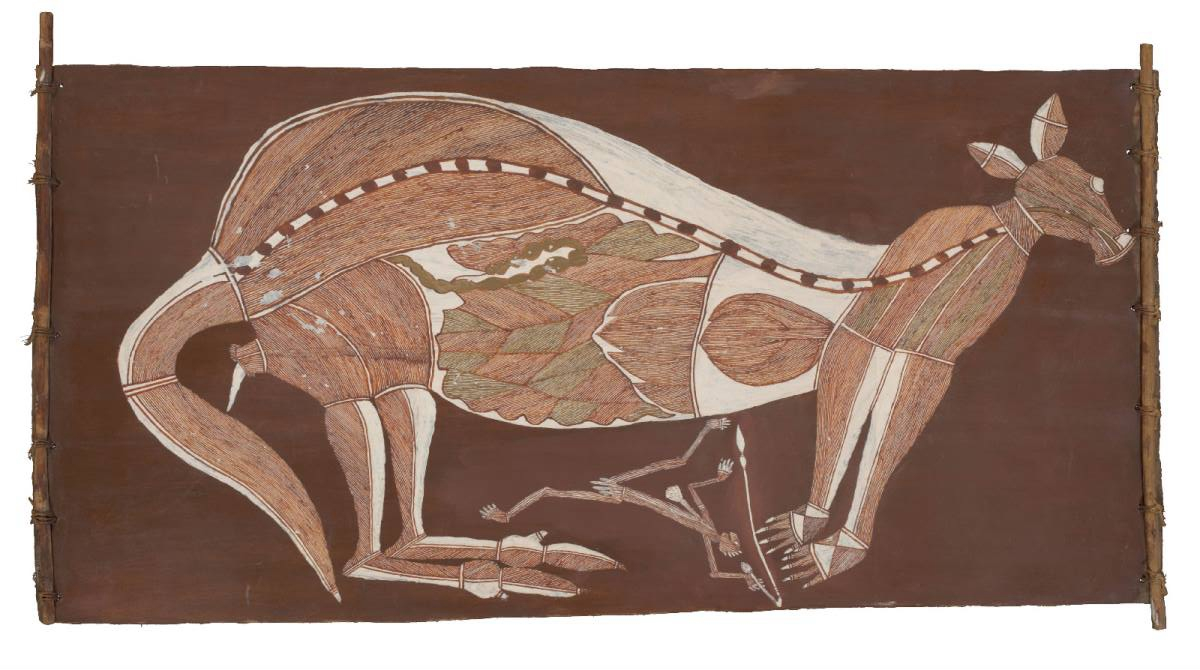
The bark painting tradition is not uniform. Artists from different parts of Arnhem Land and surrounding regions work in distinctly different visual languages, though they share common materials and a shared ancestral framework.
In western Arnhem Land, the connection to rock art is visible in the predominance of figurative imagery. The Wandjina creator-beings of the Kimberley, large faces with rayed headdresses associated with wet season thunderstorms, appear in bark painting as they do in rock art from that region. In eastern Arnhem Land, painters favour geometric compositional structures built around clan designs. Central Arnhem Land artists tend to combine both approaches.
Groote Eylandt work is immediately recognisable for its black background, against which figures are painted, and for its frequent depiction of the prau boats of Makassan trepangers who made contact with these communities long before European arrival. The Tiwi people of Bathurst and Melville Islands paint colourful cross-hatched and dotted non-figurative designs, which also appear on bark baskets, carved ironwood sculptures, and other objects used in mortuary ceremonies.
Bark Painting and Political History
The most significant political use of bark painting came in 1963, when the Yirrkala bark petitions were presented to the Australian Parliament. Comprising four documents set on bark and bordered with paintings of local fish and animals, the petitions protested the federal government’s decision to grant bauxite mining rights over Yolngu land without consultation. The petitions became the first documentary recognition of Indigenous Australians in Australian law, an assertion of sovereignty and custodianship expressed in the visual language the Yolngu people had long used to mark their relationship to Country.
From 1971, government support structures for Aboriginal art began to formalise. The Aboriginal Arts Board from 1973 provided funding to establish community arts centres. Communities at Maningrida, Ramingining, and Katherine developed as significant centres for producing and marketing bark paintings through the 1970s and beyond.
Bark Painting Today
Major institutions including the National Gallery of Australia and the Museum and Art Gallery of the Northern Territory hold substantial collections that document the development of this tradition across decades. Bark paintings are sought after by collectors worldwide, valued as much for the cultural stories they carry as for their visual quality. Contemporary Indigenous artists continue working in bark painting, with some bringing modern materials or themes into the form while others maintain strictly traditional approaches.
Every painting that comes out of Arnhem Land carries Country within it. The ochres, the clan designs, and the Dreaming stories embedded in each line connect the viewer to one of the world’s oldest living art traditions. Explore original bark paintings and other Aboriginal works in our collection.