“How old is Aboriginal art?” sounds like a single-number question. It is not. The honest answer depends on whether you mean the oldest reliably dated painting, the oldest engraving, the broader tradition of using ochre, or the wider 60,000 to 80,000 year arc of Aboriginal culture itself. Each one gives a different number, and the gap between what can be proven and what is reasonably inferred is one of the most interesting parts of the story.
This article walks through what science actually knows about the age of Aboriginal art, the methods researchers use to date it, and where the well-known “65,000-year” figure sits in relation to the rock surfaces themselves. For the wider chronology of how the tradition evolved into modern canvas painting, see our full history of Aboriginal art.
The Short Answer: How Old Aboriginal Art Really Is
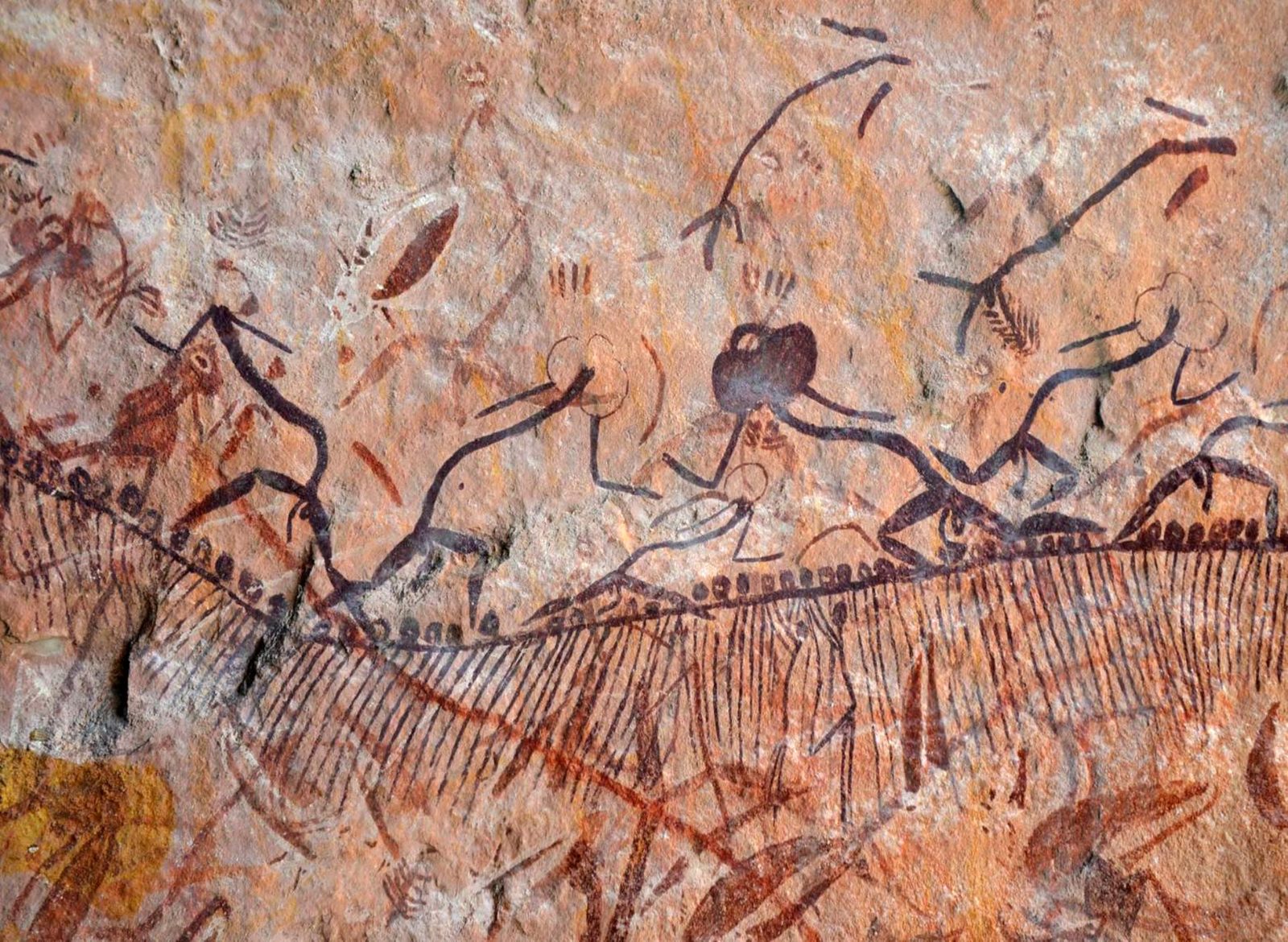
Aboriginal art is part of the oldest continuous living culture in world history, with Aboriginal people having settled the Australian continent somewhere between 60,000 and 80,000 years ago. The visual practice that produced rock art has been dated back at least 20,000 years, while archaeology has dated ancient occupation campsites to 50,000 to 65,000 years. The 60,000-plus year figure most often quoted refers to the arrival of Aboriginal people and the continuous culture that began then, not to a specific surviving painting.
Most contemporary Aboriginal canvas painting is much younger. The acrylic dot painting tradition that the world recognises today started at the desert community of Papunya in 1971, when senior desert men began transferring their cultural stories onto modern materials. That single moment is the start of the rock-to-canvas shift, and it is the reason a fifty-year-old painting and a twenty-thousand-year-old painting can both be called Aboriginal art without contradiction.
Why Dating Aboriginal Art Is Notoriously Difficult
Dating rock art is hard for two reasons science has not fully solved. The first is materials. Most pigment art contains no carbon that can be dated, so radiocarbon dating is usually not feasible. The second is environment. The cave paintings recognised as the world’s oldest, in Indonesia and Spain, sit on deep limestone surfaces that grow a microscopic layer of minerals over the paint. Researchers measure the decay of uranium in that layer to give a minimum age for the art beneath it.
Australia has very little art in deep limestone caves. The richest rock art galleries in the Kimberley, Arnhem Land, and Cape York are on sandstone, which does not form the same uranium-bearing laminate. As geologist Professor Brad Pillans of the Australian National University has put it, the idea that Aboriginal art has been part of culture since earliest times is mostly an inference, not a direct measurement. New methods are being developed, but the rock surfaces themselves resist easy dating.
The Oldest Reliably-Dated Aboriginal Art
According to archaeologist Dr Bruno David of Monash University, the oldest reliably-dated rock engravings in Australia are 13,000 to 15,000 years old, at Laura in Queensland. They were dated using radiocarbon dating of charcoal buried at the same depth as the engravings, an indirect but defensible approach.
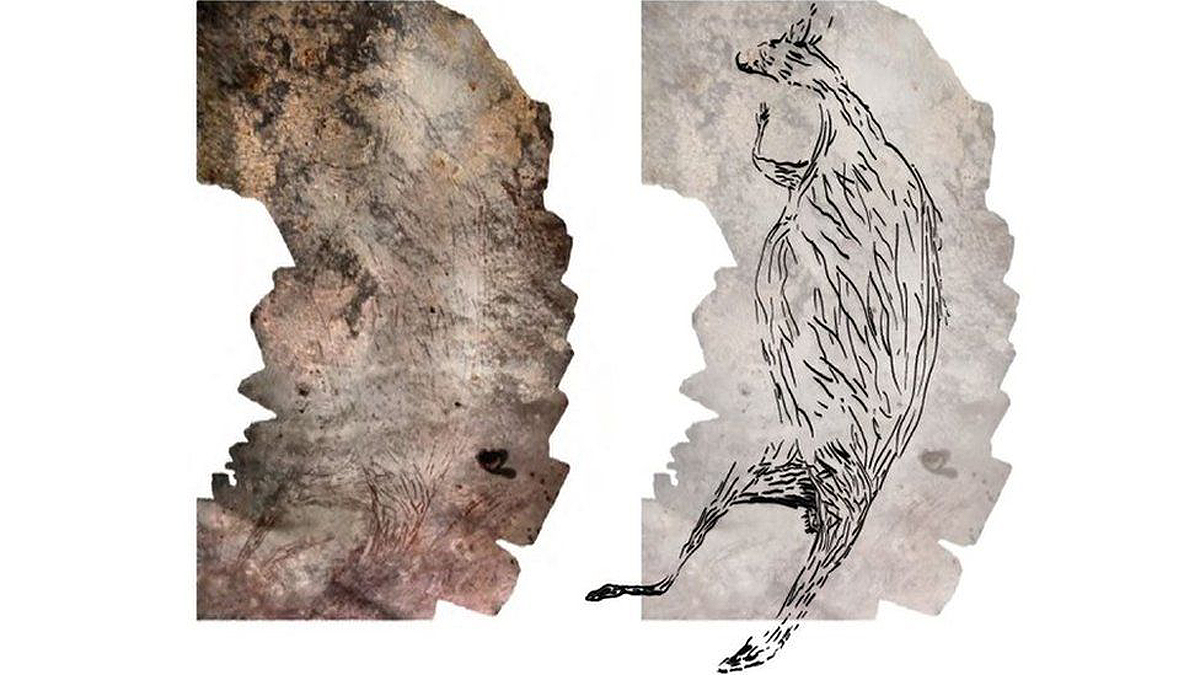
Beyond engravings, the oldest reliably-dated piece of rock art in Australia is a 28,000-year-old charcoal cave painting fragment, found buried in an Arnhem Land cave by David and colleagues. It survived and could be dated because it had been preserved inside carbon-containing soil. The Kimberley kangaroo dated to 17,300 years old in 2021 holds a related title: it is Australia’s oldest known intact in-situ rock painting, meaning the painting is still where the original artist put it on the rock. For more on the specific sites where these works survive, including Laura, Arnhem Land and the Drysdale River, see the dedicated site profiles.
The 50,000-Year Inference: Ochre Crayons and Genyornis
Between the 28,000-year confirmed date and the 60,000-plus year arrival of Aboriginal people sits a long stretch of circumstantial evidence. Dr David points to ochre crayons dated to around 50,000 years ago. The dated art itself has not been recovered, but the tools used to make it have, and that is enough for researchers to reasonably assume Australia has pigment art going back to roughly the moment people first arrived.
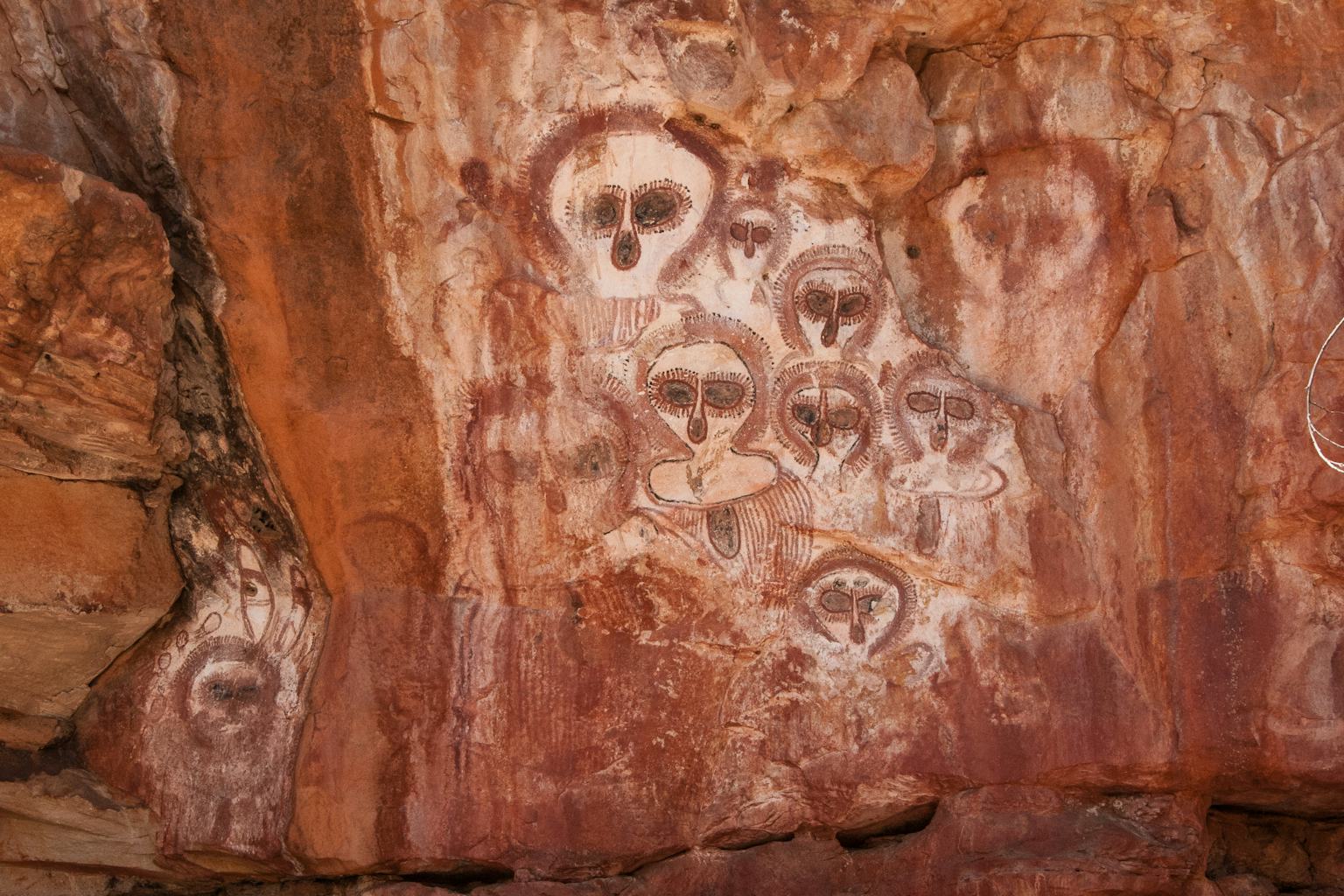
A second line of inference comes from a giant emu-like bird painted on the Arnhem Land plateau. Some researchers say the creature looks like Genyornis, a species of extinct megafauna believed to have gone extinct at least 40,000 years ago. If they are right, the person who drew it could only have seen Genyornis more than 40,000 years ago. The bird may or may not be Genyornis, and Dr David emphasises the ochre crayons remain the firmer evidence, but the painting sits in the conversation about Australia’s oldest possible images. Hand stencils in some limestone caves in North Queensland are also believed to be more than 30,000 years old, and may yet move the verified ceiling higher when their dating projects complete.
How Aboriginal Art Sits in the Global Picture
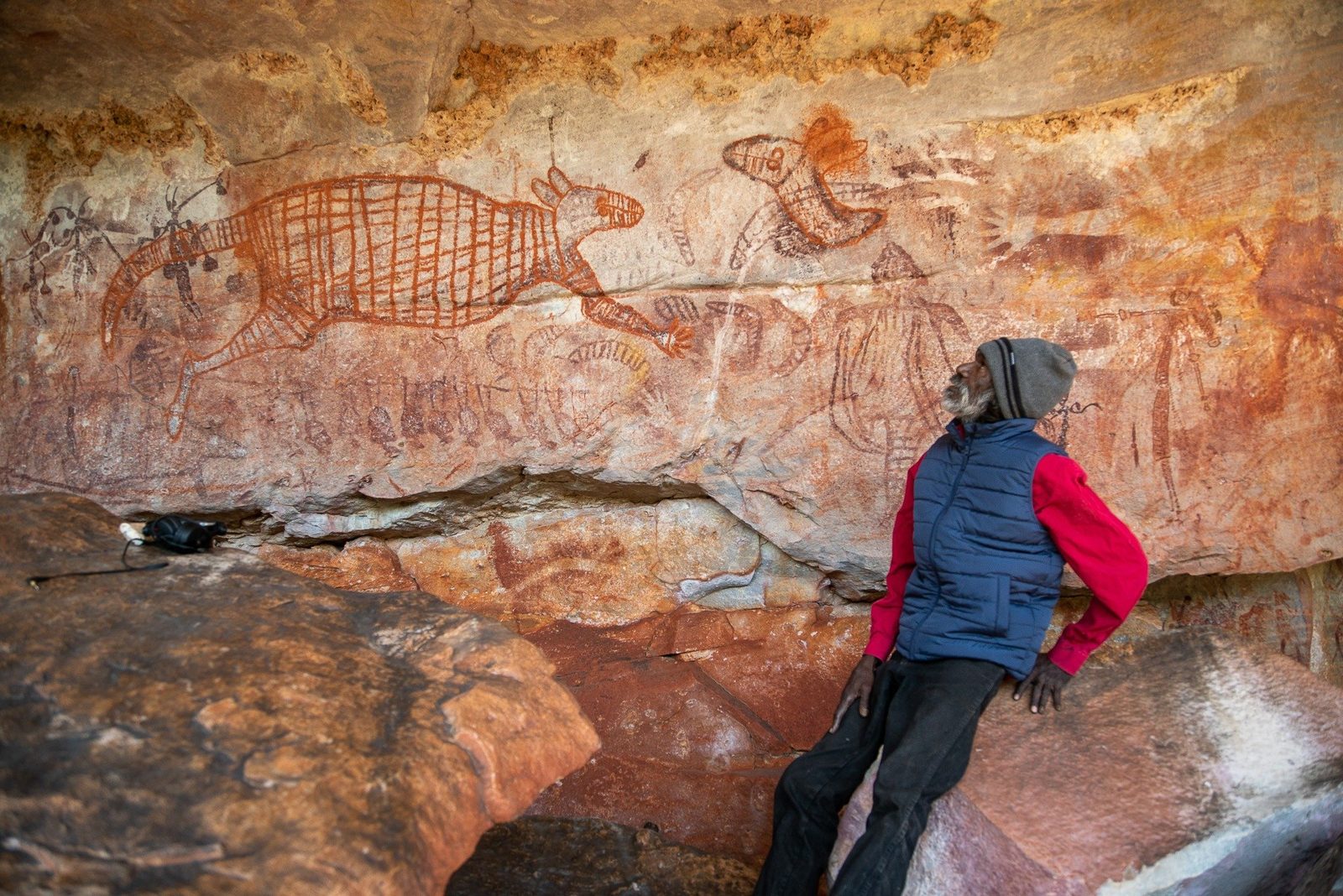
Aboriginal art is widely described as part of the oldest continuous living culture on Earth, and the broad claim survives scrutiny because it covers culture rather than a specific painting. The narrower claim of “oldest rock art in the world” does not survive in the same way. The currently recognised oldest rock art with a direct date is in Indonesia and Spain, dated through the uranium-thorium method on limestone laminate, not in Australia. Pillans and his ANU colleague Keith Fifield have argued that engravings on the Burrup Peninsula could plausibly survive for 50,000 to 60,000 years on the rock surfaces involved, but no direct dates exist for those engravings yet.
The mismatch between Aboriginal Australia’s likely deep antiquity and its current set of measured dates is a function of geology and methodology, not absence. Many of the techniques used here, particularly hand stencils, ochre body decoration, and engraving, are exactly the practices that are hardest to date with current science. The next decade of research is likely to keep shifting the verified numbers backward, even if the deepest origins stay below the threshold of direct measurement.
Quick Answers
Is Aboriginal art the oldest in the world?
Aboriginal art is part of the world’s oldest continuous living culture, with Aboriginal people settling the continent between 60,000 and 80,000 years ago. The specific claim that Australia holds the oldest dated rock art is not currently supported. The oldest directly dated rock paintings on record are in Indonesia and Spain, not Australia.
When did Aboriginal art start?
Pigment-making tools have been dated to around 50,000 years ago, suggesting Aboriginal pigment art began close to when people first arrived in Australia. The oldest reliably dated piece of rock art itself is 28,000 years old, from an Arnhem Land cave.
What is the oldest Aboriginal art in Australia?
The oldest known intact rock painting in Australia is a 17,300-year-old kangaroo in the Kimberley, dated in 2021 using fossilised mud wasp nests built over and under the pigment. The oldest reliably-dated rock engravings are 13,000 to 15,000 years old, at Laura in Queensland.