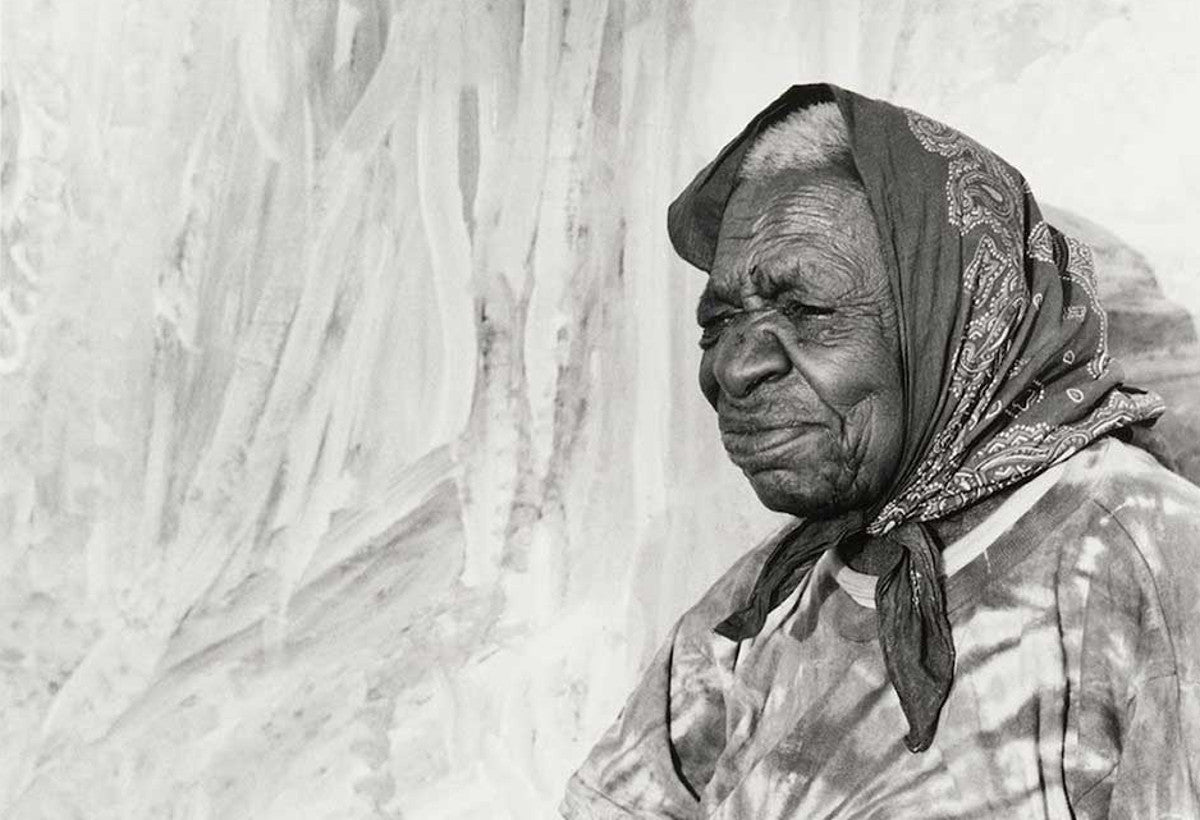
Emily Kame Kngwarreye is one of the most important artists Australia has ever produced, and she barely picked up a brush until she was almost eighty. Born around 1910 at Alhalkere, a soakage on the edge of the Utopia pastoral station about 250 kilometres north-east of Alice Springs in Central Australia, she spent most of her long life as a senior desert community custodian rather than a painter. When she finally began working on canvas in the late 1980s, she produced roughly 3,000 paintings in eight years and changed how the world saw Aboriginal art.
A desert elder who painted late in life
Emily was an Anmatyerre woman of the Sandover region, and her authority came from Country long before it came from galleries. She was the senior custodian of the Alatyeye (pencil yam) and Kame (yam seed) Dreamings, the Boss Woman responsible for the ceremonies tied to that land. The English word for what she painted is the Dreaming, the body of ancestral knowledge that explains how the country and its people came to be. Everything she put on canvas grew out of that role. She did not learn to make abstract pictures and then attach meaning to them. The meaning came first, carried through ceremony, and the paintings followed.
Early life on Utopia
She was the adopted daughter of Jacob Jones, an important law man, and she grew up in a world that was changing fast. As a young woman she worked as a camel driver and a stock hand on the pastoral stations of the area, unusual work for a woman at a time when most were employed only for domestic duties. That history shows in the strength of her later painting. Emily was married twice and had no children of her own, though she raised her relative Lily Sandover Kngwarreye and her niece Barbara Weir, both of whom became respected artists. Several of her nieces, including Gloria, Kathleen, Ada Bird, Violet and Nancy Petyarre, also went on to paint. Her standing in the community was settled long before the art market ever heard her name.
From ceremony and batik to canvas
Emily’s first art was ceremonial. She painted Awelye, the designs associated with women’s rituals, onto skin using ochre and her fingers. Painting for sale arrived at Utopia in 1977, when a government education program introduced batik to the women. In 1978 Emily became a founding member of the Utopia Women’s Batik Group, and from the start her work stood apart. Instead of filling the silk with familiar symbols, she preferred layered lines and dots that hinted at plants and figures. In 1988 the same program introduced acrylic paint on canvas through a project run by the Central Australian Aboriginal Media Association. Her first canvas, Emu Woman, came out of that summer. She found paint far better suited to her than the slow work of batik, and she never looked back.
Eight years, many styles
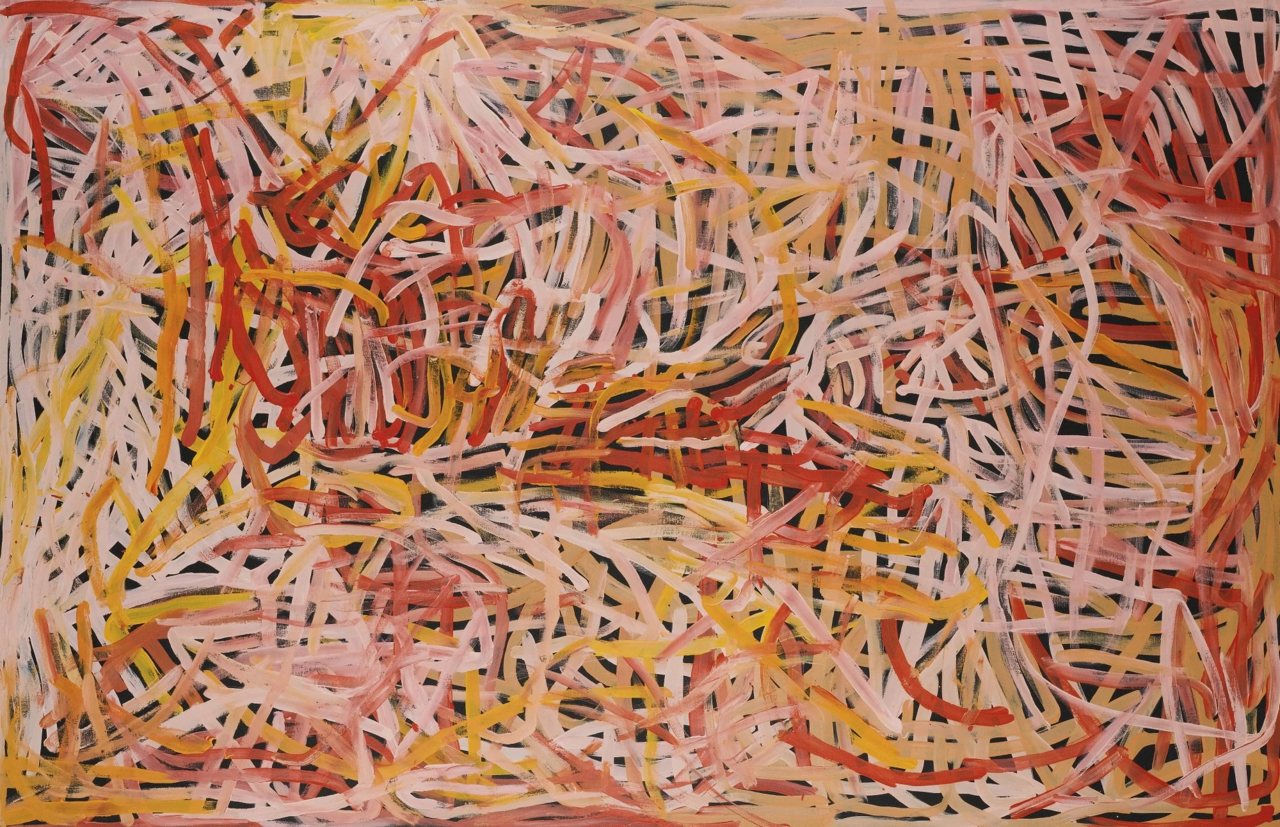
What makes her career so remarkable is how much ground she covered in so little time. Her early canvases showed fine tracings following the tracks of the yam and the emu, with dots scattered across the surface. By 1992 the dots had thickened into dense fields that buried the underlying symbols completely. She then took up larger brushes, working faster and looser, sometimes dragging the brush so the dots ran into lines. By the mid-1990s she had arrived at the loose, vividly coloured style sometimes called her dump-dump works, made by pushing loaded brushes into the canvas so the paint mixed where it landed. In her final two years she stripped everything back to bold parallel lines drawn from ceremonial body designs, and then to the loose, meandering tracks of the pencil yam roots. She painted on the ground, crouched over the canvas, and was known to walk away the moment a work was finished without ever stepping back to judge it.
Earth’s Creation and the record sales
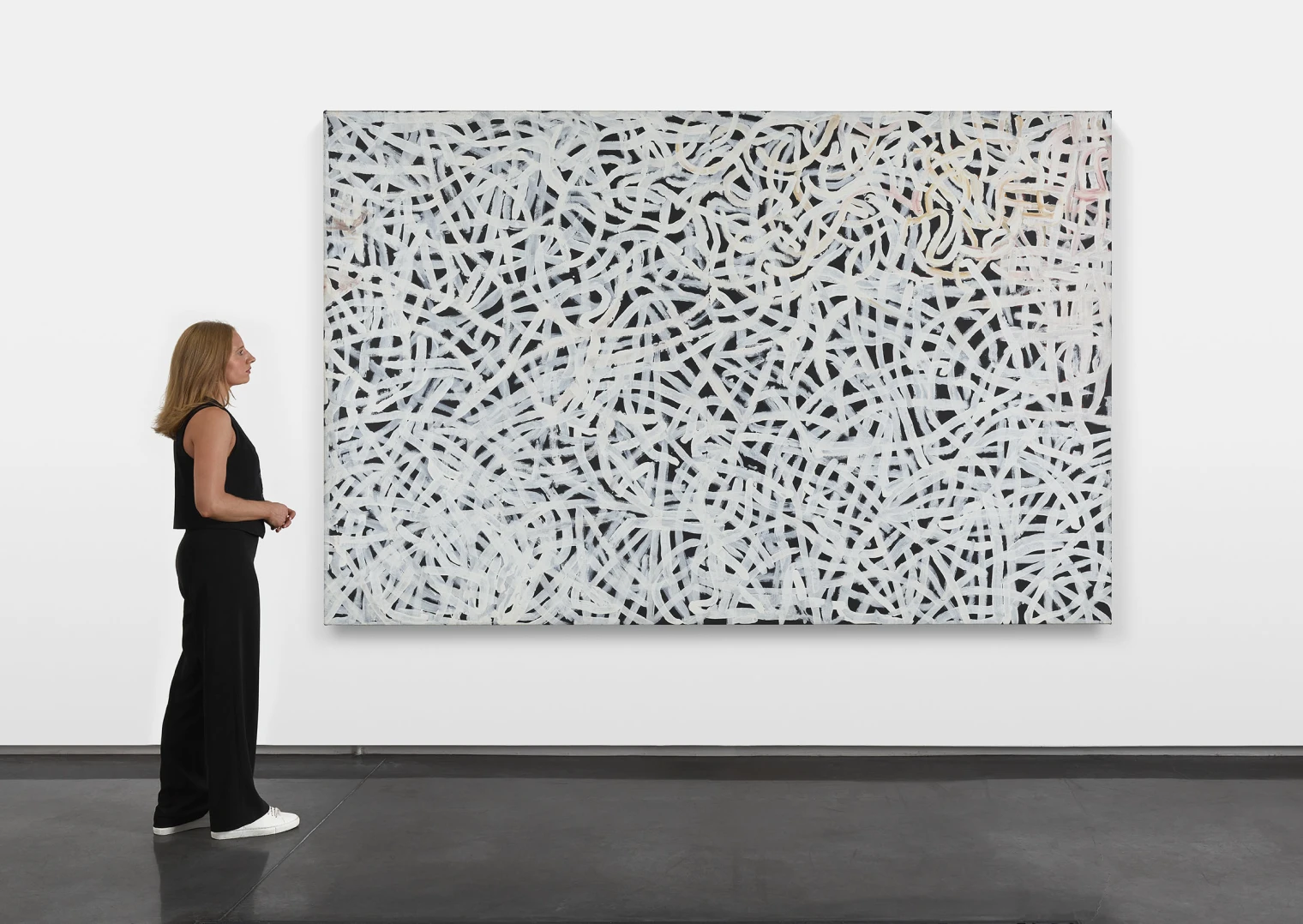
Her most famous painting is Earth’s Creation, made in 1994. It is a monumental work, 2.7 metres high and 6.3 metres wide, alive with the colour of the desert after rain. In 2007 it sold at auction for 1.064 million dollars, then the highest price ever paid for a work of Australian Aboriginal art and for any female Australian artist. A decade later, in 2017, it broke its own record at 2.1 million dollars. Another late masterpiece, Big Yam Dreaming from 1995, an eight-metre canvas of white lines on black, hangs in the National Gallery of Victoria and has been called a perfect bridge between Aboriginal art and contemporary international painting. These were not lucky pictures. They were the work of an artist at full power.
Why the world calls her famous
Emily was the first woman to emerge as a leader from a desert painting movement that men had dominated, and she did it in a way that transformed the whole field. In 1992 she became the first Indigenous artist to receive an Australian Artists Creative Fellowship, presented by Prime Minister Paul Keating. Critics reached for comparisons with Monet, Pollock, Kandinsky and Matisse, artists she had never heard of and was entirely indifferent to. She lived simply to the end, camped near the Arlparra store under the bloodwood trees, dipping her brush into kerosene-tin paint pots and giving away money as fast as it came in. She died on 2 September 1996, around the age of 86. The following year she became one of three artists chosen to represent Australia at the Venice Biennale, and the Queensland Art Gallery staged the first national touring retrospective ever given to an Aboriginal artist.
Her place in the story today
Recognition has only grown since her death. A major survey at the National Gallery of Australia in 2023 and 2024 was the first paid blockbuster exhibition the gallery had ever devoted to a First Nations artist, and in 2025 Tate Modern in London gave her a full solo show that introduced her work to a new global audience. Her paintings still set the pace at auction, and the women of Utopia who learned beside her carry the tradition forward. To understand her is to understand a wider story, one told through the desert painters who turned ancient knowledge into some of the boldest art of the modern era. Emily Kame Kngwarreye sits at the very centre of that story, an elder who painted her whole Country onto canvas and asked the world to look.