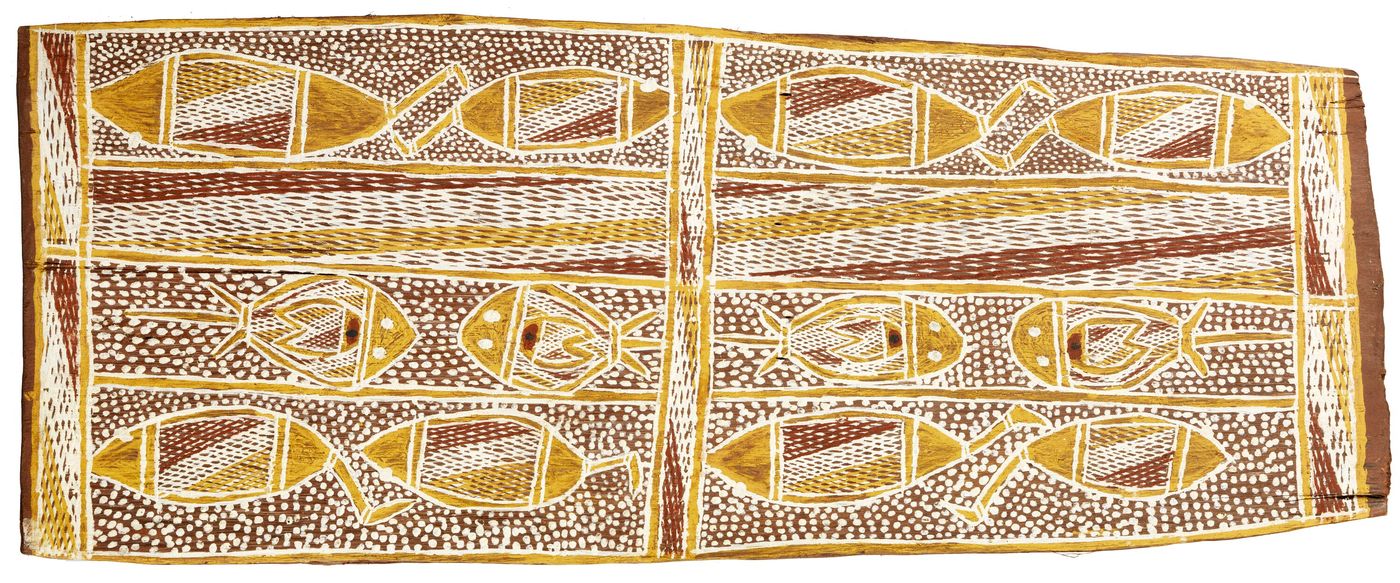
When people picture Aboriginal art, the first style most recognise is the dotted Western Desert canvas. There is another tradition, older as a continuous practice and visually entirely different, that comes from the Top End of the Northern Territory. It is painted on bark stripped from stringybark trees, drawn with ochres rather than acrylic, and built around a fine cross-hatching technique called rarrk. The artists who paint it are some of the most respected in Australian art history. Their work hangs in the National Gallery of Australia and major international collections, and several of them spent their lives painting their clan’s sacred designs onto the same surfaces that the rocks of the region had carried for tens of thousands of years.
This is a guide to the famous rarrk artists of Arnhem Land: where they come from, what they paint, and why their work is recognised at the level it is.
What rarrk is and why it is not dot painting
Rarrk is a cross-hatching technique. It is built from fine parallel lines, traditionally applied with brushes made from reeds or human hair, layered into a shimmering surface that reads as ancestral power and presence. The technique was first used in ceremony, where the same designs were painted on participants’ bodies during rites of passage, on bark for ceremonial display, and on sacred objects. It carries spiritual meaning, not just pattern: the density and direction of the lines can signal the painter’s clan and moiety.
Rarrk is not dot painting. Dot painting is a Western Desert acrylic tradition. Rarrk is an Arnhem Land ochre tradition. The two regions, the two surfaces, and the two languages of visual storytelling are fundamentally different, and the artists working in rarrk are not interchangeable with the painters who came out of the desert. The story of how rarrk moved from rock and skin onto portable bark sits inside the broader rock to canvas shift in Aboriginal painting.
Where rarrk lives: Bininj and Yolŋu Arnhem Land
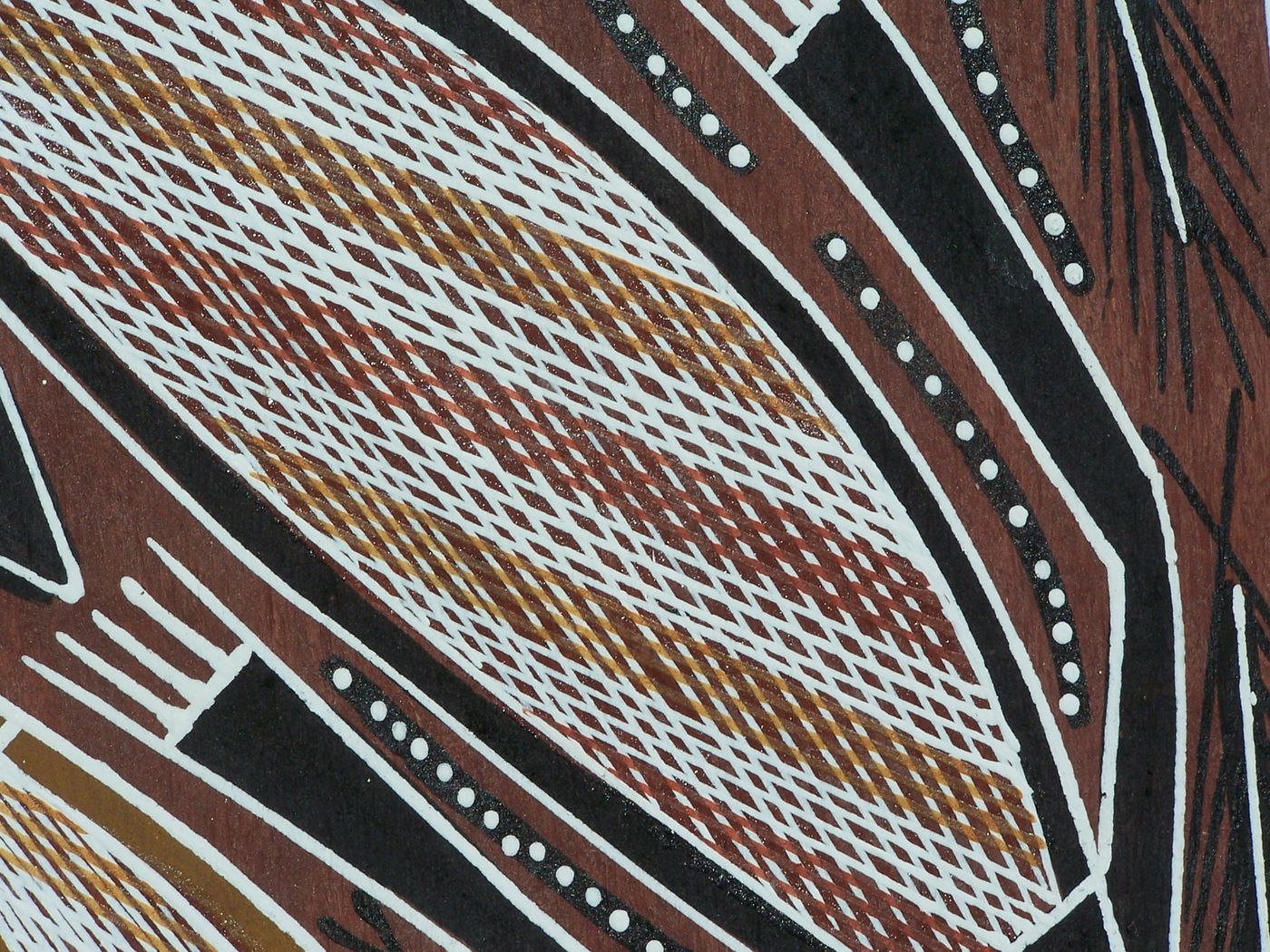
Arnhem Land in the north-east of the Northern Territory is divided culturally into two large blocs. The people of north-eastern Arnhem are Yolŋu. The west Arnhem people identify as Bininj, with Kunwinjku as one of the main languages. The two groups are themselves divided into two moieties, Dhuwa and Yirritja, which order who can paint which design.
There is also a vocabulary distinction worth knowing. Rarrk is the cross-hatching technique used across Arnhem Land. Miny’tji is something more specific: the named sacred clan designs, especially Yolŋu, that carry rights and authority of their own. A rarrk pattern can be applied within figures and backgrounds, while a miny’tji pattern is the sacred design itself. Both often sit in the same painting.
Western Arnhem masters: Kunwinjku rarrk painters
The Kunwinjku-speaking communities around Gunbalanya (also called Oenpelli) and Maningrida produced several of the most internationally recognised rarrk painters of the past half-century.
Lofty Bardayal Nadjamerrek
Senior Kunwinjku ceremonial leader, c. 1926 to 2009, and one of the foundational painters at Injalak Arts and Crafts Centre, which opened at Gunbalanya in 1989. His rarrk paintings on bark and paper are held in the major Australian collections.
Mick Kubarkku
Kunwinjku, c. 1922 to 2008. A contemporary of Lofty Nadjamerrek who painted in the same broad western Arnhem tradition, with the rarrk shimmer at the core of his figurative bark work.
John Mawurndjul
Also Kunwinjku from Western Arnhem Land. Mawurndjul has carried the rarrk tradition into the international art conversation more visibly than any other living painter. His work depicts ancestral beings and the natural landscape of his country, with the cross-hatching itself doing most of the spiritual work. The technique in his hands is both a continuation of inherited Kunwinjku practice and a personal expression of his connection to country.
Eastern Arnhem and Yolŋu masters
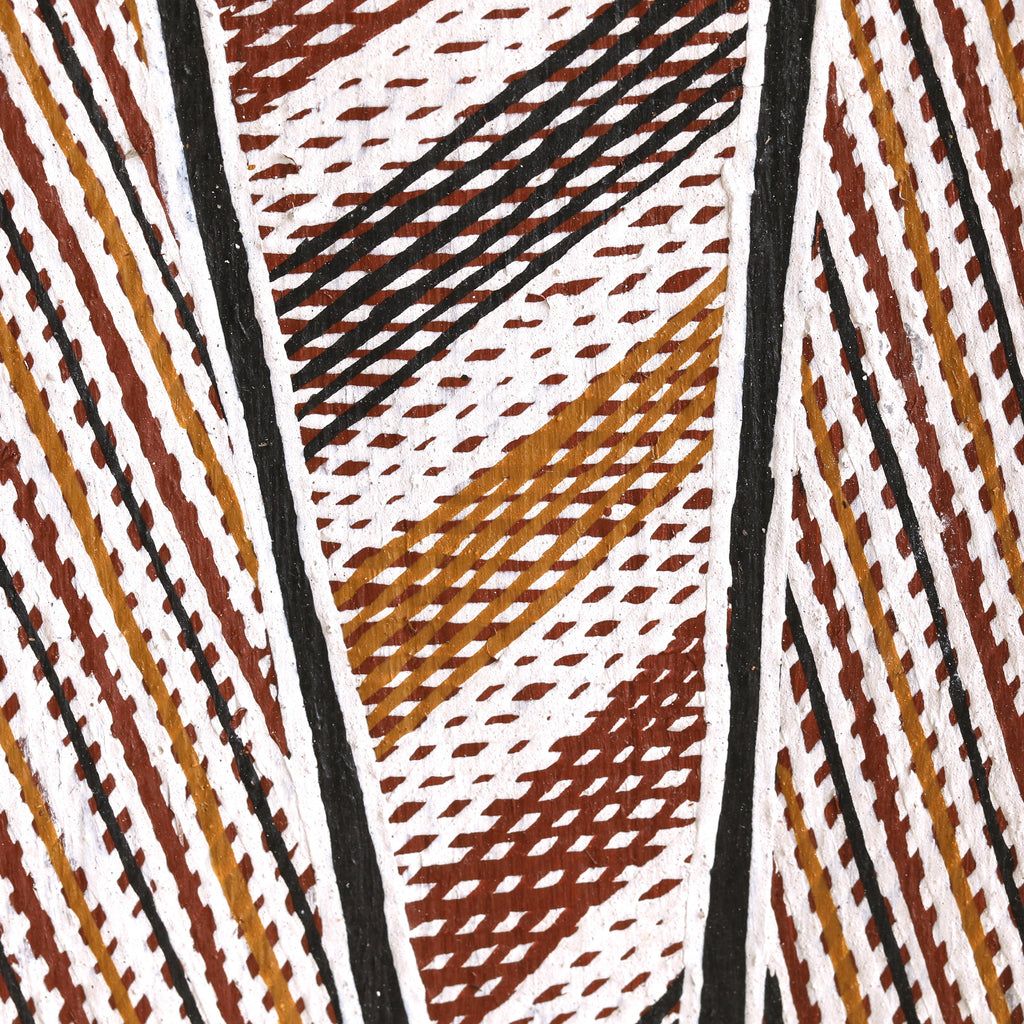
Yirrkala, on the Gove Peninsula in eastern Arnhem Land, sits in the country of seventeen Yolŋu clan groups. The Buku-Larrnggay Mulka Arts Centre opened there in 1975, and the Yolŋu painting tradition that flowed through it is the one most associated with miny’tji sacred clan design.
Mawalan Marika
1908 to 1967. A senior Rirratjingu Yolŋu artist who became one of the most influential painters of his generation and a key cultural leader in the years leading up to the land-rights era at Yirrkala.
Djambawa Marawili
Born 1953. A senior Madarrpa elder and one of the most internationally collected living Yolŋu painters, working in both traditional bark and the larger-scale formats that Buku-Larrnggay Mulka popularised from the mid-1990s.
Wukun Wanambi
Born 1962. Another senior Yolŋu painter at Yirrkala whose work has carried Yolŋu miny’tji into major Australian and international shows.
The Milingimbi and Ramingining figures
Central Arnhem Land has its own bark painting lineage. Milingimbi Island, a long-time Macassan trading point off the coast, produced four senior figurative and abstract painters whose work defined the central Arnhem tradition.
The Milingimbi senior generation
David Malangi (1927 to 1999), Dawidi Djulwarak (1921 to 1970), Paddy Dhathangu (c. 1914 to 1993) and Micky Durrng (1940 to 2006) are the four names most associated with Milingimbi bark painting. The community’s first dedicated art centre was built there in 1967, and the bark paintings from the island strictly adhere to traditional colours and patterns owned by specific clans.
Jimmy Wululu and the Ramingining school
The Ramingining settlement was founded after the 1976 Aboriginal Land Rights Act, and runs the Bula’bula Arts Aboriginal Corporation (established 1990). Jimmy Wululu (born 1936) is the Ramingining painter most associated with diamond-grid bark works, a pattern significant to his clan. Many of the Ramingining painters had previously sold through the Milingimbi centre before relocation.
Two cultural moments that fixed rarrk in the public record
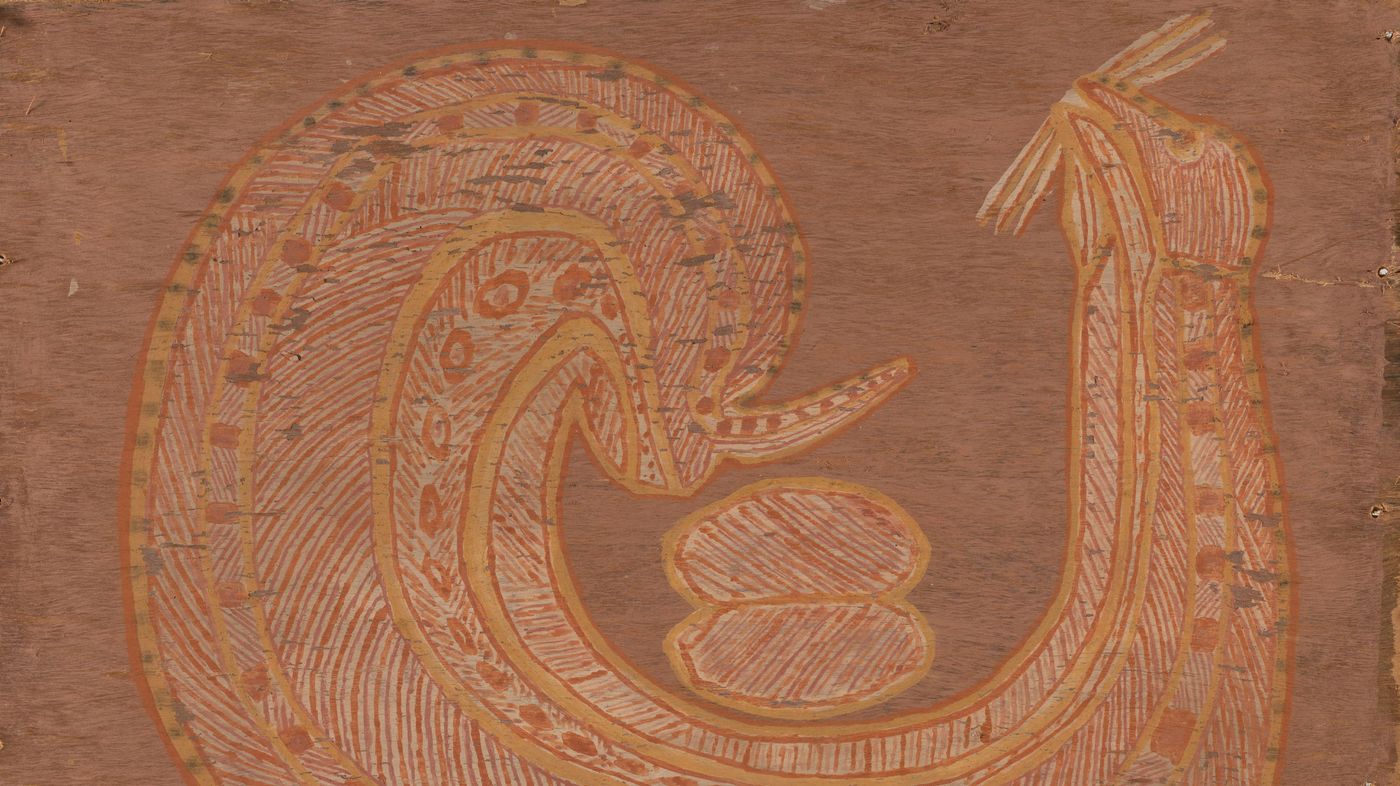
Two events in particular put Arnhem Land painting onto the national stage.
The Yirrkala Bark Petition of 1963 was presented to the Australian Parliament after the federal government granted a bauxite mining lease over Yolŋu country without consultation. The petition combined typed text with traditional bark painting, and although it failed in its immediate aim, it became a pivotal land-rights document and a precedent for sacred-site protection.
The Aboriginal Memorial at Ramingining was created in 1988, the Bicentenary year, as a statement about the deaths of Aboriginal people since European settlement. It consists of two hundred hollow log coffins decorated with rarrk and clan designs, with the installation permanently housed at the National Gallery of Australia. It remains one of the most significant artworks in the country.
Where to see rarrk today
Most of the famous rarrk artists are represented through the art centres in their own communities. Buku-Larrnggay Mulka at Yirrkala, Injalak Arts at Gunbalanya, Maningrida Arts and Culture (one of the largest Aboriginal art centres in Australia, opened in 1973), Bula’bula Arts at Ramingining, and Anindilyawaka Art Centre on Groote Eylandt (opened 2005) are the primary sources for new and historical work. The state galleries and the National Gallery of Australia all hold permanent Arnhem Land collections, and the major auctions move significant works most years.
The broader art communities map shows where each of these centres sits on the continent, and the mechanics of how the art centres themselves work explain why buying directly from them is still the most reliable path to authentic rarrk.