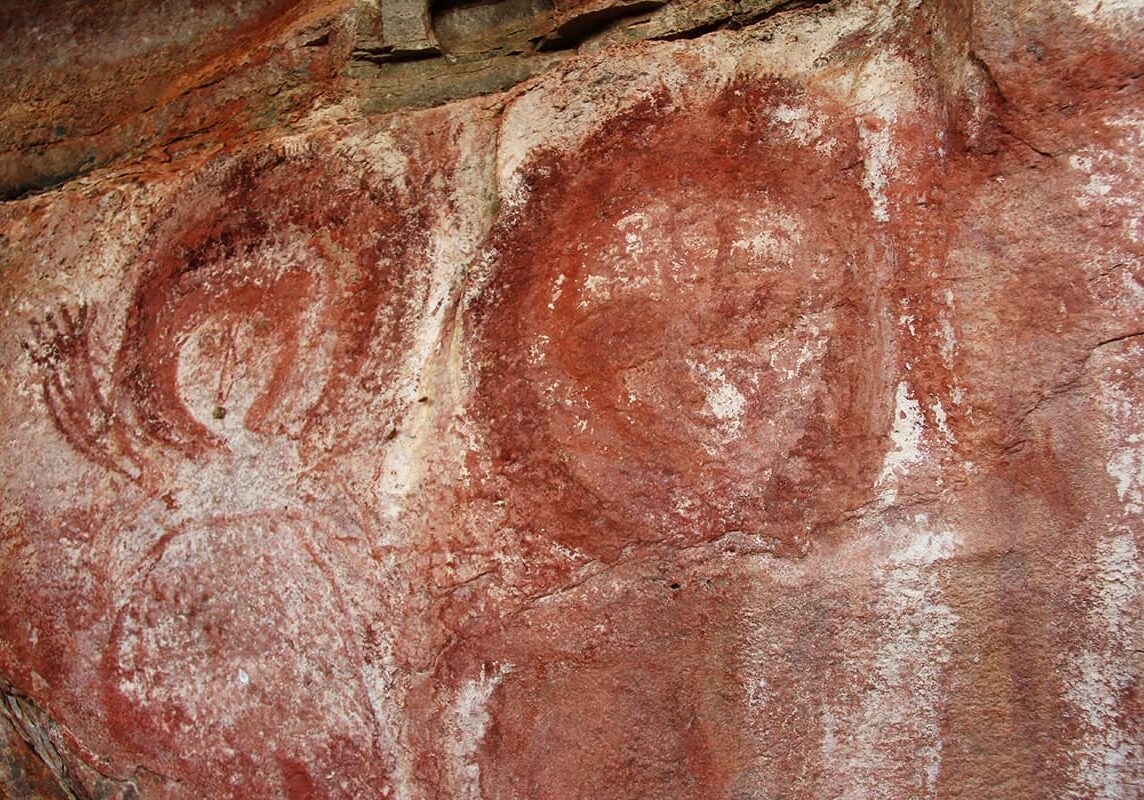
The Aboriginal art of the Kimberley region is one of the deepest visual records on the planet. Spread across more than 420,000 square kilometres of north-west Western Australia, it runs from Naturalistic animal paintings tens of thousands of years old to the Wandjina figures that traditional owners still paint and re-paint today.
Where the Kimberley is
The Kimberley spans roughly 423,500 square kilometres in north-west Western Australia, an area about the size of the United Kingdom. The country is marked by ranges and gorges, dense river valleys, boab trees, and coastal beaches, bounded by ocean, the Ord River, and the Great Sandy Desert. Multiple Aboriginal language groups have lived across the region for millennia, and the differing painting styles found in the Kimberley reflect that diversity of country and culture.
How old Kimberley rock art is
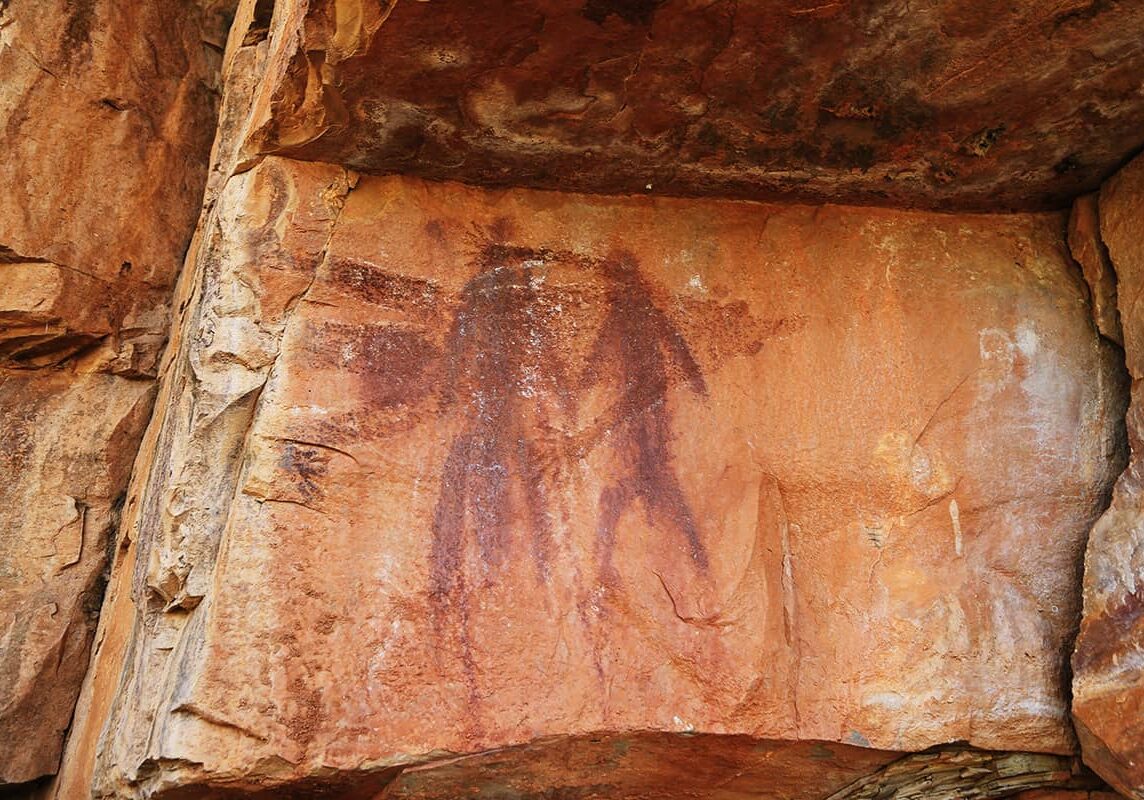
The Kimberley hosts some of Australia’s oldest known rock paintings, at least 17,300 years old by direct dating, with archaeological context that pushes the human story much further back. The oldest directly dated example in the wider rock art record is ochre-smeared limestone from Carpenter’s Gap in the south-west Kimberley, dated to 41,000 years ago, and excavations near Kakadu have suggested a human presence in Australia of around 65,000 years.
The region has thousands of documented rock art sites, and researchers estimate that tens of thousands more remain undocumented in remote shelters and on stone formations across the country.
The Naturalistic style
The earliest visible style on the Kimberley walls is called Naturalistic. It focuses on animals, with minimal human figures, and includes a famous kangaroo painting dated between 17,500 and 17,100 years old, painted in a red mulberry ochre derived from iron oxide. The style is thought to reflect the world that the artists actually saw in front of them, and the inclusion of certain species over others is one of the lines researchers use to track environmental change.
Gwion Gwion figures, formerly called Bradshaw
Following the Naturalistic period came the Gwion Gwion motifs, formerly known as Bradshaw figures. They are characterised by slender, elegant human figures shown with accessories: bags, tassels, headdresses, and other carefully drawn objects. Some Gwion paintings show figures using new technologies such as spear-throwers, and researchers have interpreted that progression as a record of how hunting adapted to a changing climate. The style is distinct enough from other Kimberley work that, once you have seen a few, the silhouette is unmistakable.
Wandjina, a living tradition
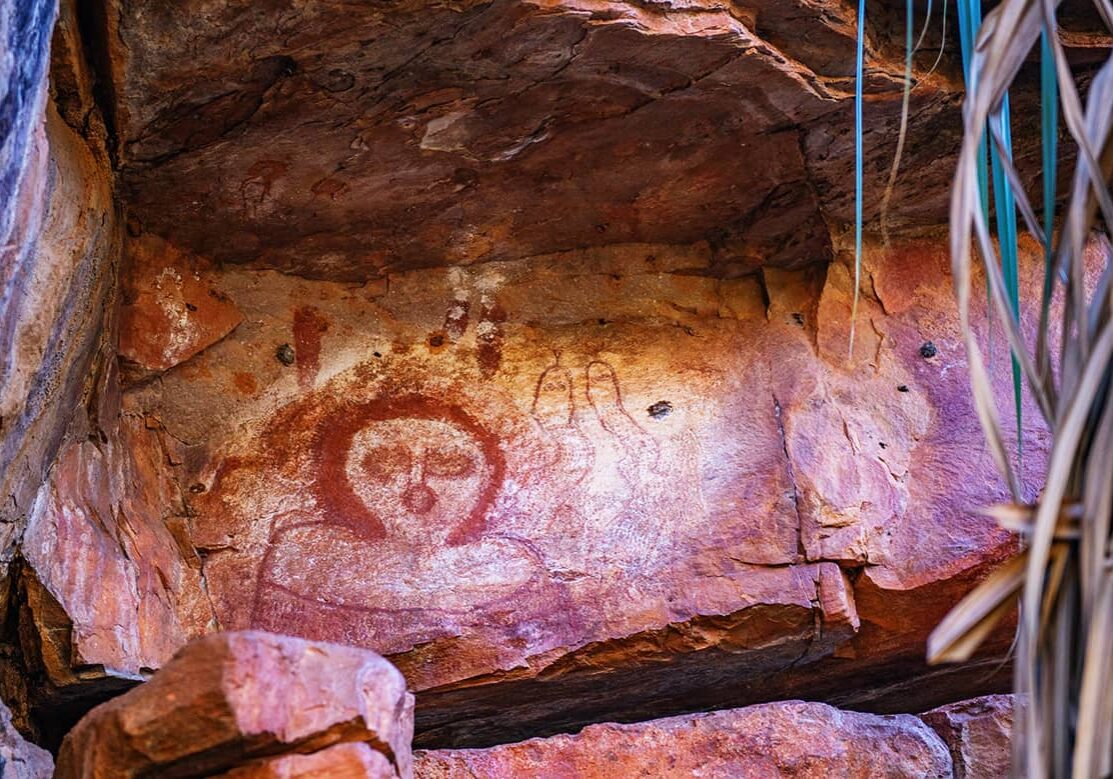
The Wandjina (sometimes spelt Wanjina) tradition is the youngest of the well-known Kimberley styles and the only one that is plainly a living tradition. Wandjina paintings depict spirit ancestors in anthropomorphic form and have been continuously made for the last 4,000 to 5,000 years. The figures usually have large, wide eyes and no mouth, surrounded by halo-like headdresses, and they represent powerful beings that govern weather and human behaviour. Traditional owners continue to refresh existing Wandjina paintings, which is part of why the tradition is still classified as living rather than archaeological.
Other styles and techniques
Kimberley rock art also includes Painted Hands, which are isolated decorated hand prints and stencils, and Static Polychrome figures, often described as clothes-peg shaped human figures in decorated costume. Techniques across the region include ochre pigments that bond exceptionally well with sandstone, engraving and carving directly into rock, applying beeswax and spinifex resin, scraping burnt earth for imagery, and creating stone arrangements with symbolic meaning. Ochre paintings on sandstone can last from hundreds to tens of thousands of years, which is part of how the Kimberley record has stayed visible.
Mowanjum and contemporary Kimberley art
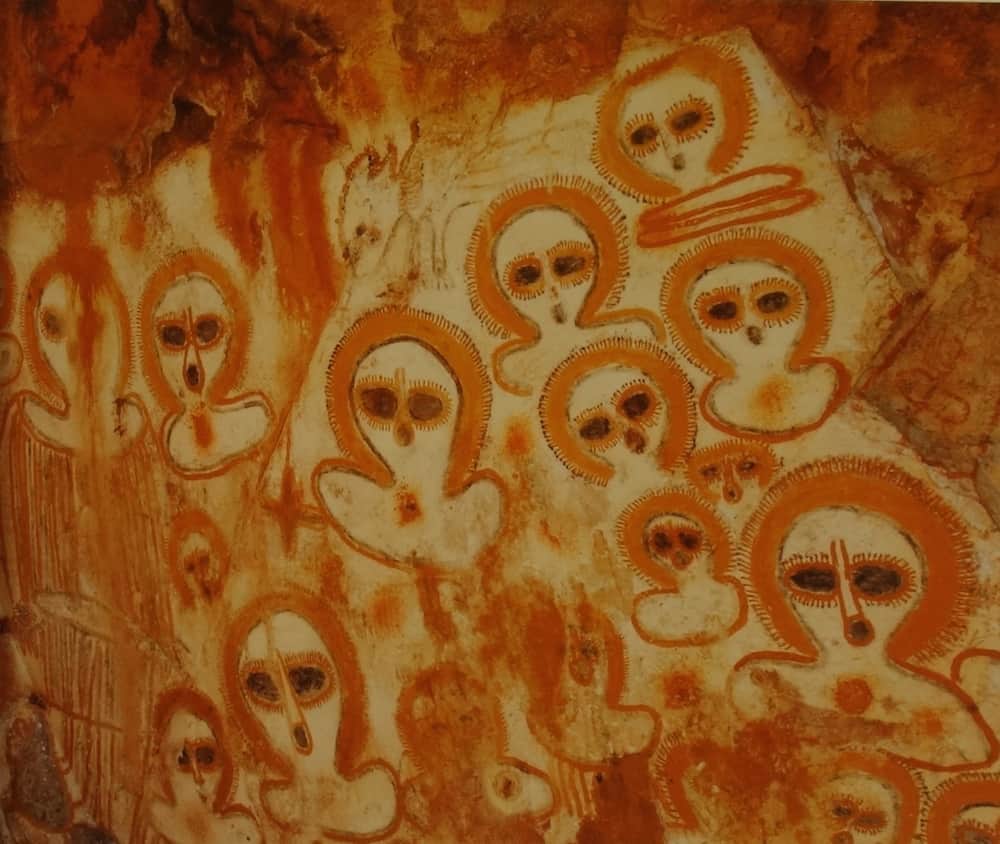
The art of the Kimberley does not sit in the past. Contemporary works produced through community art centres carry the same Wandjina, Gyorn Gyorn, and naturalistic stories on portable surfaces. Mowanjum Aboriginal Art and Culture Centre, based in Derby, is one of the most important hubs, with artists from the Worrorra, Ngarinyin, and Wunambal language groups producing Wandjina and Gyorn Gyorn works on bark, board, and canvas. Beyond Mowanjum, the wider Kimberley Aboriginal Art and Culture alliance connects independent artists and centres across the region. Indigenous Rangers also implement Healthy Country plans alongside archaeologists, protecting remote rock art sites from fire, weathering, and damage. The art also serves as a visual “voice” that reinforces Aboriginal land rights and helps communities maintain religion, language, and cultural practice.
The Kimberley in the wider Aboriginal art story
What sets the Kimberley apart from other regional traditions is the layering: a Naturalistic kangaroo, a Gwion Gwion hunter, and a freshly refreshed Wandjina can all sit within a few kilometres of each other, each speaking from a different era but to the same Country. That stacked record — climate, technology, ceremony, and law tracked across tens of thousands of years on the same rock walls — is something no other region on the continent matches in quite the same way.